You put your blush on in the morning and it looks perfect — the right flush, the right placement. By lunch, it’s a rumor. By evening, it’s gone like it was never there.
Most advice answers a different question than the one you’re asking. It tells you how to make blush last longer — layer this, spray that — without asking why yours is disappearing in the first place. But “disappearing” isn’t one problem. A blush that vanishes in twenty minutes and a blush that fades by 4 PM are failing for completely different reasons, and the fix for one does nothing for the other.
This guide works the way this publication always works: what you see → what it might be → how to distinguish it → how to test → what to change. The fix for each cause is completely different — and the wrong one wastes money on new blush when the old one was never the problem.
The short answer
Blush “disappearing” is usually one of five things: (1) the powder never properly adhered because it went onto a wet or unset base and got diluted into it; (2) your skin’s oils gradually broke down or dulled the color film; (3) the product physically moved — onto your hands, phone, or mask; (4) it was applied too sheerly to survive the day; or (5) it only looks faded because a heavy hand with powder muted it, or because you’re comparing against a memory of it fresher than it was.
Timing is your fastest clue: gone within minutes points at application; fading gradually through the day points at wear. But timing suggests — it doesn’t prove. The tests below do.
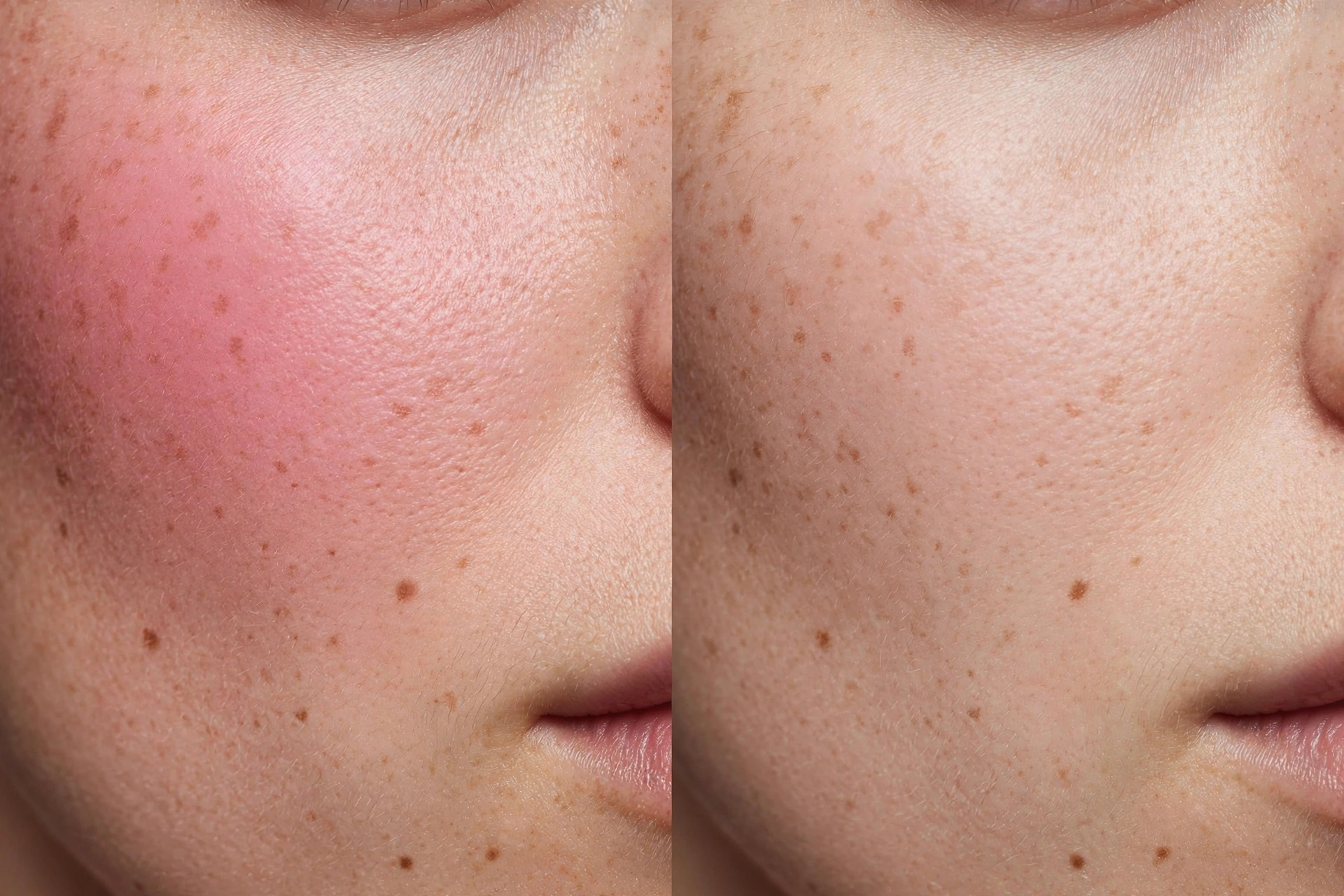
First: is it actually fading?
Before diagnosing fading, rule out four look-alikes. Each has a different fix, and treating one like another wastes your time.
| What you observe | What it likely is | Key check |
|---|---|---|
| Color evenly dimmer by afternoon; nothing on your fingers or phone; tissue pressed on cheek picks up little color | True fading | This article’s main track |
| Tiny rolls, crumbs, or flakes of product on the skin, especially where you blended most; rolls move when rubbed | Pilling — a film failure, not fading | Finger-rub test: if product balls up under your finger, that’s pilling — read our guide on why foundation pills to find the failing layer |
| Color gone from cheeks AND appearing where it shouldn’t — fingertips, phone screen, mask interior, collar | Transfer | Check contact points; transfer loss matches where things touch your face |
| Concentrated spots and bare areas visible right at application — never an even wash to begin with | Patchiness — an application problem | Look closely in good light before leaving; patchy at 8 AM isn’t fading at 2 PM |
| Cheek color was never vivid, even in morning selfies | Too-sheer application — a quantity problem, not a wear problem | Compare against a photo taken right after application |
| Blush looks darker, duller, or more orange by afternoon — not paler | Color shift, not fading | That’s a sebum-interaction problem with a different diagnosis — see why foundation turns orange for the mechanism |
Why this matters: if your blush is transferring onto your mask, no setting-spray technique for “fading” will help — the product is leaving your face mechanically. Diagnose the mechanism first.
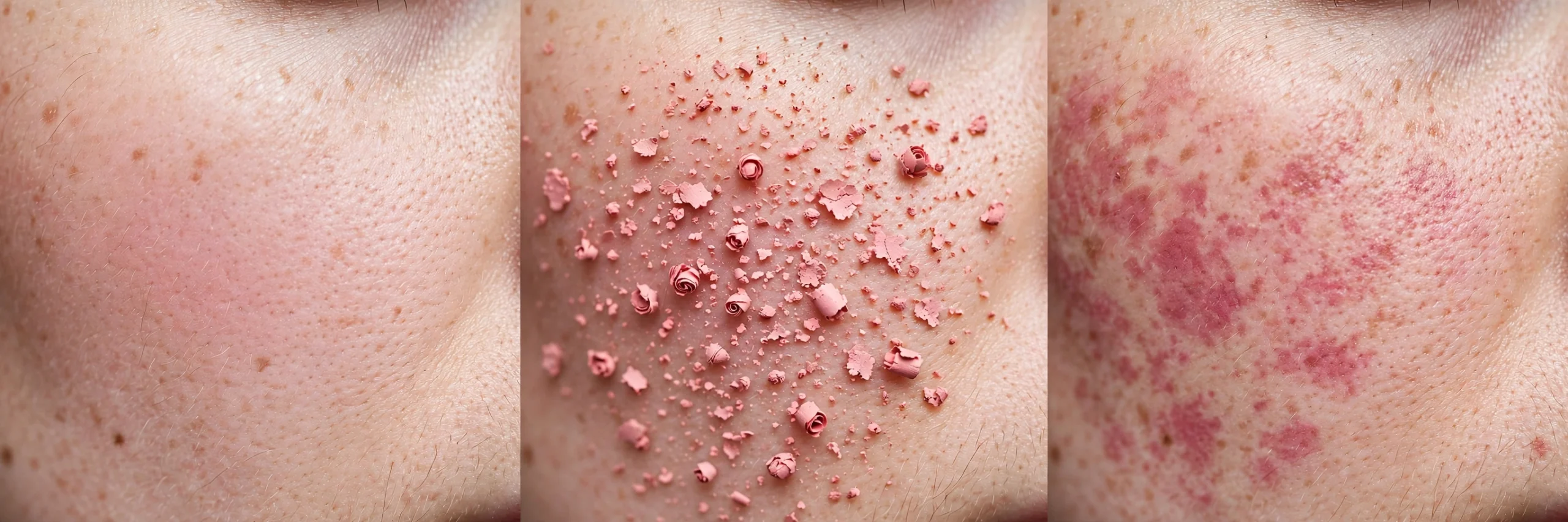
The timing router: when does it disappear?
Timing is the single fastest diagnostic clue — with one caution: it suggests, it doesn’t prove. Multiple causes can share a timing pattern, so treat each window as “check this next,” not as a verdict.
- Within minutes of application. This is almost never true wear — nothing has had time to break down. The two candidates: powder blush applied over wet or unset foundation got diluted into the base (cosmetic chemist Jim Hammer’s description: “like dropping coffee grounds into a bucket of paint”), or powder grabbed wet spots and went on patchy, which reads as “gone” where it never deposited evenly. Check next: the base-layer cause below.
- Gradually through the day, evenly. The classic wear pattern. Candidates: oil breakthrough slowly dulling and loosening the film, a mobile cream formula migrating, or simply too little product deposited to survive the day. Check next: the oil test, then the amount test.
- Holds until your face gets shiny, then goes. That’s the sebum signature — oil surfacing and interacting with the film. Check next: the oil section and the blot test.
- Disappears where you touch, blot, or where a mask sits. Friction and contact — transfer, not fading. Check next: the transfer cause.
- Fades unevenly — some areas hold, others go. Either uneven application (wet spots grabbed more color) or uneven oil production across the face. Check next: application review.
Note what timing can’t tell you: it can’t distinguish a powder problem from a cream problem, or tell you whether your setting spray is helping. For that, you need the formula differential and the isolation tests.
What kind of blush are you wearing? The formula differential
Blush formulas don’t fail the same way, because they aren’t built the same way. Knowing your formula’s architecture tells you which failure modes are even possible.
Powder blush is pigment plus mineral fillers held together by a small amount of binder (stearates, coated powders). It adheres by sitting on the skin’s surface — it doesn’t soak in. Its strengths: the mineral fillers actively absorb oil and moisture through the day. Its characteristic failure: applied over anything wet or unset, it mixes into the base and visually disappears, or grabs in concentrated spots. It can also look muted if buried under too much setting powder.
Cream blush is pigment dispersed in an emollient oil-and-wax base — often nearly half the formula. It stays mobile and may never fully “dry down.” Its strength is a skin-like finish; its characteristic failure is staying too mobile: on oily skin, your skin’s own oils mix into the product’s oil phase (“like dissolves like”) and weaken the film, and it’s the most transfer-prone format.
Liquid blush is typically water-based. It sets faster than cream as the water evaporates — but it shares cream’s rule about order: liquid over powder creates a paste and goes patchy.
Stain/tint is a water-based dye solution (water, glycols, dye). When the water evaporates, the dye remains on the skin — there’s no oil phase for your skin’s oils to dissolve. By architecture, it’s the most wear-resistant format. (Brand “lasts all day” claims are marketing, not measurements — but the mechanism is real.)
One honest statement the rest of the internet won’t give you: no credible source ranks wear time across these formats. You’ll read that cream “lasts longer than powder” and, elsewhere, that powder “lasts longer on oily skin” — both are expert assertions, neither is measured. The defensible frame is formula × skin interaction, not a universal ranking. Your job isn’t to find the “longest-lasting format” — it’s to find which failure mode matches your face.
The professional layering rule that matters here: cream on cream, powder on powder. Powder over a cream or liquid blush locks it — the dry powder absorbs the wet layer’s mobility. Cream over powder is the risky direction: it can pick up and move the base, or create paste. (You’ll see the reverse — cream stamped over powder — as a viral finish technique. That’s about luminosity, not longevity; don’t confuse the two.)
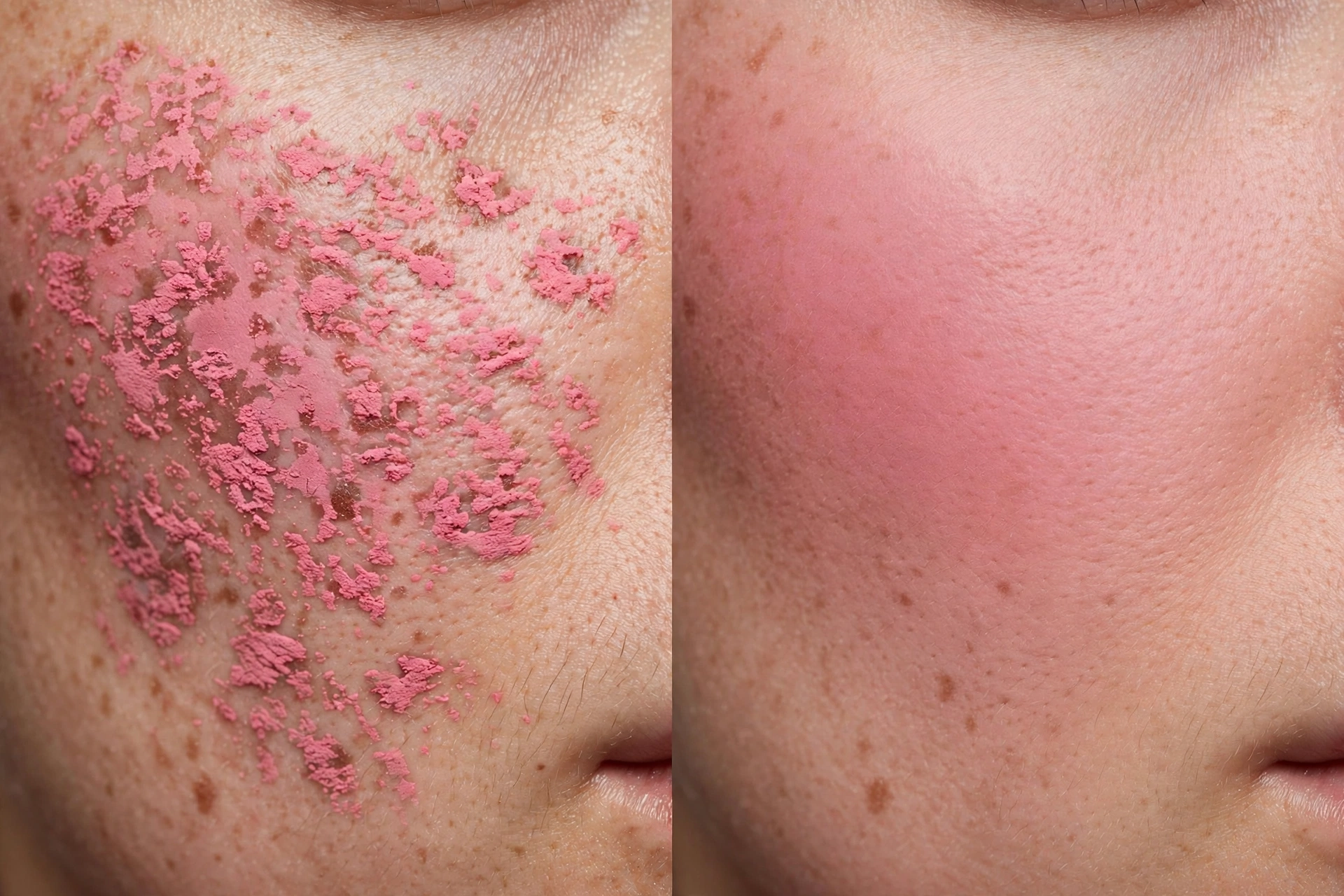
The causes: diagnose yours
Each cause below follows the same pattern: the mechanism (with evidence labeled), a one-variable test, and the fix. Run the tests on one cheek and keep the other as your control.
1. Powder went onto a wet or unset base
Mechanism. This is the best-evidenced cause in this entire guide. When dry powder blush meets wet or unset liquid foundation, the powder mixes into the base instead of sitting on it — Hammer’s “coffee grounds into paint.” What you see twenty minutes later isn’t fading; the color was diluted at application. A related failure: powder hitting tacky spots grabs instantly in concentrated patches (“like dropping flour into water”), which reads as disappearing where it never deposited.
Test. Tomorrow, do your normal routine on one cheek. On the other, let your foundation fully set first (give it several minutes — practitioners suggest up to around ten, but that’s a rule of thumb, not a law), then pat a thin veil of translucent powder on the cheek before your blush. Compare at midday.
Fix. Let the base set before powder blush goes on; or put the translucent-powder veil down first so the pigment has something dry to hold onto. If you wear cream or liquid blush, this cause is less likely — creams are compatible with an unset cream base.
2. Oil breakthrough dulled and loosened the film
Mechanism. Your skin’s sebum interacts with the makeup film over hours: it wets out pigments (making red iron oxides look deeper and warmer), changes how light refracts through the film (less light bounces back, so color reads duller and darker), and in oil-heavy formulas it can partially dissolve the film itself — “like dissolves like.” Peer-reviewed formulation research and pigment experts converge on this; what they also agree on is what it is not: true chemical oxidation. Iron oxide pigments are already fully oxidized — they can’t oxidize further on your face. If anyone sells you the “oxidation” story for fading blush, they’re working from a myth.
Test — the blot check. Midday, when the blush looks faded, press (don’t rub) a blotting paper or clean tissue onto the cheek. If it comes away oily and the blush looks better in the areas you blotted — or if fading tracks exactly where your face gets shiny — oil is your driver. (Press, don’t wipe: wiping adds friction that disturbs product on its own, which would contaminate the test. Dermatologist guidance on blotting papers specifies pressing for exactly this reason.)
Fix. Reduce what the oil has to work with: thinner base layers, a mattifying primer as an oil barrier on the oiliest zones, and blush formats less vulnerable to oil (powder over cream layering, or a stain). Note the limit honestly: nothing you apply stops sebum production — on very oily skin, oil can still surface through or around any film. You’re managing the interaction, not eliminating oil.
3. The formula and your skin are mismatched
Mechanism. A cream blush’s emollient base stays mobile; on very oily skin that mobility plus your sebum means the color migrates and dulls. Conversely, powder on very dry or flaky skin can cling to dry patches and wear unevenly. Neither format is “bad” — the pairing is wrong.
Test. Wear your usual blush on one cheek and the opposite format on the other for a full day (cream vs. powder). Don’t change anything else. The cheek that holds color better tells you which architecture suits your skin.
Fix. Oily skin leaning: powder blush, or cream locked with powder over it. Dry skin leaning: cream or liquid, with skin properly moisturized and set first — powder over flakes will only emphasize them.
4. Too little product was deposited to survive the day
Mechanism. This one is common sense backed by thin evidence: less pigment deposited means less color to lose. A single sheer pass — especially of a buildable formula — may look perfect in the morning mirror and have no reserves by afternoon. (One MUA training source states it directly; no one has measured a dose-response curve, so treat it as plausible, not proven.)
Test. On one cheek, apply your blush in two thin layers instead of one sheer pass. If the two-layer cheek outlasts the sheer cheek, quantity was your problem.
Fix. Build in thin layers rather than one sheer wash. Note the boundary: this is not a license to cake it on — excess product across layers is its own failure mode (sliding, breakdown). Find the minimum that survives your day.
5. It’s transferring off, not fading out
Mechanism. Cream and liquid formulas stay mobile enough to lift onto anything that touches your face — fingers, phone screens, mask edges, collars, scarves. Warm hands make it worse: heat plus friction breaks the film down. What looks like “fading by 3 PM” is often “removed by 3 PM.”
Test. Press a clean tissue to your cheek midday: if color lifts onto the tissue readily, or if you can see blush on your phone screen or mask interior, you’re dealing with transfer. Also check the pattern — transfer loss matches contact points.
Fix. Set the mobile layer: a light veil of translucent powder over cream/liquid blush, or a film-forming setting spray as the final step (see the next cause for what sprays can and can’t do). And reduce face-touching — each touch removes product.
6. Your setting step is working against you
Mechanism — two sub-cases. First, not all sprays set. Hydrating or “dewy” mists are mostly water plus humectants like glycerin — they make powder look less dry, but they form little holding film and don’t meaningfully extend wear. Only film-forming “fixing” sprays (silicone/acrylic polymers, often with alcohol to dry fast) lay down the barrier that resists rubbing, sweat, and oil — that’s the mechanism cosmetic chemists actually describe. If your spray’s job was hydration, it was never going to lock your blush down. Second, setting powder is a double-edged tool: a thin veil absorbs oil and gives blush grip — but a heavy hand buries the pigment under light-scattering particles and the blush reads muted or “gone.” That chalky veil isn’t fading; it’s burial. (A heavy powder hand is also the classic route to cakey foundation — same mistake, different symptom.)
Test. Skip your setting spray for one day (one cheek if you’re cautious). If wear is identical, the spray wasn’t contributing. For the powder question: apply blush, then add powder to only half the cheek — if the powdered half looks muted immediately, your powder hand is too heavy.
Fix. Use a film-forming spray if longevity is the goal (check that the formula actually contains film-formers, not just glycerin and fragrance), applied as the final step. Keep setting powder to a thin veil — and if your blush looks muted right after powdering, the problem was never wear.
7. Skincare or sunscreen underneath never set
Mechanism. A greasy sunscreen or heavy moisturizer that hasn’t absorbed becomes a slide layer: makeup applied over it never anchors, and the whole stack — blush included — migrates. Dermatologists advise giving sunscreen anywhere from a couple of minutes to around ten before makeup, precisely because rushing lets products mix and slide.
Test. One morning, give your skincare and SPF a full few minutes to absorb before any makeup (do your hair, get dressed, then come back). If everything — not just blush — wears better that day, the base was the problem.
Fix. Lighter, faster-absorbing SPF for makeup days; genuine wait time before foundation. This cause usually announces itself: when the base slides, it’s rarely only the blush that suffers.
The same-day isolation protocol
You don’t need a week of experiments. One day, one face, two cheeks:
- Baseline. Do your full normal routine. Note when the blush starts to go and what it looks like (evenly dimmer? patchy? shiny first?).
- Pick your prime suspect from the timing router and causes above — the one whose description matched best.
- Change one variable. One cheek gets the test version (set base first, or blotted at noon, or opposite formula, or two thin layers). The other cheek stays exactly as usual — that’s your control.
- Compare at two checkpoints: midday and evening, in the same light. Photograph both cheeks if you want an honest record — memory flatters the morning.
- One variable at a time. If the test cheek wins, you’ve found it. If nothing changes, your suspect was wrong — pick the next-best match and test again tomorrow.
Most people find the answer by the second test. The single most common finding: the blush was never going to survive the base it was put on — the foundation or skincare underneath was the problem, not the blush.
What not to chase
- “Oxidation.” As the evidence showed, iron oxide pigments can’t oxidize further on your face — what looks like darkening is sebum wetting and optical change. Anyone diagnosing your fading blush as “oxidation” is using a story, not a mechanism.
- Your brush or sponge. No credible source ties tool choice to wear time — tools affect finish and blendability. If someone tells you a different brush will make your blush last hours longer, that’s unsupported.
- Exact wait-time rules. “Wait exactly ten minutes” is one practitioner’s rule of thumb; dermatologists give ranges from one to fifteen minutes depending on the product. Wait until the layer feels set, not until a timer dings.
- Sprays that “melt layers together.” No cosmetic-chemistry source describes such a mechanism. What hydrating mists actually do is re-wet powder so it looks less dry — visual integration, not structural melding.
- Cream-over-powder as a longevity hack. The viral technique is about a luminous finish, and it contradicts the professional “cream on cream, powder on powder” rule. For wear, it’s not a technique — it’s a trend.
Quick fixes by diagnosis
| If your diagnosis is… | Change this |
|---|---|
| Powder diluted into a wet base | Let foundation set; or translucent-powder veil on cheeks before blush |
| Oil breakthrough | Mattifying primer on oily zones; thinner layers; powder-over-cream or stain formats; midday press-blot |
| Formula–skin mismatch | One-cheek test; switch the format architecture, not the brand |
| Too-sheer application | Build in two thin layers instead of one sheer pass |
| Transfer | Set the mobile layer (powder veil or film-forming spray); stop touching your face |
| Wrong setting step | Film-forming spray as final step (not a hydrating mist); lighter powder hand |
| Unset skincare/SPF sliding the base | Genuinely wait for SPF/skincare to absorb before makeup |
FAQ
Why does my blush disappear so fast but my foundation stays?
Because they’re different films failing for different reasons. Foundation is formulated as a continuous film designed to stay put; blush — especially powder over an unset base, or cream on oily skin — can fail at the adhesion or oil-interaction level while the foundation beneath holds. Diagnose the blush layer on its own terms.
Does setting spray make blush last longer?
A film-forming spray can — it lays a polymer barrier over the whole face, blush included. A hydrating mist mostly won’t; it’s designed to make makeup look less powdery, not to lock it down. And no blush-specific spray efficacy has been measured — the honest claim is barrier-over-everything, not blush-targeted.
Why does my blush fade by noon even though I use primer?
Primer helps adhesion and buffers oil, but it doesn’t stop sebum production or fix a powder-on-wet-base problem. If fading tracks your shine pattern, oil is overwhelming the primer — thin your layers and consider your blush format. If the blush was gone within the hour, the primer isn’t the issue; the base timing is.
Is powder or cream blush better for long wear?
No credible source ranks them — and experts contradict each other on it. What matters is the pairing: powder formats suit oilier skin and set bases; cream formats suit drier skin and need locking (powder over the top) on oily skin. Test the architecture on your own cheek rather than trusting a universal ranking.
Found your cause? The fix only works if it matches the mechanism — don’t buy a new blush until the tests tell you the old one’s format was actually the problem.
1 thought on “Why Does My Blush Disappear So Fast? Find What’s Fading It”
Comments are closed.