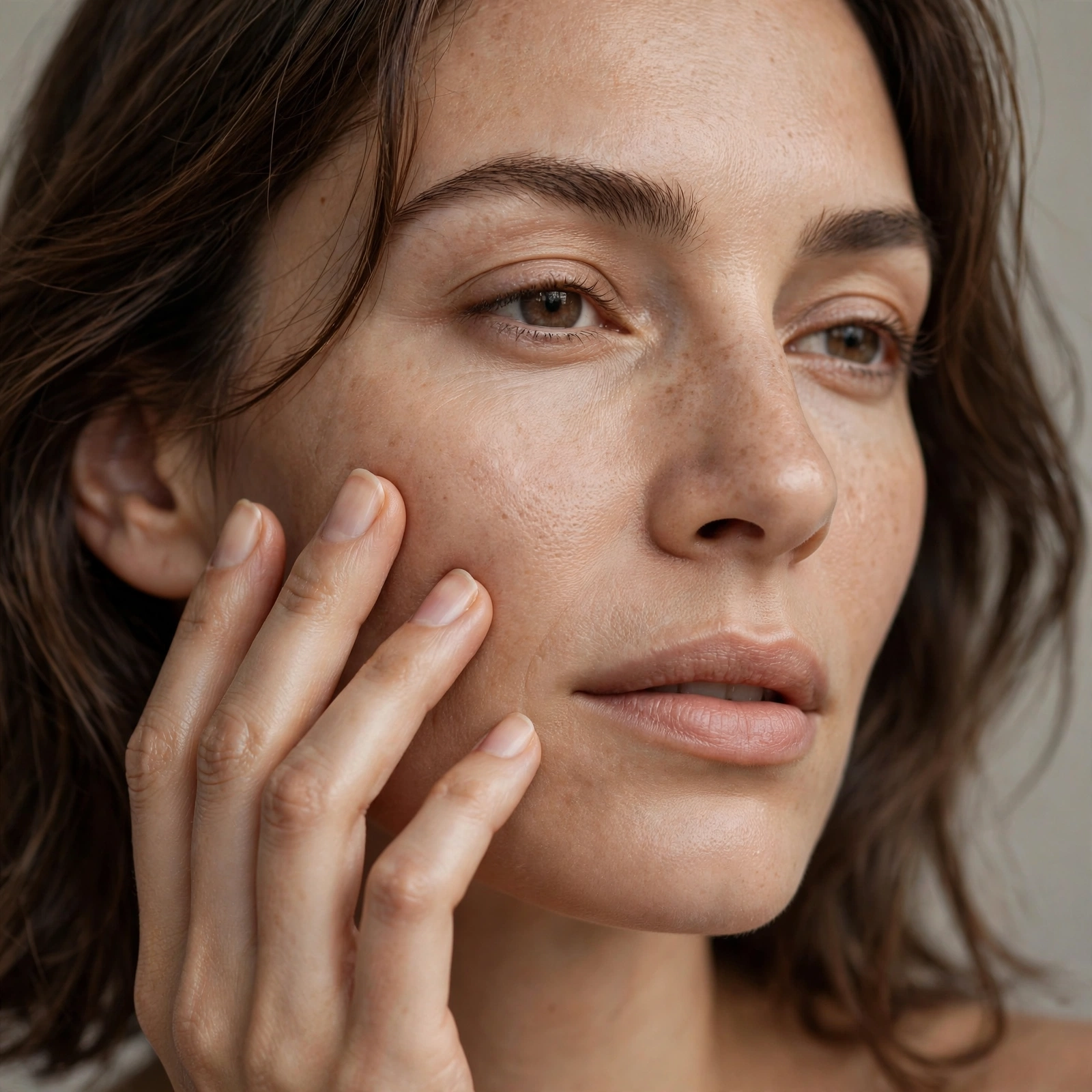
The short answer
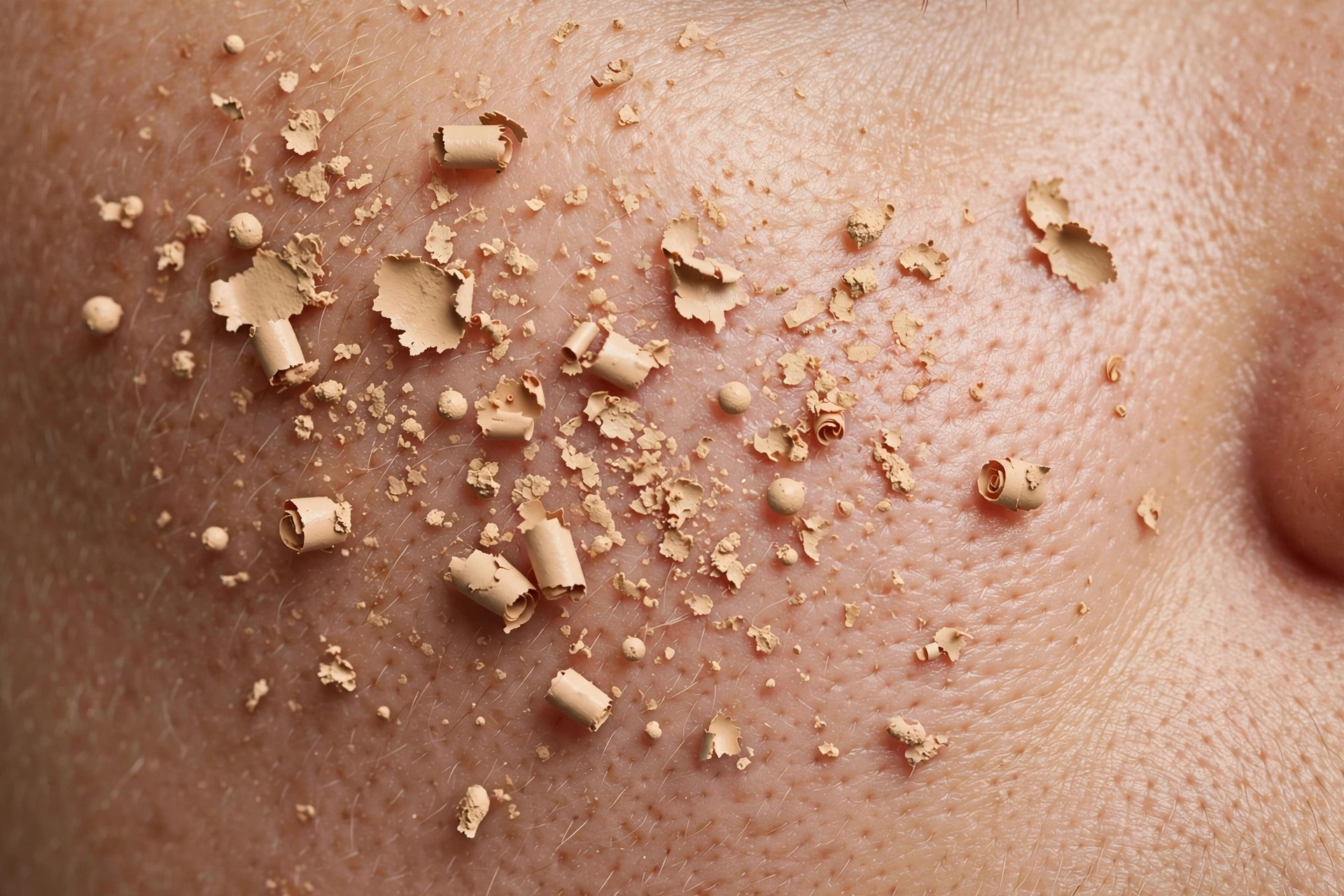
Foundation pilling is product physically rolling or balling into small flakes, crumbs, threads, or little balls — during application or shortly after. If you rub a fingertip over the area, the product visibly moves or lifts into rolls instead of staying put.
Pilling is not one problem with one cause. It is what happens when a not-fully-set film of product meets shear force — rubbing, buffing, or layering another product on top before the layer beneath has stabilized. Common contributors include too much product across layers, insufficient dry-down between layers, friction from rubbing or overworking an area, film-forming products interacting, and skincare or sunscreen underneath that never fully set.
The fix is diagnosis first: identify what is actually balling up, when it starts, and which layer is moving. This guide walks you through all three, with a same-session test that finds the failing layer without spending days guessing.
What foundation pilling actually looks like
Pilling has a specific visual signature. Learning it is the first diagnostic step, because several foundation problems get lumped together under vague words like “patchy” or “not sitting right.”
Pilling looks like this:
- Tiny rolled balls, crumbs, or flakes of product sitting on the skin’s surface — like the pills that form on a worn sweater.
- Thin rolled strands or threads of product, especially where you blended repeatedly.
- The rolls move when you touch them. A light rub with a fingertip dislodges or shifts them; they are not bonded to the skin.
- It often concentrates where you worked the product hardest — the cheeks where you buffed in circles, the jawline where you dragged product down, the T-zone where you layered the most.
- Makeup can look perfectly smooth in the mirror at first glance, then reveal the rolls when you look closely or touch your face.
One useful confirmation: gently roll a clean fingertip over a suspect area. If product gathers into tiny balls under your finger, that is pilling — a mechanical failure of a product film. If the makeup stays put but looks heavy or dry, you are dealing with a different problem (see the differential below).
Pilling vs cakey vs separating
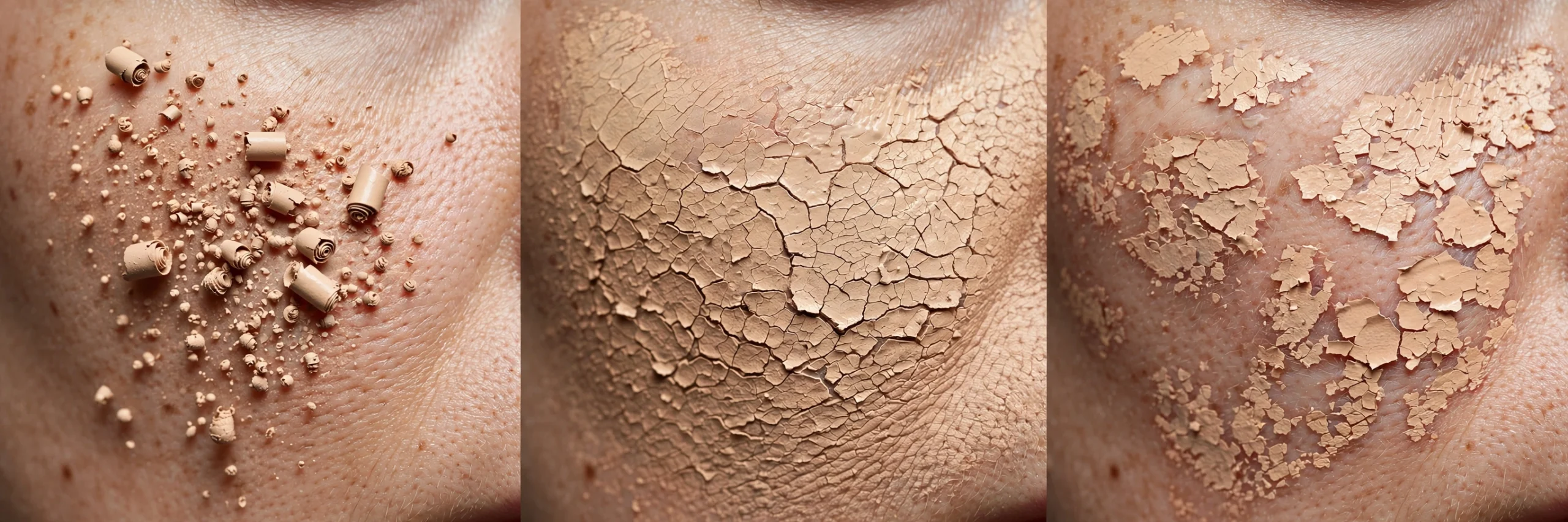
This distinction matters more than any product recommendation, because each of these three has a different cause and a different fix — yet they are used interchangeably in most advice. They are not the same.
PILLING — Product physically rolls, balls, flakes, or threads. The rolls move or detach when rubbed. The signature is mechanical: something that was a film got sheared into pills. Think: eraser shavings on paper.
CAKEY — Product stays on the skin but looks heavy, thick, dry, cracked, or powdery. Nothing rolls or lifts when you touch it; the problem is texture and excess, not film failure. If your foundation looks like a dry mask sitting on your face, that is cakey, not pilling — read our guide on why foundation looks cakey for the full diagnosis.
SEPARATING — The foundation film loses its evenness: it splits, breaks apart, becomes patchy, or pools in zones. The product is still a film — it has just stopped covering evenly. There are no loose rolls; the coverage itself has fractured.
| What you observe | Most likely | Key test |
|---|---|---|
| Tiny balls/crumbs/threads that move when rubbed | Pilling | Finger-rub test: product rolls up under your finger |
| Heavy, dry, cracked, thick-looking finish that stays put | Cakey | Touch it: nothing lifts; the finish itself looks wrong |
| Coverage fractured into patchy zones or pooled areas | Separating | Look for uneven film, not loose particles |
Why this matters: if you treat pilling like cakiness, you will reach for lighter products or more moisturizer — and the pilling will continue, because the film is still being sheared. If you treat separating like pilling, you will change your application technique when the actual problem is wear over time. Diagnose the mechanism, then fix the mechanism.
When does the pilling start? The first diagnostic question
Timing is the single most useful piece of information you can collect, because when the pilling begins points at where it begins. Walk through your routine mentally and place your pilling in one of these windows:
A. Before foundation even goes on. You notice rolls while applying moisturizer, sunscreen, or primer — before foundation touches your face. The foundation is innocent; the pilling is happening in the base layers.
B. The moment foundation touches the skin. You dot foundation on and the rolls appear immediately, before any real blending. This points to the transition between the base layer and the foundation — the foundation is disturbing a layer beneath it that had not set, or the two films are mechanically incompatible at contact.
C. During blending. Everything looked fine until you started working the product in, and the rolls formed as you blended. This is the classic friction signature: the shear force of your brush, sponge, or fingers is tearing a partially-set film.
D. After several passes. The first pass looked fine; the pilling appeared on the second or third pass over the same area. This points to overworking — each pass adds shear to a film that is progressively less able to tolerate it, plus product buildup from repeated application in one spot.
E. Later, after the makeup looked smooth. You left the house with good-looking makeup and the rolls appeared hours later. This is the least common pattern for true pilling — and worth double-checking against separating or dry flaking. Genuine late-onset pilling usually involves a layer that never truly set combined with touching your face during the day.
Do not force your situation into one mechanism. Note the timing honestly — including “a mix of C and D” — and carry it into the isolation test below.
Which layer is actually rolling up?
Here is the uncomfortable truth behind most pilling: the layer you blame is often not the layer that fails. Foundation gets the blame because it is the visible layer — but the rolls frequently consist of sunscreen, moisturizer, or primer that the foundation disturbed, with foundation pigment merely along for the ride.
Your complexion is a stack, and pilling can originate at any boundary:
- Bare skin. If the skin’s surface has loose dry flakes, product can roll with those flakes and look like pilling. This is not a product failure — it is product binding to loose surface cells.
- Moisturizer / skincare. Heavy creams, layered serums, or gel moisturizers that never fully absorb are classic pilling sources. Silicone-heavy skincare is a frequent suspect — but not for the simplistic reason most articles give (see the formulation note below).
- Sunscreen. Sunscreen is deliberately designed to form a protective film on the skin — and mineral (physical) sunscreens are, in formulation terms, powder suspensions: zinc oxide and titanium dioxide particles suspended in a base. Cosmetic scientist Lynn Saunders has described mineral sunscreens as drivers of “pilling disasters” precisely because those suspended particles sit on the surface rather than absorbing. A thick or unset sunscreen layer is one of the most common hidden pilling sources.
- Primer. Primers often contain film-forming polymers and silicones designed to create a smooth gripping surface. That film is useful — until it gets sheared by foundation application before it has set.
- Foundation. The foundation’s own film can pill, especially formulas with strong film-formers applied thickly and then buffed aggressively.
- Application tool and technique. Not a product layer, but a variable just as real: the shear force that turns a fragile film into pills. A dense brush worked in circles applies far more shear than a damp sponge pressed and rolled.
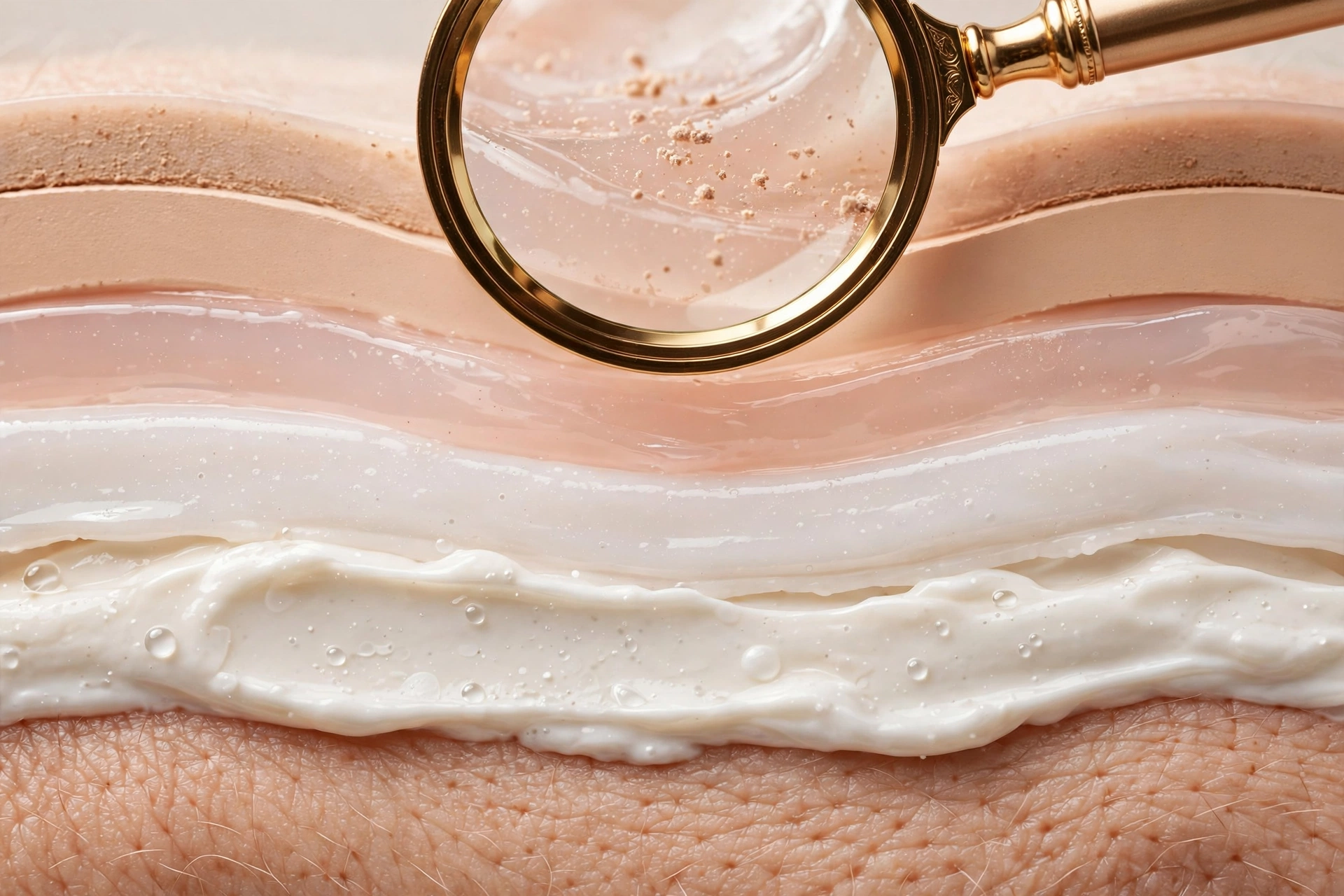
The practical question is never “which product is bad?” It is: which transition is failing? The boundary between sunscreen and primer? Between primer and foundation? Between the first and second pass of foundation itself? The isolation protocol below answers exactly that.
The same-session isolation test
You do not need to spend three days eliminating products one by one. The logic is simple — baseline → change one variable → retest → observe → move to the next layer only if needed — and it runs in a single session, on one half of your face if you like (the other half is your control).
Before you start: this test uses your actual routine, not a lab setup. Work in good light, and keep notes — even three words per step (“skipped primer: still pills” / “better” / “worse”).
Step 1 — Reproduce the problem. Do your full normal routine on one cheek. Confirm the pilling appears and note when (use the A–E timing from above). This is your baseline.
Step 2 — Test the foundation alone. On the other cheek, apply foundation directly to clean, bare skin (no skincare, no sunscreen, no primer — this is a daytime diagnostic on one cheek, not a routine recommendation). Blend the way you normally do. No pilling: your foundation is fine on its own. The problem is in the layers beneath it — move to Step 3. Still pills: the issue is the foundation itself, the amount, or your technique. Skip to the application and amount sections.
Step 3 — Add back one layer at a time. Starting from the bare-skin foundation test that worked, add back one layer per test, in order: moisturizer → sunscreen → primer. Retest after each addition. The layer whose return brings the pilling back is your failing transition.
Step 4 — Within the failing layer, change one variable. Found it? Now narrow further: less product, longer dry-down, or a different application motion — one change at a time.
A note on sunscreen during testing: do not treat sunscreen as disposable. If you are testing during the day, keep sun protection on the rest of your face and limit the bare-skin diagnostic to a small test area; the diagnostic value comes from the comparison, not from going unprotected. For a fuller multi-layer test, an indoor evening session is the honest context — no UV exposure, no sun-protection compromise. The AAD’s standing guidance is to apply sunscreen to dry skin about 15 minutes before going outdoors — and letting sunscreen fully set before layering makeup over it is consistent with both sun protection and pilling prevention: a dry, stable film shears less.
Reading the results: most people find the culprit by Step 3. The single most common finding: the pilling returns with the sunscreen or the moisturizer — the foundation was never the problem.
Why application and friction can matter
Pilling is, at its core, a friction story. A cosmetic film that is stable at rest can still be torn apart by shear — and the shear comes from your hands, brush, or sponge.
Formulation science describes this mechanism directly. A L’Oréal formulation patent defines cosmetic pilling as a film-forming polymer that “rubs off the skin during product application, leaving the polymer residue in clumps of small balls or the like, resembling pills, on the skin” — noting that it is both aesthetically unattractive and can reduce or eliminate the film-former’s function. In other words: the rubbing is not incidental to pilling; it is the force that creates it. (The patent concerned alcohol-based sunscreen gels and named one specific problem polymer, acrylates/octylacrylamide copolymer — it is an example of the mechanism, not a universal villain.)
Independent friction research supports the same picture. A 2022 study of topical cream friction (Ali et al., International Journal of Pharmaceutics) observed that continued rubbing during application can cause a residual formulation to peel off the skin in what the authors called a “snowball effect.” And a 2024 study of sunscreen films (Chen et al., Polymers) found that external friction disrupts the distribution of UV agents on skin — while films built from matched film-forming chemistry survived rubbing substantially better. The through-line: films are vulnerable to shear, and film chemistry decides how vulnerable.
What this means in practice:
- Rubbing and circular buffing apply the most shear. Repeated circles with a dense brush over the same area is the highest-friction common technique.
- Repeated passes compound the problem. Each pass adds shear to a film that is progressively drier and more fragile — which is why pilling often appears on the second or third pass (timing pattern D).
- Pressing and patting (with a sponge, or fingers) apply far less shear than dragging motions. This is not a universal rule that pressing always wins — some formulas genuinely need buffing to blend — but when pilling is the problem, reducing shear is the first technique variable to test.
- Overworking one area concentrates both shear and product buildup. Cheeks and jawlines — where people blend longest — are the classic pilling zones.
- Tool vs. technique: a brush is not inherently worse than a sponge. A brush used with light stippling motions can apply less shear than a sponge dragged hard across the face. Judge the motion, not just the tool.
Product amount and layering
Excessive product across multiple layers is one of the most reliable pilling contributors — and one of the easiest to test. Thick layers take longer to set, stay mobile longer, and give shear more material to roll up.
Use relative guidance rather than chasing universal numbers:
- Each layer should be the thinnest layer that still does its job. Sunscreen needs its full protective amount (this is non-negotiable), but moisturizer, primer, and foundation can all be thinned without losing their function.
- Build in thin passes, not one thick one. Two sheer passes of foundation set more stably than one heavy pass — with less shear per pass if you let the first settle.
- Watch the total stack, not just one product. Three thin layers can still be too much total product if each one is at the heavy end of its range. Pilling is often a stack problem, not a single-product problem.
- Resist the urge to “fix” pilling by adding more. More foundation over pilled product just gives the shear more material. If you see rolls forming, stop adding — diagnose instead.
You will not find a universal “use exactly one pump” rule here, because no source supports one across formulas and faces. Your own isolation test (Step 4) will tell you where your stack’s threshold is.
Dry-down: letting each film stabilize
Layers need time to form a stable film before the next product disturbs them. A moisturizer that is still wet, a sunscreen that is still tacky, a primer that has not gripped yet — each is a fragile film waiting for shear to tear it.
Teach yourself to read the layer instead of the clock:
- Touch-test the boundary: press a clean fingertip lightly to the layer. If product transfers to your finger or the surface feels excessively wet or tacky, it is not ready for the next layer.
- Watch the finish change: most products visibly shift as they set — from wet-shiny to satin, from mobile to still. That visible shift is your signal.
- Do not invent universal waiting times. “Wait exactly five minutes” is not supported by any source across products. A thin gel serum may set in under a minute; a rich sunscreen may need several. The layer tells you, not the clock.
This is also where sunscreen guidance and pilling prevention agree: dermatology guidance (via the AAD) advises applying sunscreen to dry skin about 15 minutes before going outdoors, and dermatologists routinely advise letting sunscreen dry and absorb for a few minutes before makeup. That guidance exists for sun protection — but a dry, stable sunscreen film is also simply harder to shear into pills. One habit serves both goals.
Sunscreen, primer, and foundation interactions — the honest version
Most articles explain pilling with a tidy rule: silicone + silicone = good, water + water = good, silicone + water = bad. It is memorable, and it is wrong as a universal rule — we already covered why in our cakey-foundation guide, and the reasoning applies here too.
The honest version:
- “Silicone-based” and “water-based” are label simplifications, not formula descriptions. A product’s first ingredient does not determine its entire film chemistry. Two “silicone-based” products can contain different silicone types that do not get along — cosmetic scientist Lynn Saunders has described opposing silicone types as behaving like “opposing magnets,” repelling each other unless identical. So even the “like with like” version of the rule fails at the chemistry level.
- What actually matters is film compatibility at the boundary — whether the lower layer has formed a stable film, and whether the upper layer’s application disturbs it. A well-set silicone primer under a water-based foundation often works perfectly; a wet “compatible” pairing can pill badly.
- Mineral sunscreen deserves special attention. As noted above, mineral sunscreens are powder suspensions — solid UV-filter particles sitting on the skin’s surface. Saunders specifically flags them as pilling-disaster drivers when layered under makeup without enough dry-down. If your isolation test fingers the sunscreen step, the fix is usually application (thinner, fully set, minimal disturbance) rather than abandoning sun protection.
- Film-formers are the usual mechanical suspects. Many long-wear primers and foundations use film-forming polymers for staying power. Those same polymers are what can shear into pills under friction — the L’Oréal patent’s entire subject was a film-former that rubbed off into pill-like clumps. Long-wear and pill-prone can be two sides of the same chemistry.
The practical takeaway: stop auditing ingredient lists for “silicone” and start auditing behavior — which layer moves, when, and under what shear. The isolation test answers this; the ingredient list rarely does.
Skin condition as a contributing factor
Skin surface characteristics can contribute to pilling without being the cause. Two mechanisms are worth knowing:
- Loose surface flakes give product something to roll with. If pilling concentrates on dry or flaky zones and the rolls contain visible dry skin, the surface — not the formula — is the variable. (This is an observation about the skin’s surface, not a skin condition diagnosis.)
- Surface hydration affects friction. Background cosmetic-science literature notes that stratum corneum water content influences the skin surface’s mechanical and frictional properties — which is consistent with the practical observation that both very dry and very occluded (over-moisturized) surfaces can pill more readily. Treat this as a contributing factor to test, not a diagnosis.
Do not let this section become “fix your skin and the pilling stops.” Plenty of people with well-maintained skin get pilling from stack and technique causes alone.
What to change, based on what you observe
Do not change everything at once. Match your observation to the most likely area, test that first, and only move on if the pilling persists.
| What you observe | Likely area to test | What to change first |
|---|---|---|
| Pills form before foundation goes on | Skincare / sunscreen layer | Thin the base layers; confirm each sets before the next; test with fewer skincare layers |
| Pills appear the moment foundation touches skin | Primer/base transition | Let the base set fully (touch-test); apply foundation with pressing motions instead of dragging |
| Pills form during blending, on the first pass | Friction + unset lower layer | Reduce shear (press/stipple instead of buff); confirm the layer beneath had set |
| Pills appear only after repeated passes | Overworking / product buildup | Stop at the first even pass; thin each pass; do not re-blend settled areas |
| Pills in isolated areas only (cheeks, jawline, around nose) | Local amount, dryness, or application pattern | Less product in that zone; check for surface flakes there; change the motion in that zone |
| Pills return when sunscreen is added back | Sunscreen film | Thinner sunscreen application, full dry-down, minimal disturbance on top — never skip protection |
| Pills with every foundation, every routine | Foundation formula or habitual technique | Test foundation on bare skin (isolation Step 2); if it pills alone, the formula’s film is shear-sensitive for you |
| Pills only with one specific primer or foundation pairing | That specific boundary | Change the order (foundation directly over set sunscreen), or replace one of the two — not both at once |
Only act on the row that matches what you actually observed. The matrix is a starting map, not a prescription.
How to fix pilling without restarting everything
Sometimes the rolls are localized and the rest of the face is fine. A full restart is not always necessary:
- For a small pilled zone: gently lift the rolls with a clean, dry spoolie or a piece of tape pressed lightly — do not rub. Then press (not drag) a tiny amount of foundation over the spot with a fingertip or sponge. The key is minimal shear on already-set makeup.
- For a zone that keeps re-pilling: the underlying layer there never set. Blot the area lightly, let it sit undisturbed for a few minutes, then reapply foundation with pressing motions only.
- For pilling discovered mid-routine: stop adding product. Identify the timing (A–E above) and the zone, finish the rest of the face with a lighter hand, and run the isolation test next time rather than layering over the problem now.
- What not to do: do not “seal” pilled makeup with powder or setting spray. Powder over rolls locks the texture in place; spray does not re-bond a sheared film. Fix the film or remove the zone — do not bury it.
When restarting the base is the better option
Restart when:
- The pilling is widespread rather than zonal — rolls across the whole face mean a stack-level failure, and spot-fixing will take longer than restarting.
- The failing layer is at the bottom of the stack (moisturizer or sunscreen). Everything above a failed base layer is compromised; there is no way to fix the foundation without fixing what is under it.
- You have already tried two spot fixes and the pilling returned. Repeated patching adds more product and more shear — the stack is now worse than a fresh start.
Restarting is not failure; it is the isolation test telling you the answer. Note which layer you suspect, restart with that layer thinned or better set, and treat the second attempt as your experiment.
Frequently asked questions
What causes foundation pilling?
Pilling happens when a not-fully-set film of product meets shear force — rubbing, buffing, or layering product on top before the layer beneath has stabilized. The film tears into tiny rolls, crumbs, or flakes. Contributors include too much product, insufficient dry-down between layers, friction from application, film-forming products interacting, and unset skincare or sunscreen underneath. There is rarely one universal cause.
Is pilling caused by mixing silicone-based and water-based products?
Not as a universal rule. “Silicone-based” and “water-based” are label simplifications — two silicone products can contain different silicone types that repel each other, and a well-set silicone primer under a water-based foundation often works perfectly. What matters is whether the lower layer has formed a stable film and whether the upper layer’s application disturbs it. Diagnose behavior (which layer moves, when) rather than auditing ingredient lists.
Why does my makeup pill even when each product is fine on its own?
Because pilling is usually a boundary problem, not a product problem. Each product can be perfectly good alone and still fail at the transition — an unset sunscreen disturbed by primer, a primer sheared by foundation application. This is exactly what the layer-isolation test is designed to find.
Does sunscreen cause foundation to pill?
It can contribute — sunscreen is designed to form a film, and mineral sunscreens are particle suspensions that sit on the skin’s surface. But the fix is application (thinner layer, full dry-down, minimal disturbance on top), not skipping protection. Never routinely skip sunscreen to stop pilling.
Can I stop pilling without removing all my makeup and starting over?
Sometimes. For a small pilled zone, gently lift the rolls without rubbing and press a tiny amount of foundation over the spot. But if the pilling is widespread or the failing layer is at the bottom of the stack, restarting is faster and more reliable than patching.
Why does my foundation pill in some areas but not others?
Pilling concentrates where shear, product amount, or unset layers concentrate — the cheeks and jawline where people blend longest, zones with more product, or areas with surface flakes. Zonal pilling points to local amount, dryness, or application pattern rather than a globally bad formula.
Does powder stop or cause pilling?
Powder does not fix pilling — applied over rolls, it locks the texture in place. And powder applied over an unset, mobile base can itself contribute to the disturbance. Fix the film first; powder comes after the base is stable.
Is pilling a sign that my products are bad?
No. Pilling is a mechanical event — film plus shear — not a quality verdict. Excellent products pill under the wrong stack conditions, and the isolation test exists precisely because blaming (and replacing) products is usually the wrong move.
Sources
- U.S. Patent 7,022,316 B2 (L’Oréal SA) — “Non-pilling UV-photoprotecting sunscreen compositions.” Formulation-level definition of cosmetic pilling as film-forming polymer rubbed off into pill-like clumps during application; friction as the shearing force. https://patents.google.com/patent/US7022316B2/en
- Ali, A. et al. — “Tactile friction of topical creams and emulsions,” International Journal of Pharmaceutics 615 (2022) 121502. Peer-reviewed observation that continued rubbing during application can cause residual formulation to peel off skin in a “snowball effect.” (Verified via journal citations; the pilling observation is discussed within a broader friction study, not a dedicated pilling-mechanism paper.)
- Chen, Y. et al. — “Structural Similarity-Induced Inter-Component Interaction in Silicone Polymer-Based Composite Sunscreen Film for Enhanced UV Protection,” Polymers 2024, 16, 3317. External friction disrupts sunscreen agent distribution on skin; films built from matched film-forming chemistry survived rubbing substantially better. https://doi.org/10.3390/polym16233317
- Get The Gloss — “Why your skincare and makeup is pilling (and how to stop it).” Cosmetic scientist Lynn Saunders on silicone types behaving like “opposing magnets,” silicones sitting on the surface, pill-prone powders (iron oxide, talc, mica, fluorphlogopite), and mineral sunscreens as powder suspensions driving pilling. Practical context only. https://www.getthegloss.com/beauty/makeup/why-your-skincare-and-makeup-is-pilling-and-how-to-stop-it/
- American Academy of Dermatology (via BioSpace) — guidance to apply sunscreen to dry skin about 15 minutes before going outdoors. Cited for sun-protection context; the dry/set film is mechanism-consistent with pilling prevention, not an AAD pilling claim. https://www.biospace.com/confused-about-sunscreen-new-american-academy-of-dermatology-survey-shows-americans-need-a-refresher-on-sunscreen-application-and-spf
- MedicalXpress (reporting AAD dermatologist guidance, 2023) — apply sunscreen first, then moisturizer, then makeup; give sunscreen a few minutes to dry before layering products. https://medicalxpress.com/news/2023-10-sunscreen-skincare-routine.amp
- “Multidimensional In Vivo Assessment of Skin Performance Following Repeated Application of a Multi-Step Cosmetic Regimen,” Cosmetics 13(5):259. Background literature (cited within) that stratum corneum water content influences the skin surface’s mechanical and frictional properties. https://www.mdpi.com/2079-9284/13/5/259
No dermatologist review, cosmetic-chemist review, laboratory testing, or personal product testing is claimed. Formulation mechanisms are described from the cited sources with their limitations noted; practical guidance is framed as diagnostic testing, not universal rules.
5 thoughts on “Why Is My Foundation Pilling? How to Find the Layer That’s Balling Up”
Comments are closed.