White specks appearing in your brows after gel are not one problem. They are a symptom that can start in three different places: inside the tube, in the gel layer itself, or only where the gel meets something else on your skin. Each starting point has a different fix, and guessing wrong usually means changing technique for a product problem — or replacing a product for a technique problem.
So do not start by changing everything. Run the checks below in order. Each one is a single-variable test: it either clears a suspect or points at the next decision.
These tests work by observation and comparison. One piece of general cosmetic science helps interpret what you see: film-forming ingredients in hair gel dry into a clear film that can break into pale, light-scattering fragments when stiff or disturbed. That is an analogy, not proof of what any specific brow gel is doing on your brow.

Check 1 — Does the residue exist before the gel touches you? (Test A)
Before your next application, look at the wand in good light, and at the neck of the tube. Is there white residue, crumbs, or dried film there?
This is the only check that can end the investigation before the product touches your face, so it comes first.
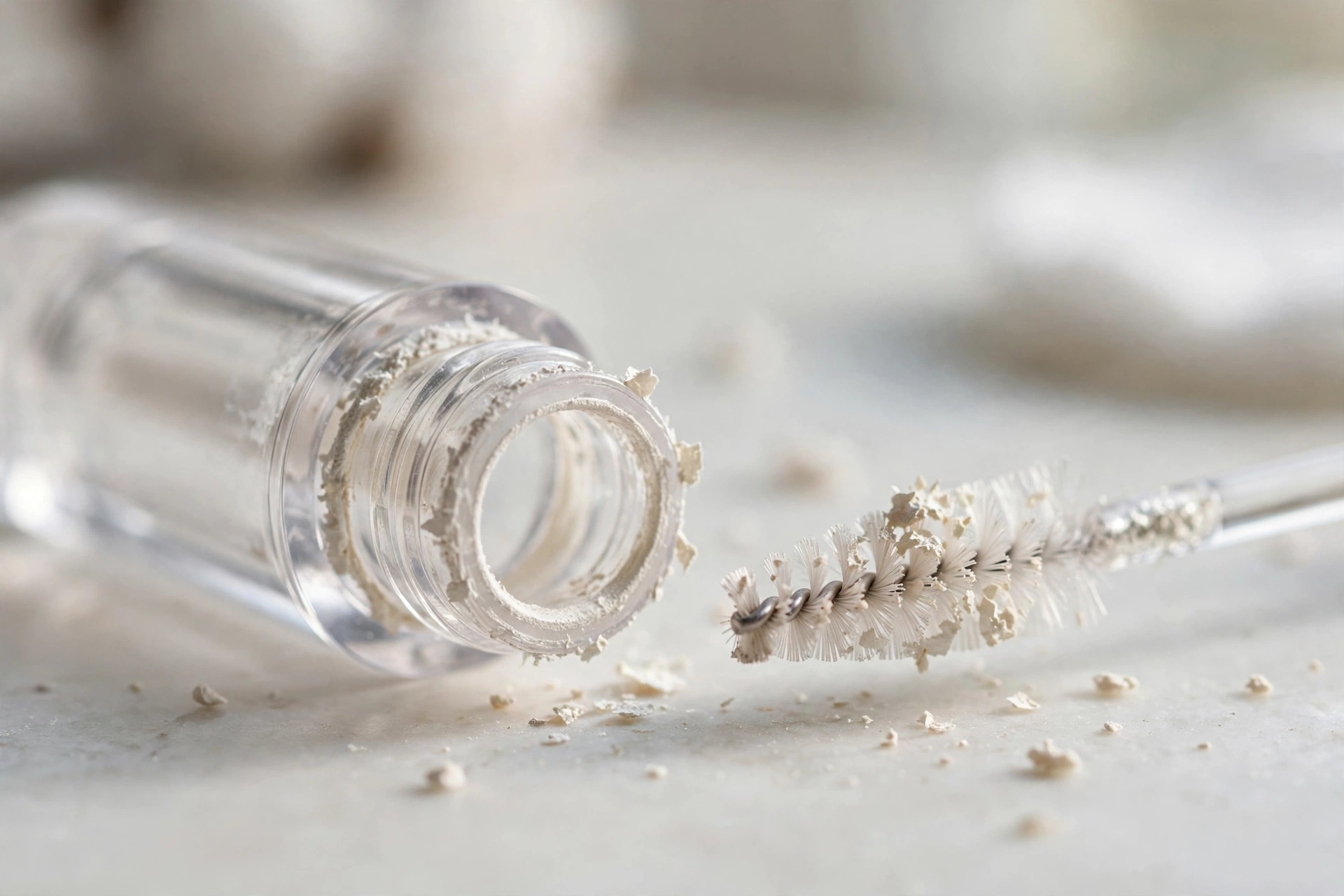
- Residue only on the tube neck: wipe the neck clean once, draw the wand out again, and check the wand itself. Dried product can collect at the opening without the whole tube being affected.
- Residue on the wand on the first draw: clean the neck once and draw the wand again, from deeper in the tube. If the second draw comes out clean, the contamination was at the opening — continue to Check 2. If residue recurs throughout that second draw, the flaking starts with the product’s state, not your technique, and no application test can clear a product that is already coming out of the tube in pieces. The endpoint here is to stop using that tube and replace it. Do not thin it out or revive it — for products used around the eyes, the standing hygiene guidance is to discard products that have dried out, and never add water or saliva to them. (That guidance comes from FDA advice for eye-area cosmetics; it is general hygiene guidance, not a brow-gel-specific discard rule.) Follow the period-after-opening symbol on your own product rather than any universal deadline.
If the wand comes out clean, the product’s condition is cleared as a suspect. Move on.
Check 2 — Does it flake on a bare brow? (Test B)
Now apply the gel, on its own, to a clean, dry brow — no foundation, powder, or skincare residue worked into the brow area. Wear it and check the result.
This is the strongest fork in the diagnosis, because it separates two families of causes:
- It flakes on the bare brow: the problem lives in the gel-and-brow-hair combination itself, with no partner product involved. Go to Check 4.
- It stays clean on the bare brow: the gel performs fine alone, so the failure needs a partner layer to appear. Go to Check 3.
One honest limit: a bare-brow pass clears the gel for solo wear. It does not guarantee it will behave over your full routine — that is what the next check is for.
Check 3 — Where exactly does it flake? (Test C)
On a normal routine day, when the flakes appear, map them before you touch anything. Are they:
- only where the gel overlaps foundation, powder, or another base product at the brow line?
- sitting on the skin between hairs, or coating the hairs themselves?
- everywhere the gel went, regardless of what is underneath?
If flaking shows up only in the overlap zone, the problem is the boundary between layers, and the fix is sequence and substrate, not the gel’s formula:
- Try applying gel before base products, or keep base products out of the brow line entirely, then retest. This borrows, in one line, the same one-variable isolation logic used in our foundation-layer diagnosis; the foundation problem itself belongs to that guide and is not re-taught here.
- Start from a clean, dry brow: remove skincare residue from the brow hairs before applying gel. Manufacturer instructions for brow gels include applying to clean brows.
- Respect the dry-down of whichever layer goes on second, per that product’s own instructions — brands disagree (some say let it dry, others say layer while wet), so no universal waiting rule exists.
This cannot prove the two products are chemically incompatible — only that the failure happens where they meet. That is still enough to act on: changing the boundary costs nothing and either works or sends you back to Check 4.
If flaking appears everywhere regardless of overlap, the boundary is cleared. Go to Check 4.
Check 4 — Does less product change it? (Test D)
Run a controlled comparison: on one brow, scrape the excess off the wand against the tube neck and apply one thin pass. On the other, apply the gel the way you normally would. Compare after dry-down and again after a few hours.
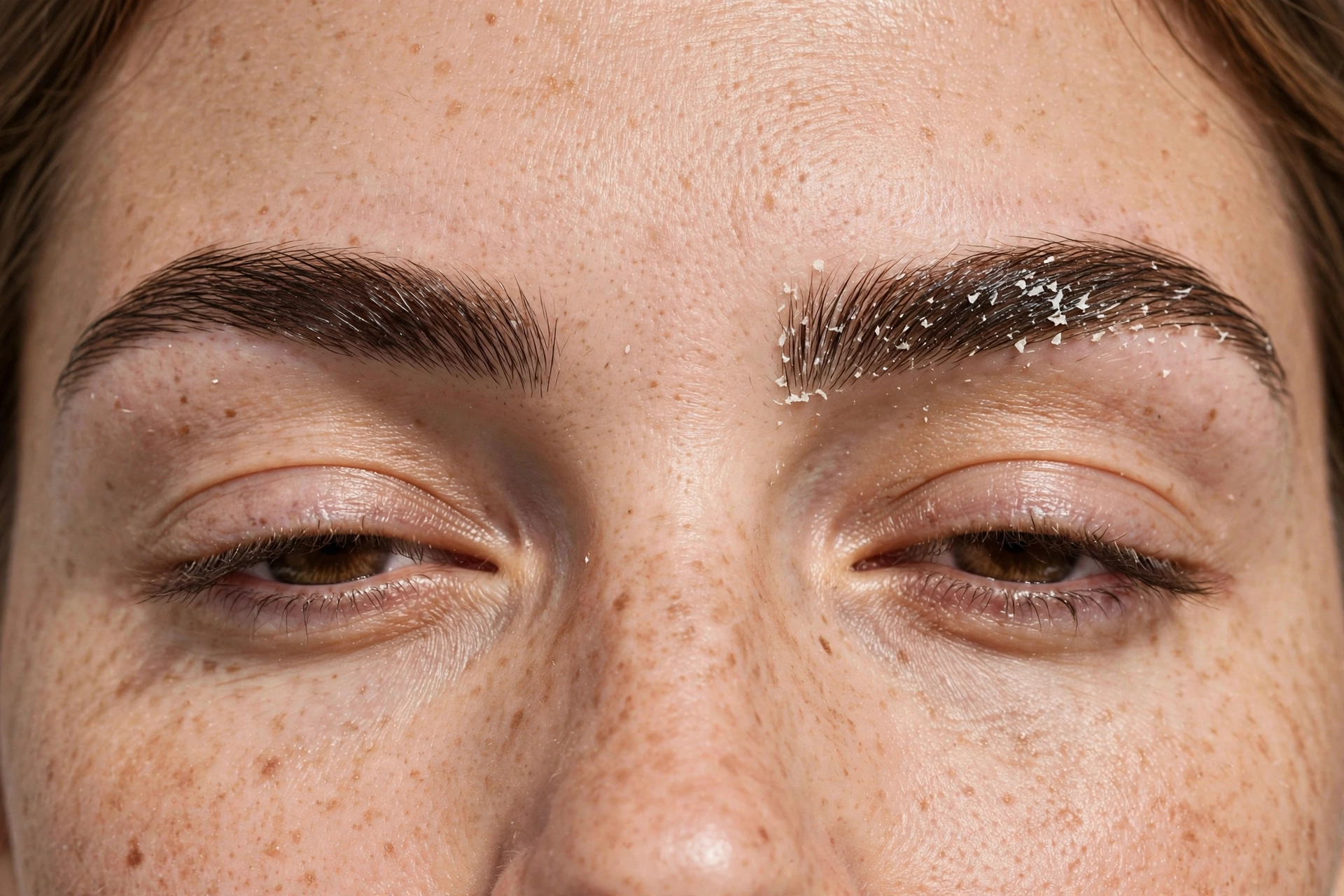
Manufacturer practice supports testing this variable: excess gel is one cause brand guidance itself names for white residue. NYX and Maybelline care teams also describe re-brushing dried gel as breaking it into white, flaky crumbs — their practical guidance, not a timing rule. Note whether you touched up either brow after it dried; if you did, repeat the test once without re-brushing before judging it.
- Thin side stays clean, normal side flakes: dose is sufficient to cause your problem. Your endpoint is mechanical: scrape the wand, use one thin pass, and leave the gel alone once it is on.
- Both sides flake: load is cleared as the main driver. Combined with a clean wand (Check 1) and a bare-brow failure (Check 2), this is the point where replacing the product becomes the justified endpoint — a different formula or a clear-versus-tinted switch — chosen after the tests, not as a first guess.
What a load change cannot tell you: why the thicker layer failed. A positive result suggests excess was enough to cause the flaking; it does not diagnose the chemistry of the film, and this article will not pretend otherwise.
A short note on clear versus tinted gel
This is a reading note, not another test.
Colour changes how the symptom reads, not what caused it. With a clear gel, white residue is the dried gel layer itself becoming visible. With a tinted gel, a grey or ashy cast can appear when the dried layer lightens the tint or the colour pools unevenly — but tinted gels can also throw plain white flakes. Treat the colour as a description of what you are seeing, then go back to Checks 1 to 4 to find out where it started.
Your decision, by result
- Residue that recurs throughout after one neck-clean retest → replace the tube. (Check 1)
- Clean alone, flakes only where your routine overlaps → change the sequence: gel before base, or keep base out of the brow line. (Check 3)
- Clean alone, flakes where residue sits in the brow → change the prep: start from a clean, dry brow. (Check 3)
- Flakes on a bare brow, thin load fixes it → keep the product, change the dose and stop re-brushing dried gel. (Check 4)
- Flakes on a bare brow at any load → replace the formula, as the last step after the other suspects are cleared. (Checks 2 + 4)
- Flakes appear on days you wear no gel at all → it is not the gel.
That last result matters. If you see flaking with no gel involved, you are looking at skin flakes rather than product residue, and product tests will never fix it. Persistent scaling, itching, or redness is a reason to see a clinician rather than to keep troubleshooting cosmetics.
One boundary for a neighbouring symptom: flakes falling from your lashes are a mascara problem, not a brow-gel one, and they need their own diagnosis.
Evidence basis: controlled self-comparison (Checks 1–4); manufacturer instructions and care-team guidance on dose, clean brows, and not re-brushing dried gel; and general film-former behaviour described for hair gels, used as a labelled analogy. No brow-gel-specific clinical study is claimed, because none was found.