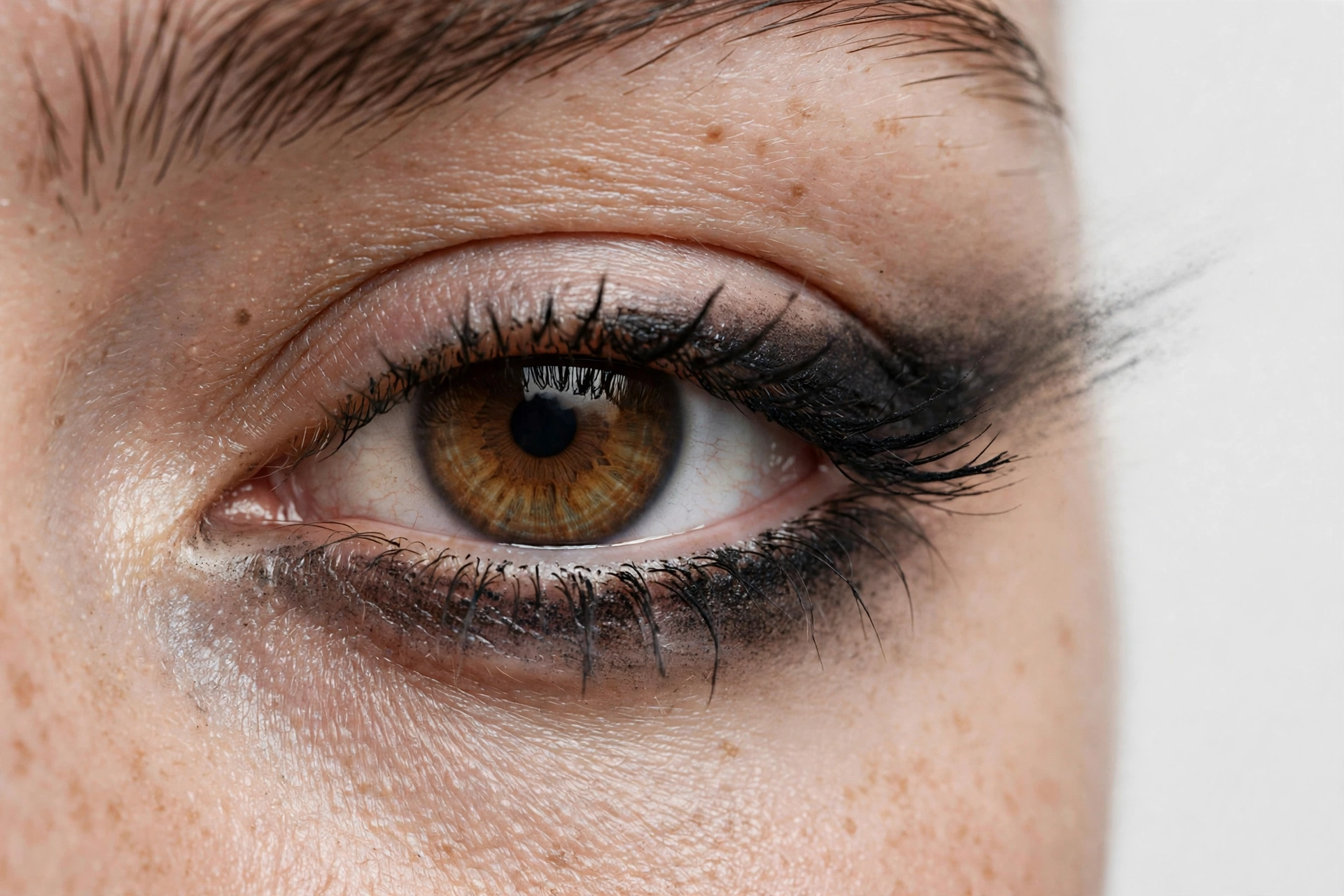
You draw it on in the morning — sharp wing, clean waterline, tidy lower lash line. By afternoon there’s a grey halo where the wing was, a smudge blooming in the inner corner, or a faint stamp of liner sitting in your crease.
Here’s the thing most advice skips: “eyeliner smudging” isn’t one problem. Liner that bleeds off the waterline and liner that transfers onto a hooded lid are failing for completely different reasons — different zones, different mechanisms, different fixes. The waterproof pencil that survives your waterline might still stamp your crease by 3 PM, and the primer that fixes your oily lid does nothing for a watery inner corner.
This guide works the way this publication always works: what you see → where it happens → what may be causing it → how to check → what to change. Where the smudge appears is your fastest diagnostic clue — but a clue, not a verdict. The tests below do the proving.
The short answer
Eyeliner smudges when something defeats the film holding the pigment in place — and the “something” depends on the zone. On the waterline, it’s usually constant moisture plus blinking. On the upper lid, it’s usually your skin’s oils softening the film, or the lid physically touching liner when you blink. In the inner corner, it’s usually tearing. On the lower lash line, it might not be your eyeliner at all — it might be your mascara.
One honest correction before we start: waterproof does not mean smudge-proof. They’re different claims tested against different enemies — waterproof resists water; smudging is defeated by oils, friction, and heat too. A waterproof liner can still melt on an oily lid. We’ll unpack that properly below.
Fast zone router: where is the smudge?
Find your pattern, then jump to its section. Each branch is a “check this next,” not a diagnosis — zones suggest; tests confirm.
- Waterline (the wet rim inside your lashes) → moisture, blinking, and formula behavior. Start with the waterline section.
- Upper lid / lash line → oil breakdown, base issues, or unset product. Start with the upper-lid section.
- Inner corner → tearing and moisture pooling. Start with the inner-corner section.
- Lower lash line → first rule out mascara transfer, then liner migration. Start with the look-alikes section.
- Outer wing / wing tip → friction, liquid applied before it dried, or lid contact on hooded eyes. Start with the wing section.
- Crease or brow bone (liner stamped where you didn’t draw it) → lid-to-lid contact, most common with hooded eyes. Start with the hooded-transfer section.
First: is it actually your eyeliner?
Before diagnosing liner, rule out three look-alikes. Each has a different fix.
| What you observe | What it likely is | Key check |
|---|---|---|
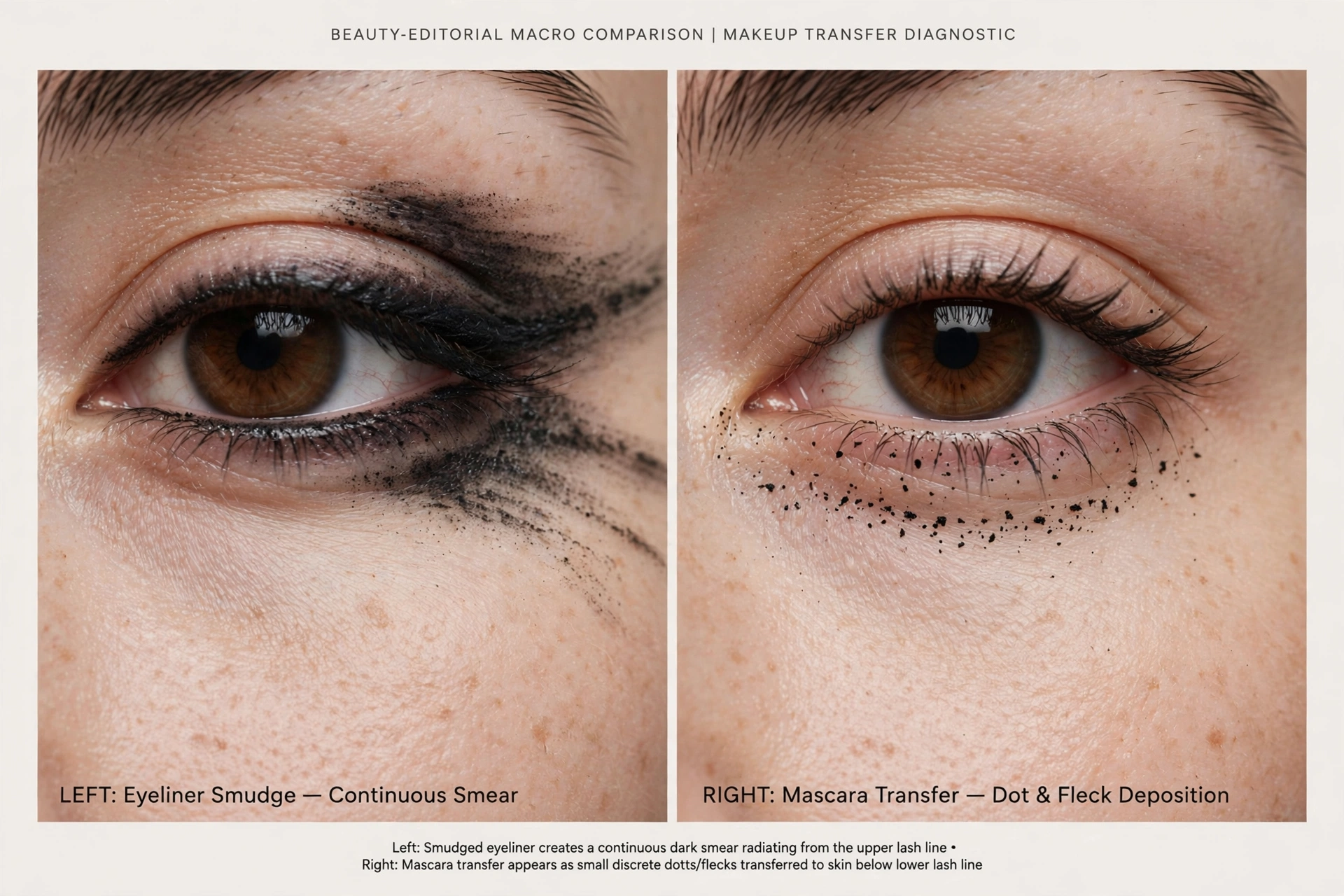
| Smudgy marks sit slightly below the lash line as distinct dots or flecks, roughly where your lower lashes would touch skin | Mascara transfer | Skip lower-lash mascara for one day. If the marks disappear, it was the mascara — our guide on why your mascara smudges → covers that diagnosis fully |
| Tiny dark specks scattered on the lid or under-eye, like dust — no continuous smear | Eyeshadow fallout | Fallout happens at application and brushes away; smudging develops over hours |
| A continuous smear radiating outward from exactly where you drew the line | Eyeliner migration | This article’s main track |
| Everything — liner, shadow, mascara — is sliding by midday | Base failure, not a liner problem | Check whether skincare or eye cream underneath ever fully absorbed |
The mascara test, stated precisely: mascara transfer traces to lash-to-skin contact — it appears as dots or flecks at the points lower lashes reach. Eyeliner smudge stays contiguous with the line you drew. One more diagnostic trick: tubing mascaras don’t dissolve in oil (they come off with warm water), so if you switch to a tubing formula and the marks persist, the liner is the more likely culprit. (This distinction is assembled from makeup-artist and retail-education guidance rather than a single published study — treat it as a strong clue, not lab proof.)
The zones: diagnose yours
Each zone follows the same pattern: what you see → what may be causing it → how to check → what to change. Language is deliberately calibrated — “may point to,” “more consistent with” — because zones suggest; they don’t prove.
Waterline
What you see: liner fades, thins, or bleeds off the wet inner rim within an hour or two; sometimes it migrates into the eye itself.
What may be causing it. The waterline sits directly against the tear film — constant moisture plus ~15,000–20,000 blinks a day of friction. Tears dilute product, and the lid’s natural oils seep in and interfere with adhesion. A particle-tracking study (Alison Ng, Centre for Contact Lens Research, Waterloo) found liner migrates into the tear film, faster and more when applied on the inner lid margin — and the researchers’ own recommendation was to apply liner in front of the lash line instead. Formula matters enormously here: liquids are widely considered unsuitable for the waterline (they can bleed, and many contain alcohol and higher preservative loads), while pencils and gels are the conventional choice.
One honest contradiction: beauty media broadly treats pencil/gel as waterline-appropriate — but optometrist Dr. Brittani Carver-Schemper holds that no eyeliner type is truly safe on the waterline, citing Meibomian (oil) gland obstruction risk. Both positions are on the record; if you wear contacts or have sensitive eyes, that second view deserves weight.
How to check. Wear liner on the waterline only (no lid liner) for a day. If the smudging is confined to the waterline while a lid line would hold, the zone — moisture plus blinking — is the driver, not your formula generally.
What to change. Use a pencil or gel formulated for the waterline rather than liquid; keep the line thin (less product = less to migrate); and consider tightlining — pushing pigment between the lashes from above rather than painting the wet rim — which several makeup artists recommend as the longer-wearing placement.
Upper lid / lash line
What you see: the line softens, smears outward, or loses its edge through the day; worst where the lid is oiliest.
What may be causing it. Sebum. Eyelids produce oil like the rest of the face, and the chemistry is straightforward: oils dissolve oily materials (“like dissolves like,” as cosmetic chemists put it) — your lid’s sebum gradually softens wax-based and creamy liner films. This is the single best-evidenced liner-smudge mechanism. A second contributor: product applied before it finished setting. Liquid liners need their volatile carriers to evaporate (makeup artists suggest around 30 seconds with eyes open or looking down); a wing drawn on a hooded lid and immediately folded shut never got the chance to set.
How to check. The half-eye primer test (below) is the cleanest check. Also note timing: smudging that worsens as the day gets oilier points at sebum; smudging present within the first hour points at unset product or base interference.
What to change. An eye primer as an oil barrier plus adhesion layer — but understand its limits (see primer myth below). Set creamy formulas with a whisper of matching powder. And give liquid liner its drying time before you blink normally.
Inner corner
What you see: liner dissolves, feathers, or vanishes specifically at the inner corner; sometimes accompanied by a damp feeling.
What may be causing it. The inner corner is the eye’s drainage zone — tearing and moisture pool here. Makeup artists treat it as a high-moisture placement to be handled carefully (several advise stopping liner short of the tear duct). Be candid about the evidence: the general “watery eyes ruin liner” consensus is strong, but inner-corner pooling as a distinct studied mechanism is thinly documented — this is professional-placement wisdom more than lab science.
How to check. Skip liner in the innermost millimeter for a day, starting the line just past the corner. If everything else holds, placement — not formula — was the problem.
What to change. Start the line slightly out from the tear duct; use your most water-resistant formula specifically in this zone; blot the corner gently before application.
Lower lash line
What you see: smudging beneath the lower lashes — the classic “panda” shadow.
What may be causing it. Two candidates, and this is where the look-alike check earns its keep: eyeliner migrating down (oils, moisture, soft formula) versus mascara transferring from lower lashes (lash-to-skin contact). Work the distinction from the look-alikes section first — dots at lash-reach distance suggest mascara; a continuous smear from the line suggests liner.
How to check. The no-lower-mascara day: skip mascara on lower lashes only. Marks gone = mascara. Marks persist = liner.
What to change. If it’s the liner: thinner application, a less mobile formula on the lower line than the upper (many artists use pencil below, liquid above), and powder-set. If it’s the mascara: that’s article #8’s territory.
Outer wing
What you see: the wing tip softens, feathers outward, or disappears while the rest of the line holds.
What may be causing it. Three usual suspects: liquid liner that never fully dried before the eye moved normally (the pre-set vulnerability window); friction from rubbing or from the outer corner’s natural movement; and on hooded eyes, the wing folding into the crease area with every blink.
How to check. Note when it fails: within minutes of application points at unset product; gradual afternoon feathering points at friction and oils.
What to change. Let liquid set fully before normal blinking; keep wings slightly shorter and thinner at the tip (less product at the highest-friction point); on hooded eyes, consider whether the wing’s placement puts it in the fold path.
Hooded-lid transfer
What you see: liner stamped onto the crease or brow-bone area — a ghost of your line appearing where you never drew.
What may be causing it. Pure mechanics: on hooded eyes the brow-bone fold overlaps the mobile lid, and with every blink the skin surfaces touch and rub. Multiple beauty editors and makeup artists document this transfer path explicitly. This is geometry, not a flaw — and it’s worth stating plainly that not every hooded eye experiences it; blink depth and fold contact vary person to person.
How to check. Look straight into a mirror after blinking a few times: if the transfer pattern matches exactly where your fold contacts the lid, it’s mechanical contact.
What to change. Transfer-resistant (film-forming) formulas rather than soft kohl; set with powder; keep liner thinner where the fold lands. And know the documented limit: makeup artists note that a kohl designed to smoke and move will still transfer despite primer — if the formula’s job is mobility, no barrier fully overrides it.

A brief safety note, once: persistent eye irritation, redness, pain, or discharge isn’t a makeup problem — have it evaluated by an eye-care professional. (Standard optometric guidance.)
Formula differential: pencil vs kohl vs gel vs liquid
Formulas don’t fail the same way because they aren’t built the same way. Here’s what each one actually is — with the chemistry kept honest.
Pencil is pigment in a wax matrix (beeswax, carnauba, microcrystalline wax plus oils). Classic pencils never truly “dry down” — the wax stays relatively mobile, which is why softer pencils smear. The exception that matters: modern long-wear pencils use volatile silicones plus film-forming polymers that set into a durable film as the volatiles evaporate — a genuinely different architecture from classic wax pencils, despite sharing the pencil shape.
Kohl deserves an honest correction: as a modern product category, it’s mostly marketing. Cosmetics historians note kohl is defined more by color and use than composition, and modern “kohl” pencils are structurally wax pencils formulated softer and creamier for blendable, smoky looks. (Traditional kohl — mineral powders like galena applied with a rod — is genuinely different, but that’s not what’s in the pencil labeled “kohl” at the drugstore.)
Gel (pot or pencil) typically pairs volatile carriers with silicone resins and waxes: the volatiles evaporate and the resin locks pigment into a film. In wear testing by cosmetic chemists, gels rank among the longest-wearing — but “gel always wins” is not supportable as a universal claim.
Liquid is usually a water-based emulsion carrying film-forming polymers (like acrylates copolymer): as the water evaporates, the polymers deposit a thin continuous film. Once set, it’s the hardest to smudge by friction — and the hardest to remove. Its vulnerability is the pre-set window, and it’s the consensus wrong choice for the waterline.
No universal ranking exists — and sources contradict each other on oily lids specifically (one major beauty publication favors liquid for oily lids; chemist testing favors volatile-plus-film-former formulas regardless of format). The defensible frame is formula behavior × your zone × your skin, tested on your own eye — not a leaderboard.
Isolation tests: change one variable
Each test isolates a single variable. Run one at a time; the unchanged eye (or cheek-side equivalent) is your control. Results are clues, not proof.
- Primer on one eye only. Apply eye primer to one lid, nothing to the other; wear your normal liner on both. What changes: oil barrier plus adhesion on one side. Observe: which side smudges first, and where. May indicate: if the primed side clearly wins, oil/base interaction is a major driver for you. If both smudge identically, your problem is formula or zone mechanics, not the base.
- The eye-cream pause. One morning, keep eye cream (and heavy moisturizer) off the mobile lid and lash line entirely — orbital bone only — and give it several minutes before makeup. What changes: emollient migration near the liner. Observe: wear difference versus your normal routine. May indicate: skincare undermining the film. (Placement and wait-time guidance is well-attested in makeup-artist and brand education; dermatologist-authored sourcing for this specific claim wasn’t found — take it as professional consensus, not medical guidance.)
- Waterline-only vs lid-only. Day one: liner on the waterline only. Day two: liner on the lid only, waterline bare. What changes: the zone under test. Observe: which placement fails. May indicate: whether your issue is moisture-driven (waterline) or oil/friction-driven (lid).
- Same liner, different zones. Wear your usual liner on the upper lid one day and the lower lash line another. What changes: zone, holding formula constant. May indicate: zone-specific mechanics versus a formula that’s simply too mobile everywhere.
- Set vs unset. On one eye, press a whisper of translucent powder (or matching shadow) over the liner; leave the other unset. What changes: surface oil absorption and mattifying of the film. Observe: transfer difference by evening. May indicate: whether surface mobility is your failure mode. (Keep the hand light — over-powdering cakes; see the myths section.)
Fixes by zone
| If your pattern is… | Change this |
|---|---|
| Waterline bleeding | Pencil or gel formulated for the waterline (not liquid); thin line; consider tightlining between lashes instead of the wet rim |
| Upper-lid softening through the day | Eye primer as oil barrier; set creamy formulas with powder; let liquid fully dry before normal blinking |
| Inner-corner dissolving | Start the line just past the tear duct; most water-resistant formula in this zone; blot the corner before applying |
| Lower lash-line panda | First run the mascara test — if it’s the liner: thinner line, less mobile formula below than above, powder-set |
| Wing feathering | Full dry-down time for liquid; shorter, thinner wing tip; check hooded-fold contact |
| Crease/brow-bone stamping (hooded) | Transfer-resistant film-forming formula; powder-set; thinner liner where the fold lands; accept the kohl limit — a formula designed to move will move |
What not to chase
Only myths actually found circulating, each checked against evidence:
- “Waterproof means smudge-proof.” False. Waterproof resists water; smudging is also caused by oils, friction, and heat — and cosmetic chemists are explicit that the terms address different things. Multiple sources confirm oils defeat waterproof films. Buy for the enemy you actually face.
- “More powder always fixes transfer.” Nuanced. A light hand of powder over liner genuinely helps — it absorbs surface oil and mattifies the film. But “more” and “always” are false: over-powdering cakes and dries the look, and powder reduces transfer without eliminating it. (It’s also worth knowing powder shouldn’t go on the waterline itself — brand education splits on this, with irritation concerns on one side.)
- “Primer is always necessary.” Nuanced. Primer is well-evidenced as an oil barrier and adhesion layer — and close to a must on very oily lids. But “always” overstates it: for eyeliner-only wear on non-oily lids, several professional sources say you can skip it. Match the step to your eye, not to a rule.
- “All smudging means oily lids.” False. Oil is one major cause among several: eye shape and blink mechanics, unset product, heavy application, rubbing, watery inner corners, migrating skincare, even lash-curler order. If your lids aren’t oily and your liner still moves, the zone sections above are where your answer lives.
- “Setting spray locks eyeliner.” Nuanced. Film-forming “fixing” sprays lay a real polymer barrier that extends wear — cosmetic chemists describe the mechanism, and wear tests support it. But “locks” overstates it, and many products sold as setting sprays are hydrating mists that do little for longevity. Check that the formula contains actual film-formers.
- “All pencils smudge — only liquid or gel can be smudge-proof.” False. The smudgy reputation belongs to soft kohl-style pencils specifically. Modern waterproof gel pencils — volatile carriers plus film-formers in pencil form — test as genuinely smudge-resistant. Judge the formula architecture, not the shape it comes in.
FAQ
Why does my eyeliner smudge on the waterline but nowhere else?
Because the waterline is the wettest, highest-friction zone: constant tear moisture plus blinking works against adhesion all day. That’s a zone problem, not a sign your liner is bad everywhere — test it on the lid before replacing it.
Does waterproof eyeliner prevent smudging?
Not by itself. Waterproof means resistant to water; smudging is also driven by oils, friction, and heat. On oily lids especially, a waterproof formula can still break down — look for transfer/smudge resistance (film-forming formulas) rather than the waterproof label alone.
Why does my eyeliner transfer to my upper lid / crease?
Lid-to-lid contact: with every blink, skin surfaces touch and rub, and mobile liner transfers — most noticeable with hooded eyes where the fold overlaps the lid. Transfer-resistant formulas plus powder-setting reduce it; soft kohl designed to smoke will still move.
Is it my eyeliner or my mascara smudging under my eyes?
Check the pattern: mascara transfer appears as distinct dots or flecks roughly where lower lashes touch skin; eyeliner smudge is a continuous smear radiating from the line you drew. Skip lower-lash mascara for a day — if the marks persist, it’s the liner.
Do I need eye primer for eyeliner?
It depends on your eye. Primer is a genuine oil barrier and adhesion layer — close to essential on oily lids, and the one-eye test above will tell you if it’s doing work for you. On non-oily lids with eyeliner only, it’s optional, not mandatory.
Found your zone? The fix only works if it matches the mechanism — don’t buy a new liner until the tests tell you the old one’s formula or placement was actually the problem.
1 thought on “Why Does My Eyeliner Smudge? Find Your Zone”
Comments are closed.