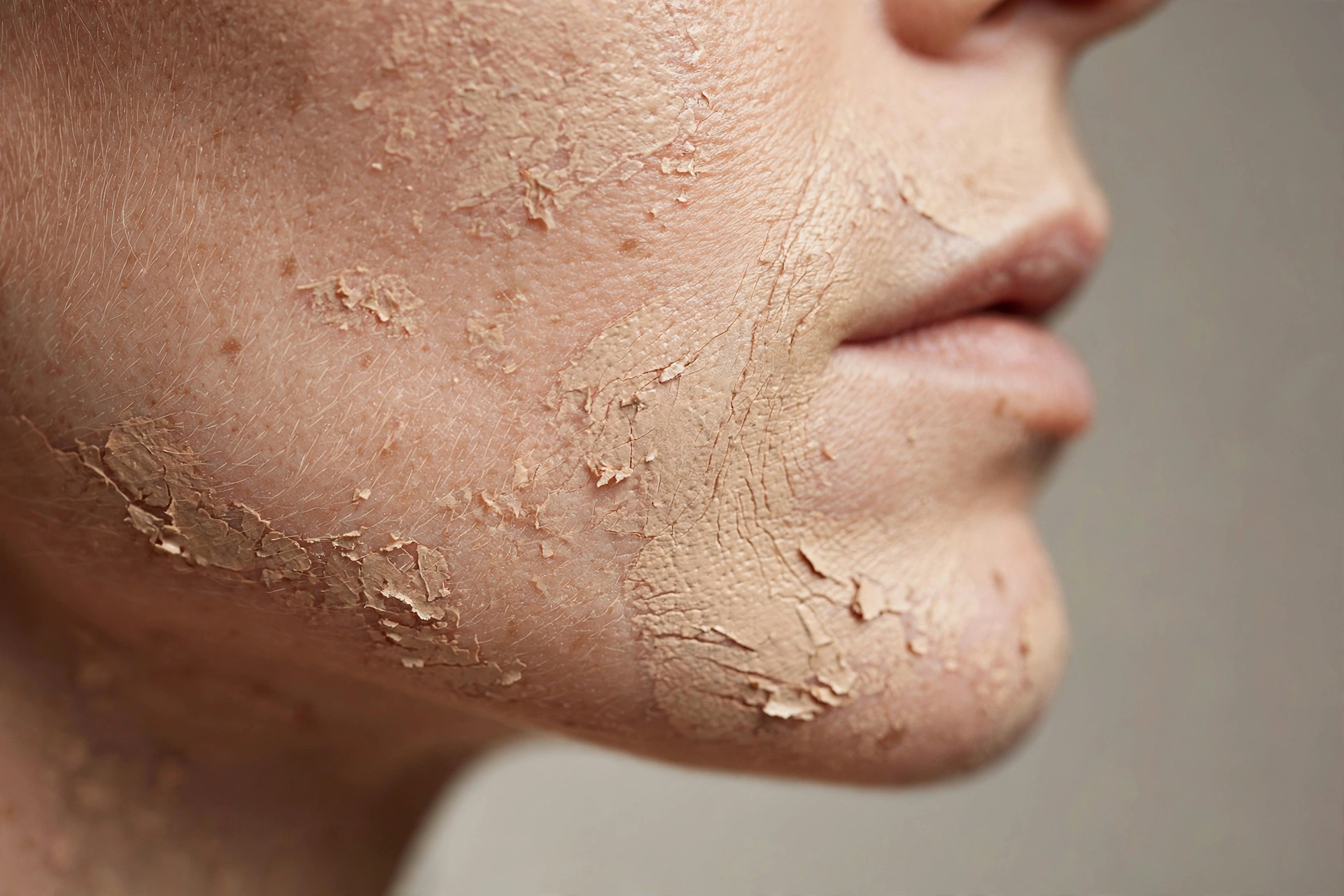
Cakey foundation has a specific look: instead of melting into your skin, the makeup sits on top of it — visible, dry, a little textured, like a separate layer you could almost scrape off. If that is what you are seeing in the mirror, here is the short answer: cakiness usually comes down to some combination of too much product, a dry or under-prepped skin surface, powder buildup, application technique, layers that do not play well together, or a formula or finish that does not suit your skin right now.
The useful question is not “which one of these is it?” It is “which one is it for me, today?” This guide is built around that. Match what you see in the mirror to the visual signatures below, find your likely cause, and change one thing at a time.
What Cakey Foundation Actually Looks Like
Healthy, well-applied foundation reads as skin — you notice even tone, not the makeup itself. Cakey foundation reads as makeup: you can see where it sits, texture looks exaggerated rather than smoothed, and the finish often looks dry and flat even if your skin is not particularly dry. It also tends to look worse in bright daylight or a car mirror than in soft bathroom light, which is why many people only notice it after leaving the house.
The difference is integration. On the left, the foundation has melded with the skin — pores and fine texture are still visible, which is what makes it look real. On the right, the product is sitting on the skin as its own layer. Everything in this guide comes back to that distinction.
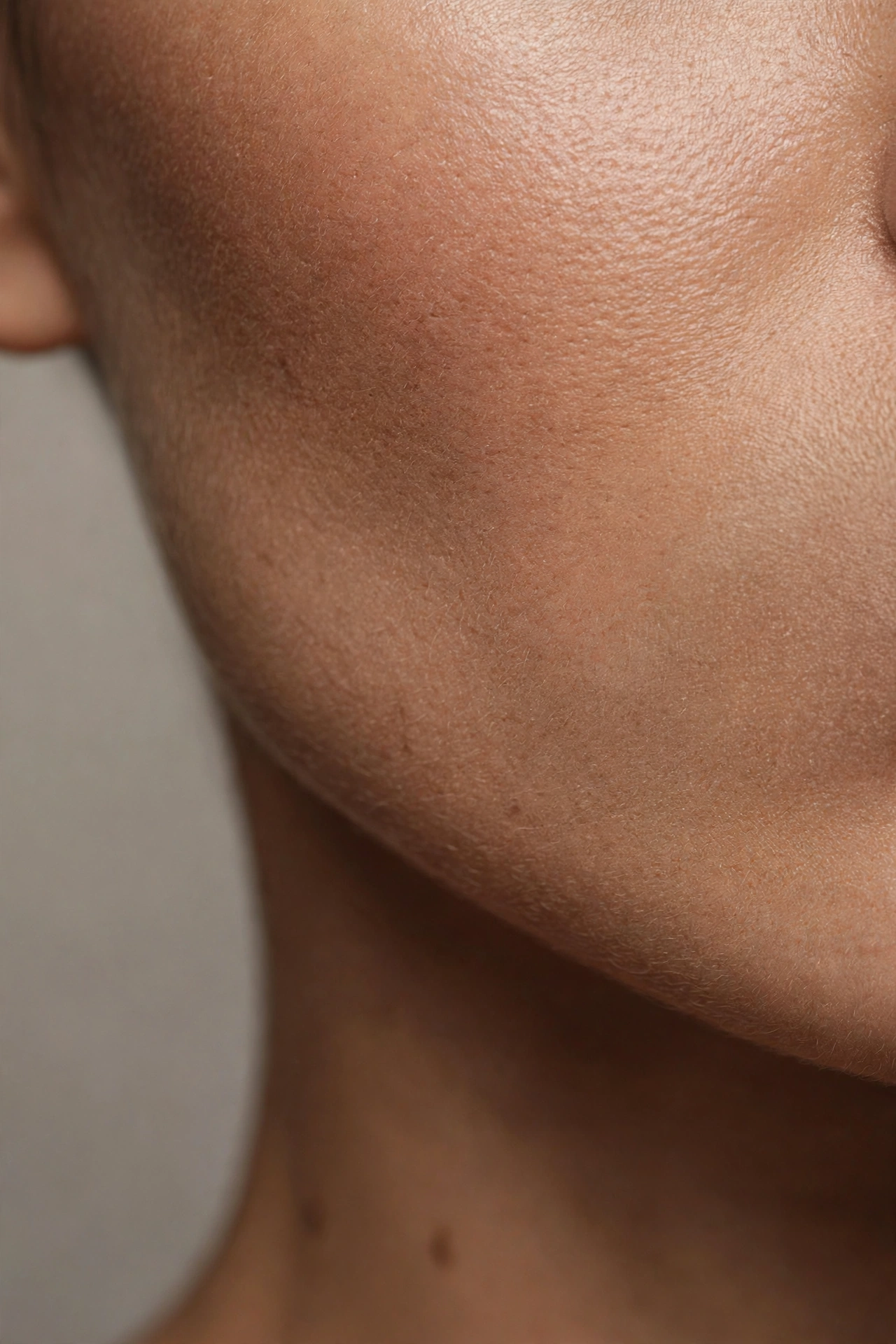
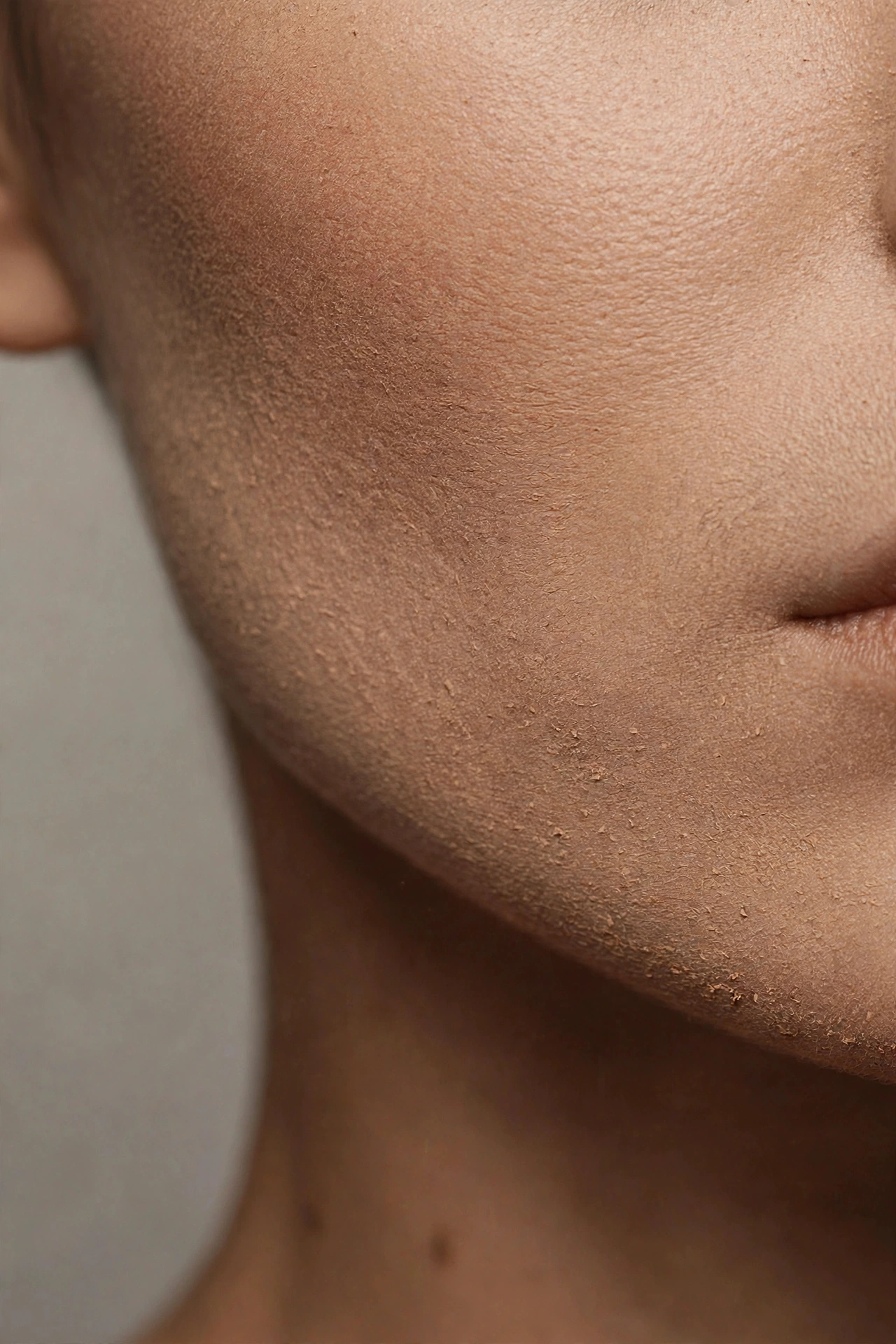
An educational comparison under the same lighting: smoothly blended foundation vs. cakey buildup. Illustrative images — not the result of any specific product.
Quick Diagnosis: Match What You See
Find your mirror symptom in the left column, then jump to the likely cause. Most people find their answer in the first three rows.
| What you see | Likely cause | Go to |
|---|---|---|
| Makeup grips flaky or rough patches; looks uneven in spots | Dry, under-prepped skin surface | Cause 1 |
| Thick, mask-like layer; settles into lines around the mouth and eyes | Too much product | Cause 2 |
| Streaks or unblended edges; heavier in some areas than others | Technique or tool mismatch | Cause 3 |
| Flat, chalky, ashy — all luminosity gone | Too much powder | Cause 4 |
| Tiny balls or rolls form when you blend or touch your face | Layers pilling against each other | Cause 5 |
| Looks fine at first, then breaks apart around the nose and chin within hours | Layering and wear issues | Cause 5 |
| Shade looks right in the morning but darker or orange by afternoon | Oxidation — a color problem, not texture | Look-alikes |
| Looks fine in your bathroom but cakey in daylight or the car mirror | Lighting exposing texture + finish choice | Cause 6 |
The 7 Causes of Cakey Foundation
Work through these in order. For each one: what it looks like → why it may be happening → how to check → what to change.
1. Your skin surface is dry or under-prepped
What it looks like: foundation catches on dry patches and clings to rough spots instead of gliding over them. The result is uneven — smooth in some areas, flaky and textured in others, often around the nose, chin, and cheeks.
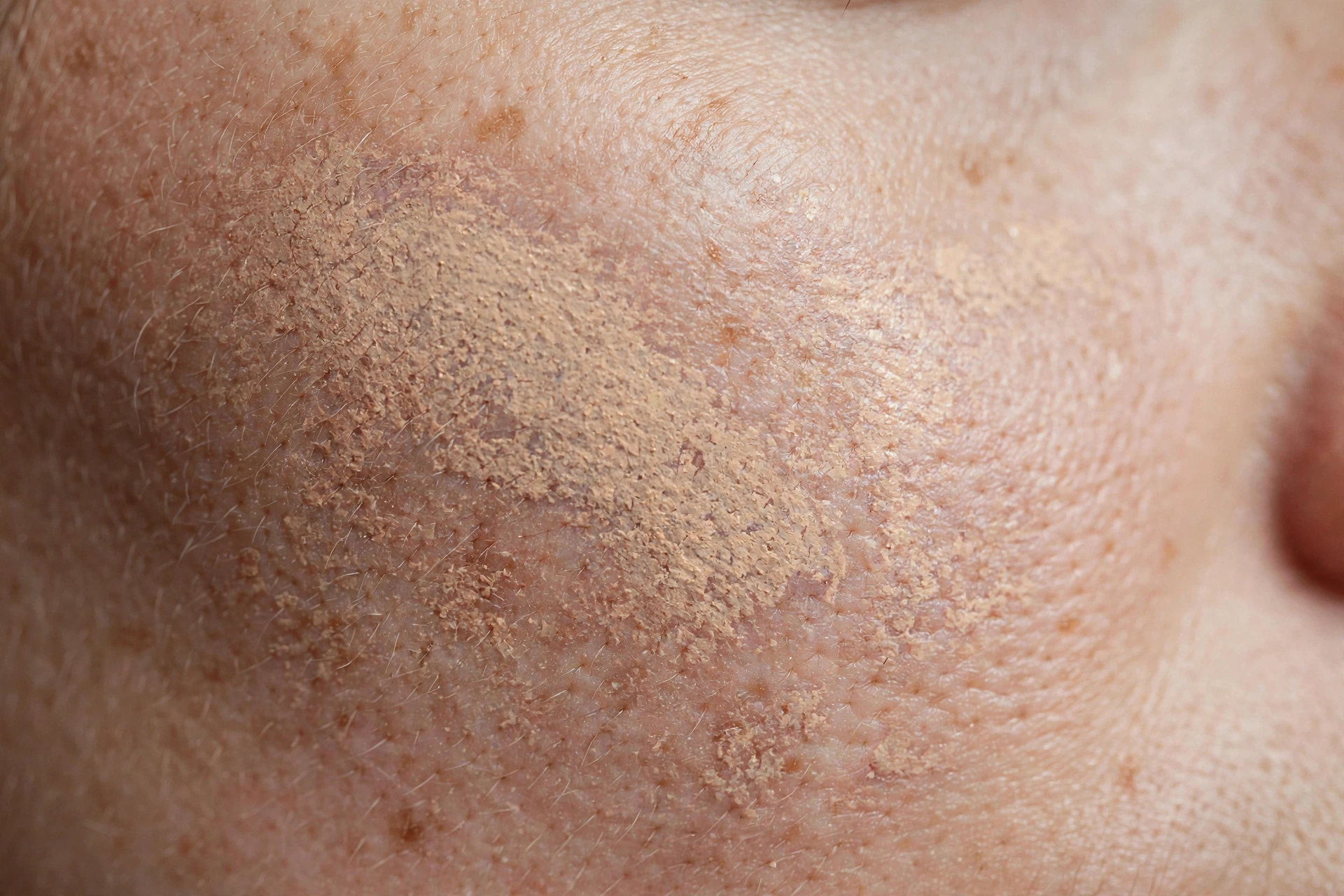
Why it may be happening: foundation cannot create a smooth surface; it can only follow the one underneath it. When the skin surface is dry or rough, liquid makeup grips the raised, dry areas and settles around them, which exaggerates every flake.
How to check: look at your bare skin in daylight before applying anything. If you can see dryness, roughness, or flaking with no makeup on, prep — not more foundation — is the fix.
What to change: moisturize before makeup, and give it time. The American Academy of Dermatology recommends applying moisturizer while skin is still slightly damp to help trap water in the surface layers, and choosing a cream or ointment over a thin lotion when skin is dry. Then wait a few minutes and let the layer absorb fully before foundation goes on — makeup applied over a still-wet base slides, separates, and cakes.
2. You are simply using too much product
What it looks like: a thick, mask-like layer with no skin showing through — not even texture. It settles into the lines around your mouth and eyes, and it tends to look heavier as the day goes on.
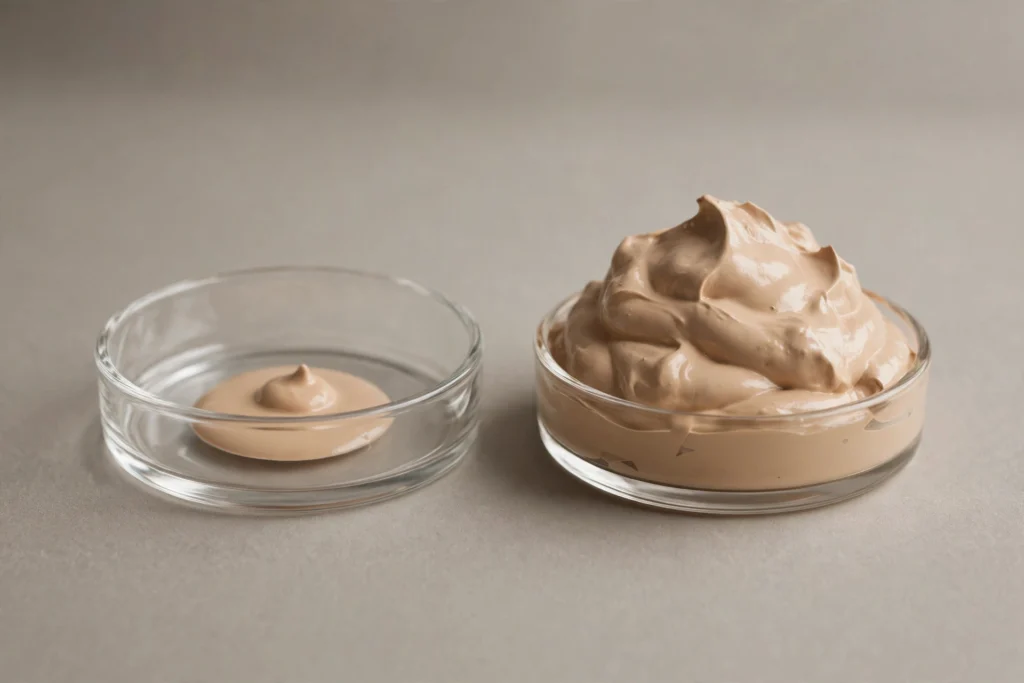
Why it may be happening: excess product has nowhere to go. One thin layer can meld with skin; three thick ones can only sit on top of each other, and every additional layer multiplies texture instead of hiding it.
How to check: think about how much you start with. If your first application already covers like a mask, you began with too much — the fix is at the start, not the end.
What to change: start with less than you think you need — roughly a pea-sized amount per zone of the face is a reasonable starting point, not a rule. Pump sizes, formula thickness, and coverage levels vary too much for any universal number, so think relative: apply a sheer layer everywhere first, then add tiny amounts only where you actually need more coverage. For spots and blemishes, a small amount of concealer pressed on top beats an extra layer of foundation across the whole face.
3. Your technique or tools are working against you
What it looks like: streaks, unblended edges around the jawline and hairline, or patchy density — heavier where you started, sheerer where you finished.
Why it may be happening: foundation sets as its volatile ingredients evaporate, so slow, dragged-out blending leaves visible start and stop marks. Tools matter too, and honestly: a dense brush lays down the most product and can leave streaks with full-coverage formulas; a damp sponge sheers product out and presses it into skin, which is forgiving but absorbs some product; fingers warm and melt formula in nicely for sheer coverage but offer the least precision. None is universally “best” — the mismatch is the problem.
How to check: watch where the heaviness sits. Streaks in one direction point to a brush dragged too slowly; a mask that will not sheer out points to too much product for the tool.
What to change: work in sections so nothing sets before it is blended, press or stipple rather than dragging long strokes, and always carry the blend past the jawline and into the hairline. If you love a brush, try finishing with a damp sponge pressed over the top — it lifts off the excess that causes caking.
4. Powder mistakes
What it looks like: flat, chalky, slightly ashy — every bit of luminosity gone. Skin looks dry even when it is not, and fine lines look deeper than they are.
Why it may be happening: powder’s job is to absorb oil and set makeup, but it cannot tell the difference between oil and the natural luminosity that makes skin look like skin. Applied heavily or everywhere, it builds its own dry layer on top of the foundation layer.
How to check: if your makeup looked fine before powder and cakey after, you have your answer.
What to change: powder only where you actually get shiny — usually the T-zone — with a fluffy brush, tapping off the excess first. A light hand beats a heavy one every time. If you have already over-powdered, a fine mist of facial spray (or a damp sponge pressed gently over the area) can re-melt the powder into the foundation instead of adding yet another layer on top.
5. Your layers are not getting along
What it looks like: tiny balls or rolls of product forming as you blend — like sweater pilling, but on your face. Or makeup that applies fine and then breaks apart around the nose, chin, or pores within a few hours.
Why it may be happening: you have probably seen the rule that “water-based products must go with water-based products, and silicone with silicone.” Treat that as the oversimplification it is. Most liquid foundations contain silicones such as dimethicone regardless of how they are marketed, and formulations are far more complicated than the first ingredient on the label. In practice, pilling and breakup come less from mixing “bases” and more from how layers are applied: too-thick layers, not letting each layer dry down before the next, over-rubbing instead of pressing, or specific film-forming ingredients that resist blending together. As a biochemist who works on cosmetic formulations explained to Refinery29, silicones tend to create a pilling effect especially when rubbed or applied in large volume — and less is genuinely more.
How to check: if the pilling started when you added or changed one specific layer — a new primer, sunscreen, or serum — that layer is the prime suspect. A quick test: apply the same routine on one side of your jaw and skip the suspect layer on the other, then compare after an hour.
What to change: simplify first. Thin layers, pressed rather than rubbed in. Give each layer a few minutes to set before the next goes on — makeup applied over a still-tacky base is far more likely to ball up. If a particular combination keeps failing, change the combination rather than blaming one product. (Pilling and separation each deserve their own deep dive, and we will give them one — for now, the method above resolves most cases.)
6. The finish does not suit your skin right now
What it looks like: makeup that is technically well-applied but still reads as dry and textured — or, at the other extreme, makeup that looked good at 8am and has slid into every pore by noon.
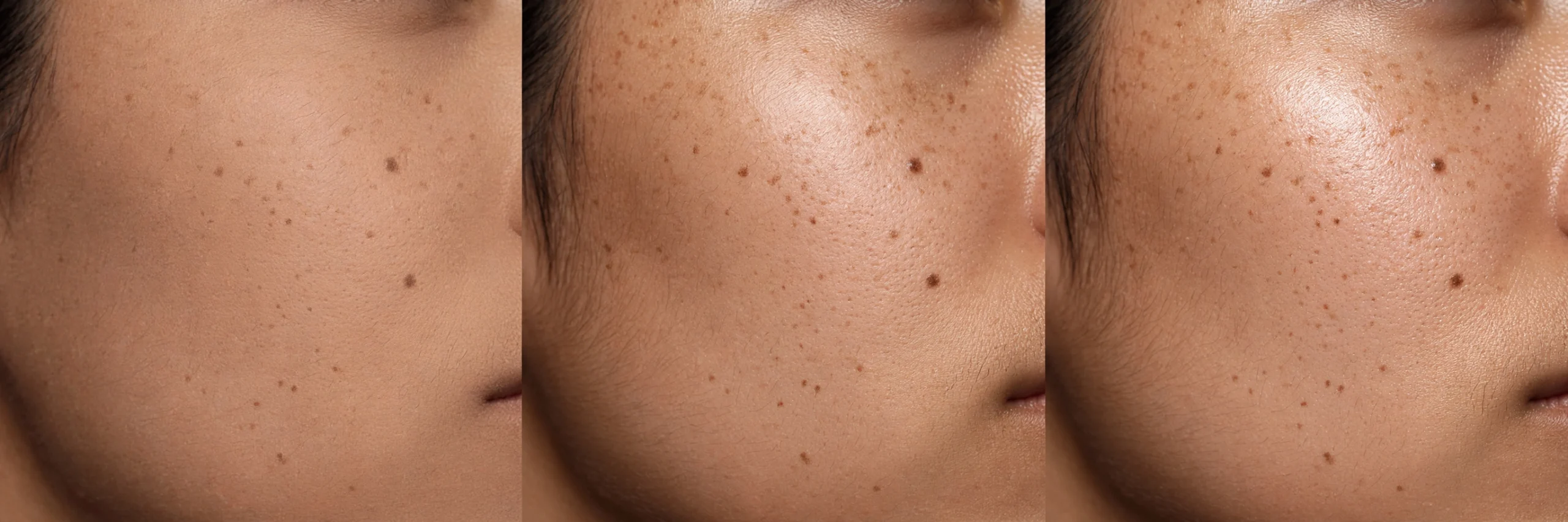
Why it may be happening: finish is not just a look — it changes how texture reads. Matte finishes absorb light, which hides shine but spotlights every flake and fine line; on dry or textured skin, matte is the fastest route to cakey. Dewy finishes reflect light and visually smooth texture, but on very oily skin they can break down and slide. Skin also changes with seasons, climate, and age, while the foundation in the drawer stays the same.
How to check: ask when the problem started. If the same foundation turned cakey when winter arrived or your skin got drier, the formula did not go bad — your skin moved and the finish did not follow.
What to change: match finish to current skin, not to preference alone. Dry, textured, or mature skin generally looks smoother in satin or natural finishes; very oily skin often does better with a soft matte kept to the T-zone. And check the light that matters: assess the result in daylight, not just bathroom lighting.
7. The formula itself is a poor fit
What it looks like: you have fixed prep, quantity, technique, powder, layering, and finish — and it still looks cakey.
Why it may be happening: sometimes the product is simply wrong for the job. A full-coverage, long-wear formula will always look heavier than a sheer one, no matter how skillfully applied — if you want a skin-like result from a mask-like formula, technique cannot fully bridge that gap. Age matters too. The FDA does not require cosmetics sold in the US to carry expiration dates, but most products print a small open-jar symbol — the period-after-opening mark, such as “12M” — showing how many months the manufacturer intends it to stay at its best once opened. A foundation that has separated, thickened, or developed an off smell is past helping.
How to check: flip the bottle over and look for the open-jar symbol (Versed’s guide to reading it is a clear explainer). Then ask honestly whether the coverage level matches what you want your skin to look like — many cakey-foundation complaints are really full-coverage formulas doing exactly what they were designed to do.
What to change: stop troubleshooting your technique and reconsider the formula category: sheerer coverage, a more hydrating base, or simply a fresher bottle. No routine fixes a product fighting your goal.
How to Fix Cakey Makeup Without Starting Over
Midday cakiness does not require a full redo. The rule: melt and sheer, never add.
- Blot first. Press blotting paper (or a clean tissue) onto shiny areas before touching anything else. Adding powder over oil just builds another layer.
- Re-melt with moisture. Lightly mist your face with a facial spray — or press a slightly damp sponge over the cakey areas — then gently press and roll. The moisture re-activates the foundation so it can settle back into the skin instead of sitting on top of it.
- Sheer out, do not layer. Use the damp sponge to lift off excess rather than pressing more product in. Less product on the skin is the entire fix.
- Skip the powder rescue. More powder on top of cakey makeup is the most common way to make it worse.
Cakey vs. Look-Alikes: Patchy, Separating, Pilling, and Oxidized
These problems get mixed up constantly, and they need different fixes — so it is worth telling them apart:
- Cakey is a texture and excess problem: too-visible makeup sitting on the skin. Fix it with less product, better prep, and lighter powder (this guide).
- Patchy is a distribution problem: coverage with gaps, where skin peeks through unevenly. It is about uneven application or absorption, not excess — and it needs its own troubleshooting approach.
- Separating is a wear problem: makeup breaking apart and disappearing in spots — typically around the nose, chin, and pores — as the hours pass. It is about adhesion and layering over time.
- Pilling is a friction problem: tiny balls or rolls forming as you apply or touch your face. It is about layers resisting each other mechanically.
- Oxidized is a color problem: the shade deepens or turns orange through the day while the texture may be perfectly fine. No amount of blending fixes a color shift.
Each of these deserves a dedicated guide — separating, pilling, oxidation, and primer/foundation compatibility will each get one here, with room to link them together properly. For now, naming the right problem is half the fix.
Frequently Asked Questions
Why does my foundation look cakey even when my skin is not dry?
Then the likely culprit is quantity or powder, not dryness. A mask-like layer from too much product, or a heavy all-over powder application, reads as cakey on any skin type. Try halving your starting amount and powdering only the T-zone before changing anything else.
Can primer stop foundation from looking cakey?
A primer can help foundation apply more evenly, but it cannot fix the most common causes — too much product, heavy powder, or a finish fighting your skin. Think of primer as a supporting layer, not a rescue product. And ignore the oversimplified “match the bases” rule; thin layers and proper dry-down time matter more.
Does setting spray fix cakey makeup?
It can soften the look of cakiness by re-melting powder and foundation together, which is why it works as a midday rescue. But it does not remove excess product — if the underlying cause is too much foundation, the spray just makes the excess look slightly better temporarily.
Why does my foundation look fine indoors but cakey in daylight?
Soft indoor lighting hides texture; bright daylight and car mirrors reveal it. This usually means the makeup was borderline cakey all along and the lighting was flattering it. Always do your final check near a window or in daylight before you leave.
How do I know if my foundation formula is the problem?
If you have corrected prep, quantity, technique, powder, layering, and finish and it still looks cakey — or if the product is old, separated, or smells off — the formula is the likely issue. Check the open-jar symbol on the packaging for the manufacturer’s intended use window, and consider whether the coverage level actually matches the result you want.
Sources
- Refinery29 — What Is Makeup Pilling & How to Stop It (pilling mechanics, formulation expert commentary)
- U.S. Food and Drug Administration: Shelf Life and Expiration Dating of Cosmetics — no U.S. laws or regulations require cosmetics to carry expiration dates
- Versed — Do Skincare Products Expire & How Long Do They Last (FDA expiration-date policy, period-after-opening symbols)
- American Academy of Dermatology: dermatologists’ tips for relieving dry skin — moisturize while skin is still damp, and creams/ointments over lotions