It’s on the collar of the white shirt. A faint beige smudge on your phone screen. Marks on your hands by mid-afternoon. The foundation was supposed to stay on your face.
Almost every guide treats this as one problem with one answer: set it with powder, spray it, buy a “long-wear” formula. But transfer isn’t one failure mode. It’s at least six — and the fix for each is completely different. A powder solution aimed at oily skin won’t help if your problem is that you pull a turtleneck over a film that never finished setting.
This article works the way this publication always works: what you see → what it might be → how to distinguish it → how to test → what to change. Your job isn’t to collect tips. It’s to figure out which kind of transfer you have — because the timing and the location already know the answer.
The short answer
Foundation transfers for exactly one physical reason: at the moment of contact, the film on your skin was movable. Either it never fully locked down, or something re-mobilized it later. That’s it. Everything else is detail about which of those two things happened and why.
Two clarifications before anything else:
- Transfer is removal by contact — rubbing and pressure — not your makeup “melting.” Nothing about your face is hot enough to melt a cosmetic film. When people say their foundation “melted onto” their collar, what happened is mechanical: fabric pressed against a movable film and carried pigment away. Keeping the mechanics in mind keeps you from chasing the wrong fixes.
- “Transfer” is not one failure mode. A collar mark that appears while you’re getting dressed, an hour into the day, is a different problem from a collar mark that appears at 5 p.m. after your skin’s oils have been working on the film for hours. The first points at an unset film and too much product; the second points at sebum, sweat, and friction. Same word, different diagnoses, different fixes.
So the entire diagnostic question is: when does it move, and where? Answer those two, and the cause — and the change to make — follows.
What transfer actually looks like (vs. what it isn’t)
Before diagnosing, define the signature — because “my makeup didn’t last” gets applied to at least five different visual problems, and only one of them is transfer.
True transfer has a specific pattern:
- Pigment is visible on another surface. The inside of a collar, a phone screen, your palms, a mask, a pillowcase — foundation-colored marks where contact happened.
- The marks map to contact points. They appear where skin pressed or rubbed against something, not randomly across the face.
- The face may look fine elsewhere. Transfer can happen from a face that looks otherwise perfect — the problem is mobility at contact points, not a whole-face failure.
Now, what people mislabel as the same problem:
- Pilling. The product rolls into crumbs or balls on the skin. It stays on your face but balls up during or after application. Nothing has moved to another surface — the failure is mechanical breakdown on the skin itself.
- Cakiness. The foundation stays on the skin but looks heavy, dry, thick, cracked, or textured. It’s a finish problem, not a mobility problem.
- Separation. The film breaks into uneven patches — some areas dense with product, some nearly bare — without necessarily moving onto another surface. The film failed in place.
- Fading. Pigment becomes less visible over the day without appearing on another surface. This is the decisive test: if your collar is clean, your hands are clean, and your phone is clean, but the foundation is gone — that’s fading, not transfer, and this article isn’t for you.
The one-question screen: is there pigment on the other surface? Yes → transfer (possibly alongside another issue). No → it’s something else, and treating it with transfer fixes will waste your time.

The timing signal: immediate vs hours-later transfer
When the transfer happens is your single most informative observation. Two patterns, two different stories.
Immediate transfer — within minutes of application, often while getting dressed. You apply foundation, you pull on your shirt, and the collar is marked before you’ve left the house. The film was still movable when contact happened. Candidate explanations, framed as hypotheses to test rather than established facts:
- Too much product on the skin — more material sitting on the surface means more material available to move.
- The film hadn’t finished setting before contact — the volatiles were still evaporating, the film not yet continuous.
- A very emollient, glossy layer that stays movable by design.
- Wet skincare, sunscreen, or primer underneath that the foundation was sitting on rather than setting over.
Hours-later transfer — the morning is clean, and the marks build through the day. You get dressed without incident, but by afternoon the collar, phone, and hands tell a different story. The film set fine and was then re-mobilized. This pattern may often involve:
- Sebum rising through the day and mixing into the film.
- Sweat and humidity disrupting the film.
- Repeated friction and touching breaking the film down at contact points.
- A formula whose finish was never meant to resist all-day contact.
Notice the asymmetry: immediate transfer is a setting story (what the film was like when contact arrived); hours-later transfer is a wear story (what the day did to the film). If you treat a wear story with a setting fix — say, changing how fast you get dressed — nothing changes. If you treat a setting story with a wear fix — say, blotting oil at noon — the collar is already marked by 8 a.m.
Your instrument here is observation, not a stopwatch. Note when the first marks appear across a normal day. Morning marks and evening marks are different diagnoses — and the sections below give each its own test.
The friction map: where it happens and why those zones
Transfer is not evenly distributed across the face, and the pattern is information. These are the zones where it concentrates, and the mechanics behind each:
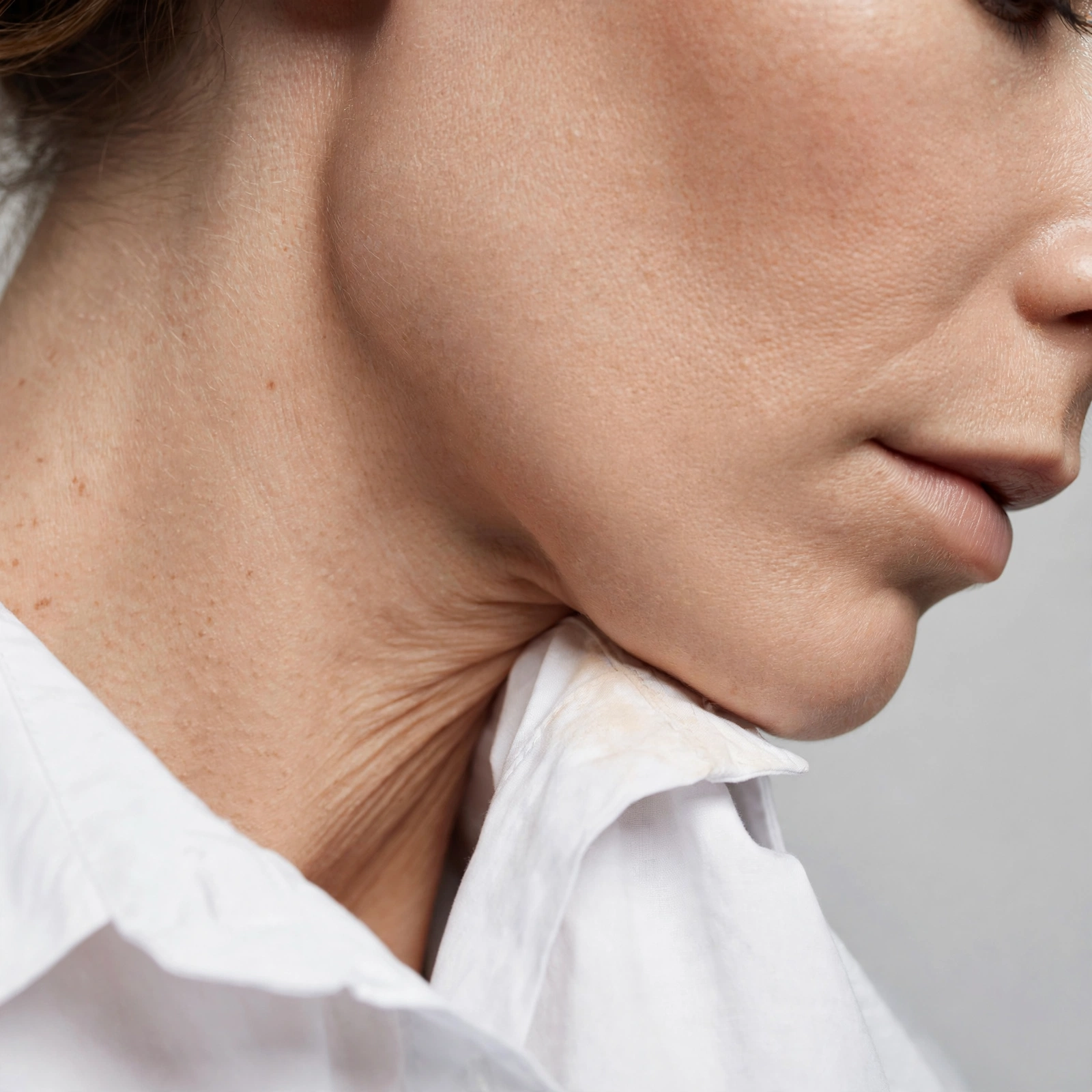
- The jawline against collars and necklines. The classic site. Fabric sits directly against this zone, moves with every turn of your head, and rubs with every tug of a neckline. Turtlenecks, high collars, and scarves multiply the contact.
- Under the chin. Same fabric contact as the jawline, plus warmth and moisture trapped under the chin area, plus the chin resting on hands.
- The nose bridge. Glasses. Constant, low-grade pressure and sliding at exactly one small zone — the most localized transfer pattern there is.
- Around the mouth. Masks, and the constant micro-movement of talking and eating. A mask is a friction chamber: fabric, warmth, moisture, and movement, all day.
- The cheek against the phone. One-sided transfer — marks on the cheek you hold your phone to — is a contact signature so specific it nearly diagnoses itself.
- Hand-touch zones. The chin, the jaw, the side of the nose — wherever your hands rest, pigment leaves with them.
The lesson of the map: localized transfer points to contact mechanics, not whole-face product failure. If the marks are only where your collar sits, you don’t have a foundation problem — you have a collar-contact problem. Rebuilding your entire routine, or mattifying a whole face that was fine, is treating the wrong thing. Fix the zone, or fix the contact — not the face.
The six drivers
The evidence, stated plainly. There is no peer-reviewed study specifically on consumer foundation transfer — on why your foundation ends up on your collar. That study does not appear to exist. The closest technical work is industry-authored: a 2021 technical-book chapter by L’Oréal USA scientists on quantifying foundation color transfer in vitro and in vivo (a book chapter, explicitly not peer-reviewed journal science), plus industry conference material on transfer-resistant formulation. Separately, a 2026 peer-reviewed paper in the International Journal of Cosmetic Science modeled foundation colour shift under sebum conditions — real peer review, but about color change, not transfer. Everything below is labeled for what it is: demonstrated formulation science, manufacturer technical claims, or practical troubleshooting inference. Where the mechanism is plausible rather than proven, it says so.
Driver 1 — Excess product. More product on the skin means more material available to move. That’s the entire claim, and it’s basic physics, not chemistry: a thicker layer has more movable mass at the surface. Note what is not claimed here: the popular idea that heavy application “keeps the film mobile” by some specific mechanism is not established science, so this article won’t assert it. Treat application amount as a test variable — if a thinner layer on one side transfers less, amount was a contributor. That’s an observation, not a mechanism.
Driver 2 — An intentionally emollient or dewy formula. Some foundations are designed to stay flexible and luminous — and a film designed to stay movable will, under contact, move. Finish is a formulation variable with real transfer science behind it. Cosmetic-industry technical literature (Dow Corning silicone scientists, writing in Cosmetics Business) describes how silicone resins of the MQ and T types are used specifically for non-transfer and wash-off resistance, and how the carrier system matters: volatile carriers tend to give better transfer resistance, while non-volatile carriers leave more slipperiness behind. The mechanism, at the qualitative level formulators publish: volatile ingredients evaporate off, and what remains is a more set film; heavier non-volatile oils stay in the film and keep it slippery. So a dewy, emollient finish isn’t a defective long-wear formula — it’s a different design choice, and judging it by long-wear standards is a category error. (Manufacturer-scientist authored technical literature — valuable formulation knowledge, not independent peer-reviewed science.)
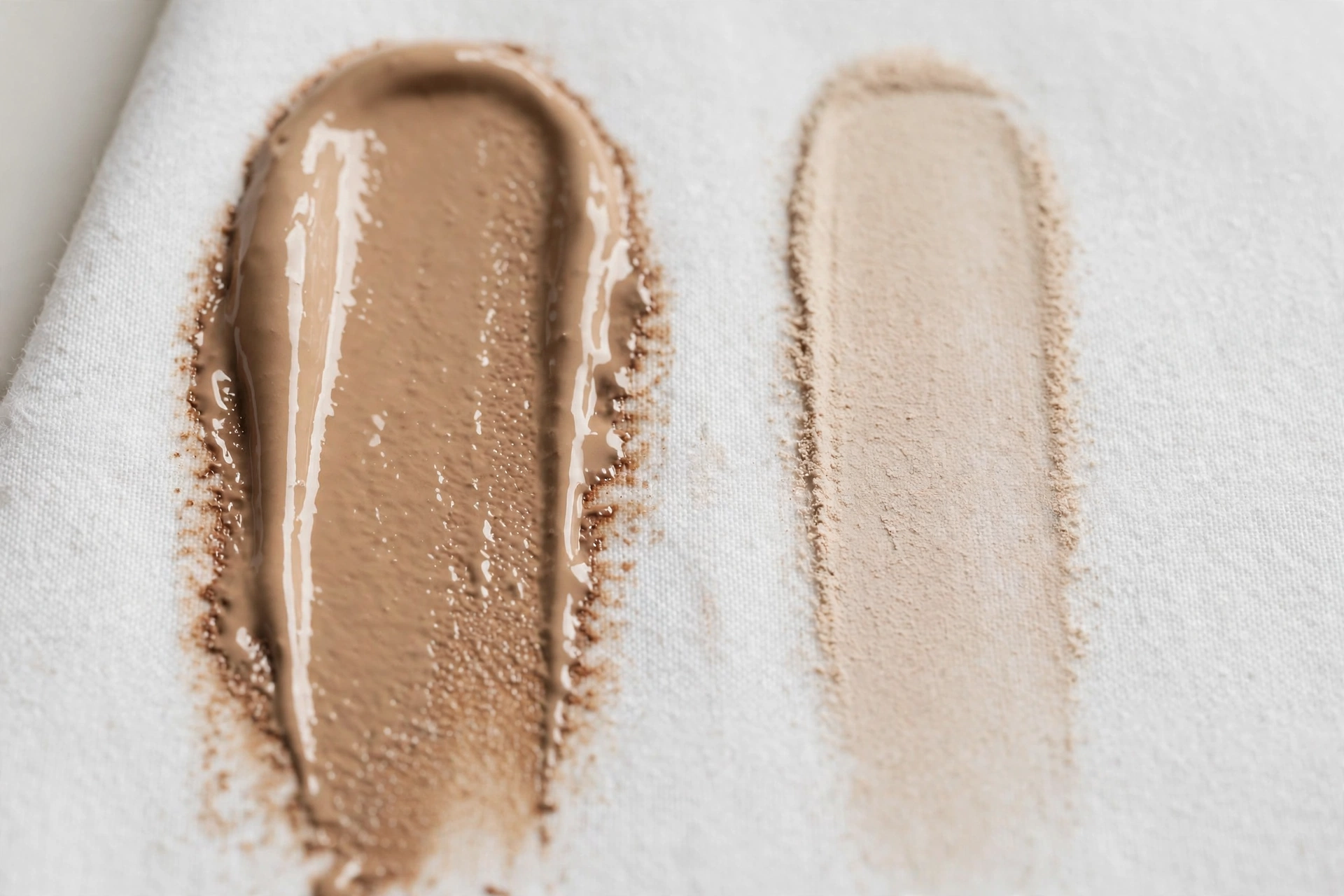
Driver 3 — The film never finished setting before contact. A liquid foundation doesn’t become a film the instant it leaves the tube. Cosmetic physical chemistry describes what happens: after application, volatile components evaporate — one industry technical source notes that after applying a cream or lotion, up to roughly 85% of the water can evaporate — leaving a surface film of the non-volatile ingredients, and a continuous film is described as crucial for makeup products specifically. Contact that arrives during this setting window presses against a film that isn’t a film yet. How long the window lasts varies by formula, amount applied, temperature, and humidity — which is why this article gives you an observation test instead of a timer. Any “wait exactly X minutes” rule you see online is a guess wearing a lab coat; the fabric-touch test in the next section is the honest version. (Industry/technical literature.)
Driver 4 — Sebum entering the film over hours. This is the hours-later story, and it has the most direct technical documentation of any driver here. An Estée Lauder Companies patent application for an oil-controlling cosmetic powder states the mechanism plainly: oil pooling on the skin causes makeup discoloration and “reduced wear and transfer-resistance” — and it defines transfer exactly as this article does, as movement of product “from the facial skin to the collar.” The same document describes oil-absorbing polymers that entrap sebum droplets, which is the formulation industry’s standard answer to this driver. Supporting physiology: a board-certified dermatologist quoted in Live Science notes the T-zone — forehead, nose, chin — carries more sebaceous glands, with sebum output varying by genetics, age, products, and hormones; and a 2021 peer-reviewed facial sebum lipidomics study in Scientific Reports (Nature Portfolio) measured sebum distribution as genuinely uneven, higher in the T-zone than the U-zone. So a transfer pattern that follows your oiliest zones while drier zones stay clean is a sebum signature — and the fix is oil management in those zones, not a new foundation. (Manufacturer technical document — a patent application, not peer-reviewed science; expert guidance on cosmetic physiology; one peer-reviewed lipidomics study on sebum distribution, not on transfer itself.)
Driver 5 — Sweat, moisture, and humidity. Moisture is the film’s enemy from the outside. Sweat mixing into the film, humid air slowing the setting process, a damp collar pressed against the jawline — all keep the film more movable than it would be dry. This driver stacks with the others: a humid day plus an emollient formula plus a high collar is three drivers arriving together, which is why summer transfer feels like a different problem from winter transfer. It partly is.
Driver 6 — The layers underneath. If your transfer is worse on heavy-skincare days, or only appears over one specific primer, moisturizer, or sunscreen, the suspect is sitting under the foundation, not in it. Frame this correctly: it is a practical observation you can test, not established film science — this article will not claim that occlusive skincare “delays film setting” as if that were a demonstrated mechanism. But as a troubleshooting hypothesis it is entirely legitimate: isolate the under-layer (next section), and if the transfer follows the layer, you’ve found a contributor. One absolute rule for all testing in this article: sunscreen is never the variable. Never skip it, never reduce it, never move it for a test. Every protocol here runs over your normal, fully applied sun protection.
The one-variable isolation test
Everything above is a suspect list. This section is how you convict the right suspect — a practical protocol that changes exactly one variable at a time and watches what happens to transfer. It is troubleshooting, not laboratory science: the goal is a confident-enough diagnosis to pick the right change, not publishable data.
The principle. Apply your foundation the same way on both sides of your face (or across one defined zone), change one variable on one side only, wear it through the same day with the same contact, and compare. The variable that changes the transfer is a contributor. The variables that change nothing are cleared.
Pick your single variable. Run one of these at a time — never two:
- Powder, one jawline only. Press a light layer of setting powder into one jawline and leave the other unpowdered. Same foundation, same amount, same day.
- Amount, one side only. Apply your normal layer on one side of the face and a visibly thinner, sheerer layer on the other.
- Under-layer, one side only. Change what sits directly under the foundation on one side — a lighter moisturizer layer, a different primer, or no primer — while the other side keeps your normal routine. Sunscreen stays identical on both sides, always.
Hold everything else constant. Same wear period. Equivalent pressure and contact — wear the same collar, use the phone on the same side, touch your face the same (unhelpful) amount. And observe on the same type of clean material: press the same clean white cloth or tissue against each zone with the same pressure at the same point in the day. This is the fabric-touch observation that replaces the invented “wait X minutes” rule — you are directly watching whether the film is still movable, instead of trusting a timer.
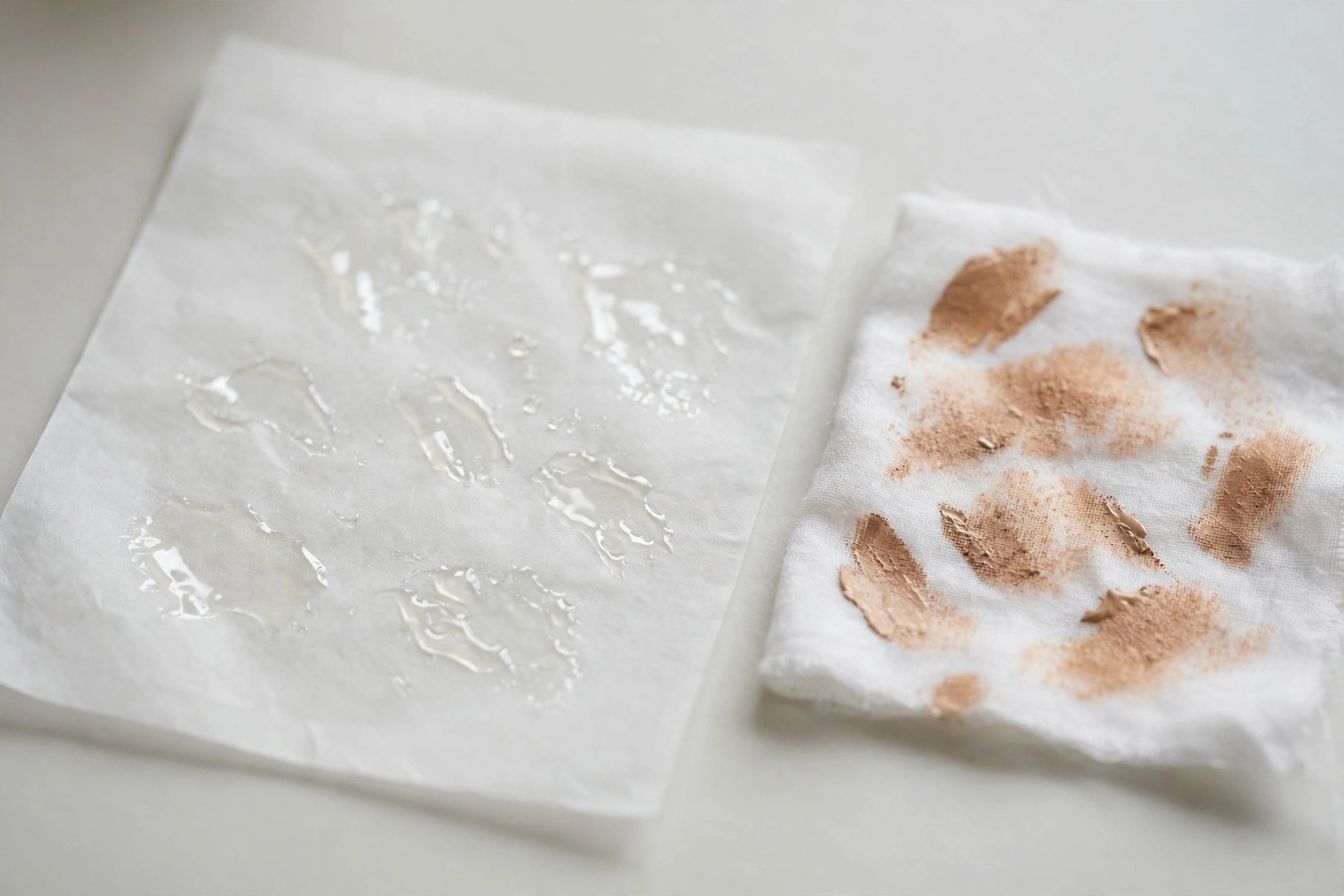
Two separate observations, don’t confuse them. A blotting sheet and a fabric swatch tell you different things:
- A blotting sheet pressed to the skin picks up colorless oil — that’s sebum, and it tells you oil was present in that zone.
- A fabric swatch picks up pigmented foundation — that’s transfer, and it tells you the film was movable at contact.
Oil present without transfer means your film is resisting your sebum fine — the driver is elsewhere. Transfer without much oil means the problem is amount, setting, or formula, not your skin’s oil. Both present together in the same zone is the classic Driver 4 signature. One press of each, in the same zone, at the same time, separates them.
If you’re comparing across days or fabrics, control the comparison. Same fabric type (cotton behaves differently from silk — fabrics are not interchangeable, and no honest test pretends they are), same pressure, same duration of contact, same application amount, same wear time, same face area. A controlled fabric comparison is a tool for isolating variables — it tells you whether this change mattered under these conditions. It is not proof of all-day real-world performance, and it doesn’t need to be. You’re diagnosing your face, not certifying a product.
How to read the results:
- Transfer stops (or drops sharply) on the powdered jawline only → friction-zone contact was the driver; targeted powder is your fix.
- The thinner side transfers less → application amount was a contributor; your normal layer is more than the film can set.
- Transfer follows the changed under-layer → Driver 6 confirmed; simplify what sits under the foundation in contact zones.
- Nothing changes on either side, but transfer builds through the day → the wear story dominates (Drivers 4 and 5); manage oil and moisture, not application.
- Nothing changes and transfer is immediate on both sides → suspect the formula’s finish itself (Driver 2); the film may simply be designed to stay movable.
What to change, based on your diagnosis
No generic tips — a matrix. Find your diagnosis on the left, make the change in the middle, and respect the warning on the right. Each “what not to do” exists because it’s the mistake this diagnosis invites.
| Your diagnosis | Change first | What not to do |
|---|---|---|
| Transfer appears within minutes — collar marked while getting dressed | Let the film set before contact arrives. Get dressed before applying makeup, or keep the neckline pulled away from your face while dressing. Apply a thinner, even layer so there’s less movable material. | Don’t add powder or buy a new foundation yet — you’d be treating a timing problem with a formulation change. Test the timing fix first; it’s free. |
| Transfer only where the collar or neckline touches | Target the friction zone, not the face: press a light layer of powder into the jawline and neck-contact area only. Consider the contact itself — a looser neckline or a scarf barrier on heavy-collar days. | Don’t powder the whole face for a collar problem. Blanket powdering trades one problem for another (see the powder note below). |
| Transfer builds over hours, worst in the T-zone and oiliest areas | Manage oil where it lives: blot midday with blotting sheets, and use targeted powder in the zones your blotting sheet showed oil. This is a sebum signature — treat it as one. | Don’t strip the entire face with every mattifying product you own. Aggressive all-over oil control creates texture and comfort problems without touching the actual contact zones. |
| A dewy or emollient formula transfers everywhere, all day, from day one | Accept what the finish is telling you: the formula is designed to stay flexible, and flexible films move under contact. If the trade-off isn’t worth it, the variable to change is the formula’s finish — particularly in high-contact zones. | Don’t try to force a dewy formula into a long-wear one with heavy powder. You’ll get the worst of both: a matte film that still moves, sitting over a formula fighting it. |
| Transfer only on heavy-skincare days, or only over one specific product | Isolate the under-layer using the one-side test above, then simplify what sits directly under the foundation in contact zones. Fewer, thinner layers under the jawline. | Never skip or reduce sunscreen to test this. Sunscreen is not a variable — change the moisturizer or primer around it, not the protection itself. |
| Transfer only on the phone side, or where your hands rest | This is a contact problem wearing a makeup disguise: speakerphone or earbuds, a conscious effort on face-touching, and light powder on that cheek zone. | Don’t rebuild your routine for a behavior pattern. No formula change fixes a phone pressed to a cheek. |
A note on powder, because it deserves precision. Powder is a variable, not an answer. Pressed lightly into a friction zone, it absorbs surface oil and adds dry material that reduces the film’s mobility at exactly the contact point — a legitimate, targeted fix. But more powder is not more fix: heavy or repeated powdering builds a dry, textured layer that photographs badly and feels worse, and it can make the finish look heavy and cracked. If your powder solution is creating a new texture problem, you’ve crossed into the territory our guide to why foundation looks cakey diagnoses — read that before adding more. The discipline is the same as the isolation test: change one thing, in one zone, and watch.
Pilling or transfer?
These two get confused constantly — and the confusion matters, because they have nothing in common except the word “foundation” and a disappointed person. One-line differential:
- Pilling = the product rolls into crumbs or balls on the skin. The failure is mechanical breakdown of the layers on your face, during or shortly after application. The product stays on your face — it just stops being a film.
- Transfer = the product physically moves from the skin to another surface via contact. Pigment on the collar, the phone, the hands.
The screen is the same one from the top of this article: is there pigment on the other surface? Balls on your face with a clean collar is pilling. A clean face with a marked collar is transfer. Both at once is both — diagnose each separately, because the fixes don’t overlap.
If the product is balling up on your skin rather than moving onto fabric, your problem is layer interaction, not mobility — and the protocol for that is how to isolate which layer is causing it, which walks through the same one-variable discipline applied to the layers underneath.
What the viral hacks actually do
Hairspray on the collar. This one is worth dissecting because it sort of works — just not the way people think. Spraying hairspray on the inside of a collar lays down a barrier on the fabric: a stiff, lacquered surface that foundation pigment has a harder time visibly marking. It protects the fabric. It does nothing to improve the makeup — the film on your face is exactly as movable as it was. And the cost is real: conventional hairsprays contain alcohols and lacquers formulated for hair, not skin. As Glo Skin Beauty expert Amanda Von Dem Hagen put it (via Health Digest), hairspray “has very different active ingredients than those in a makeup setting spray — or anything you would purposely apply to your body,” and its ingredients can irritate skin. The honest framing: a fabric barrier is a fabric solution. It doesn’t fix transfer; it hides one of its symptoms. And routine facial application of conventional hair products is not something this publication will normalize — the skin on your face is not a styling surface. (Expert guidance via consumer-health press — not a dermatology-association position, and not presented as one.)
Setting spray before makeup, or “extra layers of spray.” Setting sprays are not one category, and treating them as one is where the advice goes wrong. Compare what the manufacturers themselves actually claim:
- Urban Decay’s official page for its All Nighter spray describes “Power Set Film Formers” and makes waterproof, transfer-resistant, and sweat-resistant claims for that product. Those are the manufacturer’s claims about its own film-forming formula — attributed, not endorsed as independent science.
- M·A·C’s own site separates its sprays by job: Fix+ is positioned as a hydrating mist (“hydrates, primes, sets, and refreshes”), while Fix+ Stay Over is the makeup-locking one. The manufacturer itself is telling you these are different products for different purposes.
The takeaway: a hydrating or finishing mist is not a transfer solution, no matter how many layers you apply — it was never designed to form a wear-resistant film. Only film-forming long-wear sprays even claim transfer resistance, and those claims belong to the manufacturer. This article will not tell you that “setting spray locks makeup in place” as a universal rule, because the category doesn’t work that way.
FAQ
Why does my foundation transfer to my collar but not anywhere else?
Because transfer follows contact, not the whole face. Your collar presses, rubs, and moves against your jawline all day — no other zone gets that combination of pressure, friction, and duration. Localized transfer is a contact-mechanics signature: fix the zone (targeted powder at the contact line) or the contact (neckline choice, a barrier), not the entire routine.
Is it the foundation or my skin?
It’s the interaction — and your timing and location observations will tell you which side dominates. Transfer within minutes of application points at the film and the application (amount, setting, finish). Transfer that builds over hours, worst in your oiliest zones, points at sebum and sweat meeting the film. Run the one-variable isolation test rather than guessing; the answer is observable.
Will powder stop my foundation from transferring?
It can reduce it — in the right zone, for the right driver. Powder pressed into a friction zone absorbs surface oil and reduces the film’s mobility at the contact point, which directly addresses collar and jawline transfer. But powder is a variable, not a cure: it does little for an unset film in the first minutes, nothing for a formula designed to stay dewy, and heavy all-over powdering creates texture problems of its own. Targeted, not blanket.
Do I need to buy a new foundation?
Usually not first. Most transfer is diagnosed — and fixed — with timing, amount, zone-targeted powder, and oil management, all of which cost nothing. Consider a formula change only when your isolation test points at the finish itself: a dewy, emollient foundation that transfers everywhere, all day, from day one, despite correct application. That’s the finish variable speaking — and even then, you’re changing the finish category, not hunting for a magic product.
Does the hairspray-on-the-collar hack work?
It can reduce visible marks on the fabric, because it puts a barrier on the fabric — but it does nothing to the makeup, which stays exactly as movable. It hides one symptom of transfer rather than fixing it. Conventional hairspray is not formulated for skin: its alcohols and lacquers can irritate, so keep it off your face entirely.
Why does it only happen on my jawline — or only on my phone side?
Asymmetry is diagnostic. Transfer that follows one zone — one jawline, the cheek you hold your phone to, the nose bridge under your glasses — maps to a contact pattern, not a product failure. A whole-face problem would mark everywhere; a one-zone problem tells you exactly where the contact happens. Fix that contact.
Why does my foundation transfer hours later but stay put in the morning?
Because the film set fine and was then re-mobilized. Over hours, sebum mixes into the film (industry technical documentation describes oil pooling as reducing “wear and transfer-resistance”), sweat and humidity disrupt it, and repeated friction breaks it down at contact points. Morning-clean, evening-marked is the classic wear story — manage oil and moisture in the zones your blotting sheet flags, rather than changing how you apply in the morning.
Will a setting spray stop transfer?
Only the film-forming kind even claims to. Manufacturers distinguish hydrating and finishing mists, which refresh and add glow, from long-wear locking sprays, which claim film-forming, transfer-resistant wear. A hydrating mist, however many layers, was never designed to form a wear-resistant film. Match the product category to the job, and treat manufacturer claims as manufacturer claims.
Sources
Evidence tiers are labeled deliberately — they are part of the article’s honesty, not decoration.
- Toufique Choudhury, Ph.D., “The Physical Chemistry of Cosmetic Formulation,” HAPPI. After applying creams and lotions, up to roughly 85% of the water evaporates, leaving a surface film of the non-volatile ingredients; a continuous film is described as crucial for makeup products. Read it.
- Cosmetics Business, “Silicone Smooth Operators” (Dow Corning silicone scientists). Silicone resins of the MQ and T types are used for non-transfer and wash-off resistance; volatile carriers tend to give better transfer resistance, while non-volatile carriers leave more slipperiness. Read it.
- WIPO patent application WO2016061109A1, “Oil-controlling cosmetic powder” (Estée Lauder Companies). States that oil pooling causes makeup discoloration and “reduced wear and transfer-resistance”; defines transfer as movement of product from the facial skin to the collar; describes oil-absorbing polymers that entrap sebum droplets. Read it. (Manufacturer technical document — a patent application, NOT peer-reviewed science.)
- Urban Decay, All Nighter Long Lasting Makeup Setting Spray (official product page). Describes “Power Set Film Formers” and makes waterproof, transfer-resistant, and sweat-resistant claims for the product. Read it. (Manufacturer claims — attributed, not independently verified.)
- M·A·C, makeup setting sprays (official page). The manufacturer itself separates Fix+ — positioned as a hydrating mist (“hydrates, primes, sets, and refreshes”) — from Fix+ Stay Over, positioned for makeup locking. Read it. (Manufacturer positioning — attributed.)
- Health Digest, quoting Glo Skin Beauty expert Amanda Von Dem Hagen (originally to Glamour). Hairspray contains alcohols and lacquers that can irritate skin; hairspray “has very different active ingredients than those in a makeup setting spray — or anything you would purposely apply to your body.” Read it. (Expert guidance via consumer-health press — NOT a dermatology-association position.)
- Live Science, quoting board-certified dermatologist Dr. Gregory Papadeas. The T-zone (forehead, nose, chin) carries more sebaceous glands; sebum output varies with genetics, age, products, and hormones. Read it. (Expert guidance; cosmetic physiology only.)
- Scientific Reports (Nature Portfolio), 2021 — facial sebum lipidomics study. Measured sebum distribution as uneven across the face, higher in the T-zone than the U-zone. Read it. (Peer-reviewed — on sebum distribution, not on transfer.)
- Scrivener Publishing/Wiley, Surface Science and Adhesion in Cosmetics (2021), Chapter 12 — Joseph V. Badami and Hy Si Bui (L’Oréal USA), “Quantification of the Color Transfer from Long-Wear Face Foundation Products: The Relevance of Wettability.” Reports in-vitro and in-vivo foundation-transfer experiments. Publisher page. (Industry-authored technical book chapter — explicitly NOT peer-reviewed journal science.)
- Li et al., International Journal of Cosmetic Science, 2026. Peer-reviewed in-vitro model of foundation colour shift under sebum conditions. Read it. (Peer-reviewed; related mechanism — cited only to bound the evidence honestly, NOT as transfer evidence.)
The limitation, restated. No peer-reviewed study on consumer foundation transfer specifically was found during research for this article. The closest technical work is industry-authored (sources 2, 3, and 9 above); the closest peer-reviewed work addresses adjacent mechanisms — sebum distribution (source 8) and colour shift under sebum (source 10) — not transfer itself. Where this article describes formulation mechanisms, it does so at the qualitative level the cited sources support, and where the evidence is thin, the text says so.
1 thought on “Why Does My Foundation Transfer? How to Find — and Fix — What’s Really Moving It”
Comments are closed.