The short answer
Mascara smudges when something gets between the product’s dried film and your lashes, or between your lashes and your skin. Only six things do that: wet product transferring before it dries, oil and sebum softening the film, friction (blinking, lashes brushing skin), tears, heat and humidity, and too much product on the lashes. Most smudging is a combination of two or three — which is why switching mascaras at random so often changes nothing.
Two facts speed the diagnosis. Where the smudge lands is a clue: a black line mirroring your lash line on the upper lid usually means friction; dots and streaks under the lower lashes usually mean oil plus lashes touching skin. And when it appears matters more than any review: smudging within minutes is a wet-product problem; a clean morning followed by a midday “panda eye” is almost always oil and contact working together.
And the preview that matters most: waterproof does not mean transfer-proof. Waterproof formulas are engineered to resist water — and oil is exactly what dissolves a hydrophobic film. If you’ve already tried waterproof and it still smudged, that isn’t a defective product. It’s a diagnostic signal pointing at oil or friction, not water — and switching formulas without that knowledge is just guessing in a nicer tube.
The framework here is WHERE × WHEN × WHAT: where the smudge appears, when it appears, and which mechanism the first two point to. Run it before you change anything — the most common response to smudging, buying a new mascara, routinely fixes the wrong problem.
Where it smudges is your first clue
Look in a mirror at the actual mark, not at the general area. The pattern usually survives the whole day even when the cause doesn’t announce itself.
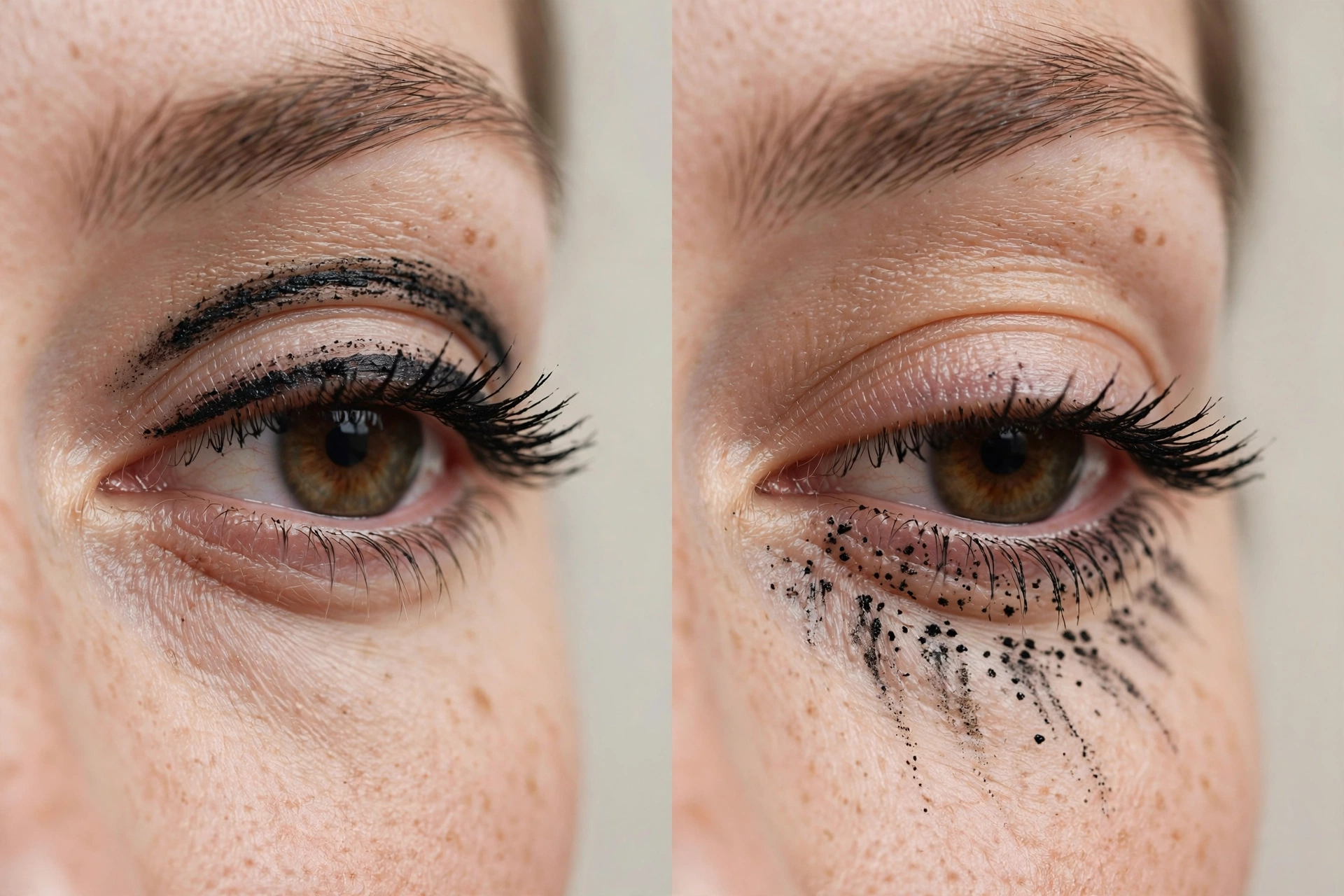
Upper-lid transfer
What it looks like: A dark line, band, or series of stamps on the upper eyelid above the lash line — often mirroring the curve of your lashes. Sometimes it shows up as small dots where the tips of individual lashes have pressed against the lid. It tends to sit higher on the lid, not at the lash roots.
What it tells you: Something pressed your coated lashes against the lid, or the lid moved across your lashes — a contact-and-friction pattern. Blinking is the usual mover: the upper lid folds and meets the lashes thousands of times a day, and smudging happens “precisely when the skin folds and creates contact.” Hooded or deep-set eyes concentrate this contact because the lid rests against the lash line more. Wet product during application also leaves this pattern — looking down while upper lashes are still wet stamps the lid.
What it rules out: It doesn’t rule anything out on its own, but heavy upper-lid transfer with no lower-eye smudging makes oil from the lower lid margin and watering less likely as the main driver — those two mostly work downward.
Lower-eye smudging
What it looks like: Dark dots, short streaks, or a general smoky haze below the lower lashes — the “panda eye” or “raccoon eye” that appears by midday. Sometimes it’s a soft grey veil; sometimes it’s distinct little prints of lash tips.
What it tells you: This is where lashes meet skin most often and where the film is most vulnerable. The lower lash line sits at the lid margin, where the meibomian glands release the eye’s own lipid oil into the tear film with every blink — an oily environment by normal physiology. Makeup artists consistently name oil here as the leading cause of under-eye transfer. Lower lashes also carry more risk per coat: they’re shorter and sit closer to skin, so they touch it sooner and more often.
What it rules out: Smudging that’s only under the eyes and never on the upper lid points away from wet-product transfer during application (that would usually mark both) and toward oil plus lash-skin contact over hours.
Lash-line and root smudging
What it looks like: The product seems to melt or bleed right at the roots of the lashes, spreading into the lash line itself or softening into a blurred halo where definition used to be. The lashes look intact at the tips but the base has turned indistinct.
What it tells you: This is the film breaking down at its anchor point — where the product grips the lash. The usual suspects are oil arriving from the skin or lid margin, heat softening the film, or mascara applied to lashes that weren’t fully clean and dry. The root is where the film is thickest and skin contact is constant, so failure here looks blurry rather than stamped — it spreads instead of transferring.
What it rules out: If the roots are intact and only the tips are leaving marks, the film itself is probably fine; the problem is mechanical (lashes touching skin) rather than chemical (film dissolving).
The thread: the upper lid tells you about friction, the lower eye about oil and contact, the roots about film breakdown. None is proof yet — but each narrows the field before you’ve changed a single thing.
When it appears: the timing router
Timing is the fastest way to narrow the field. Most readers can place themselves in one row just by remembering when the smudge shows up — but timing alone doesn’t prove a mechanism, so each row names what it rules in and what it rules out.
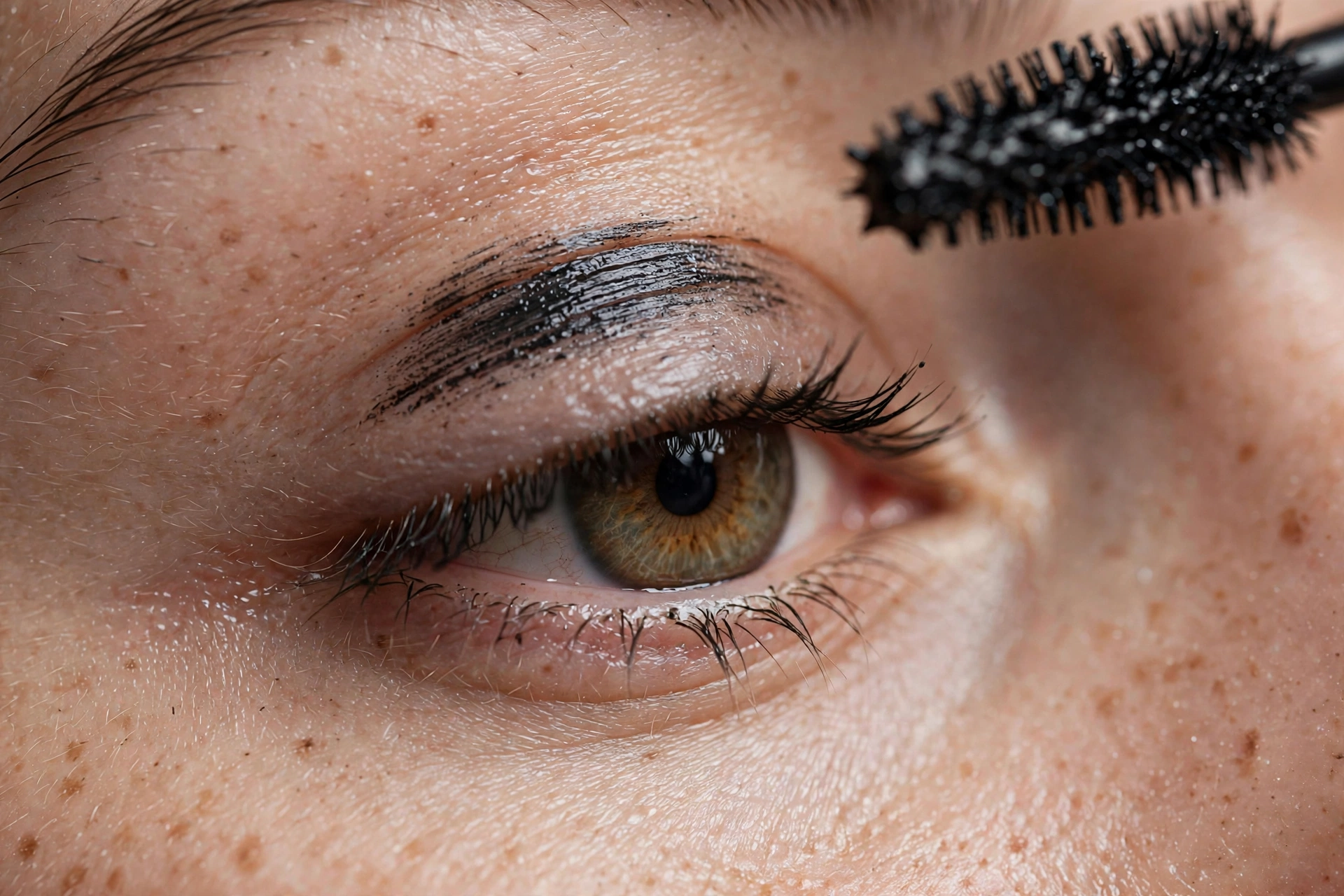
Smudges during application or within the first minutes
Investigate wet transfer and product load. If the mark appears before you’ve finished your face, it wasn’t put there by wear — wet product met skin. The classic triggers: looking down right after applying, blinking hard while the film is wet, or too much product waiting to dry. Go to Mechanism A and Mechanism F, and note the quick tests there before changing anything else.
What this rules out: oil and sebum — natural oil takes time to reach and soften the film; it doesn’t stamp within minutes on a clean face.
Looks perfect in the morning, smudges by midday or afternoon
Investigate oil plus friction — the most common pattern, and the most frustrating, because the application was flawless. Over hours, the eye area’s own oil migrates into the film and softens it, while thousands of blinks transfer the softened film onto skin: the standard midday failure. Go to Mechanisms B and C.
What this rules out: wet transfer — hours of clean wear means the product dried properly.
Only smudges (or smudges much worse) on hot, humid, or sweaty days
Investigate film failure under heat and humidity. Mascara films are wax- and polymer-based; heat softens waxes and humidity interferes with the dried film. If a mascara that behaves in air conditioning fails on a warm day, the film is the variable. Go to Mechanism E.
What this doesn’t rule out: oil — heat also increases sebum flow, so hot-day smudging is often heat and oil together. The tell is the day-to-day consistency: reliable except when warm means film failure is at least one cause.
Smudges right after watering, tearing, yawning, or allergy-driven eye watering
Investigate water plus rubbing — the only row where water itself is the primary suspect, and the one row where “waterproof” is genuinely the right answer. Tears break down water-based films and carry pigment as they travel; the instinctive wipe does the rest. If smudging tracks your watery days and not your calm days, go to Mechanism D.
What this rules out: oil as the primary cause — oil-driven smudging is sudden and event-linked; water-driven is sudden and follows the tear track.
One persistent watering or irritation note, stated once because this is a cosmetic guide, not medical advice: if your eyes water or feel irritated often — not just during the obvious sad-film or allergy moment — that’s a health question for a clinician, not a mascara question.
The router doesn’t assign mechanisms with false confidence: “smudges by midday” is strong evidence about oil and friction, not proof. The differential and the isolation test convert evidence into a diagnosis.
The six mechanisms, and how to tell them apart
Each mechanism below has the same five parts so you can compare honestly: what it looks like, when it appears, a quick test, what to change first, and what NOT to change yet — because fixing the wrong thing first is how people spend six months and four tubes.
A. Wet-product transfer
What it looks like: Fresh, sharp marks — a stamp of the lash line on the upper lid, dots on the lower lashes’ neighbors, sometimes a full transfer print if you looked down while the product was wet. The smudge looks wet even after it dries: dark, defined, and clearly shaped like your lashes.
When it appears: During application or within the first 10–15 minutes. Never appears hours later on its own.
Quick test: Apply one eye’s mascara, then deliberately keep your eyes open and still for two full minutes — no blinking hard, no looking down, no pressing your lids. If the marks vanish, the old marks were wet-transfer events, not wear failures.
What to change first: Slow down. Keep your gaze level or slightly up while the upper lashes dry, shield the skin behind the lower lashes (even a tissue works), and let each coat dry before the next — makeup artists cite “thin layers, fully dried between coats” as standard practice, partly because thin coats set faster. Also consider whether the formula itself stays wet unusually long; that widens this window.
What NOT to change yet: Your skincare, your mascara type, or your routine. Wet transfer is an application event — it says nothing about the film’s wear behavior or your oil levels. Changing products over a wet-transfer problem is the most common wasted fix in this subject.
B. Oil and sebum breaking down the film
What it looks like: Gradual softening — the morning’s crisp lashes turn slightly blurry by afternoon, then grey-black dots and streaks appear under the lower lashes, sometimes a mirrored line on the upper lid. The smudge looks diffuse rather than stamped. Often both eyes show it, though usually one side is worse.
When it appears: Hours after application. The classic pattern is “fine at 9, smudged at 2.”
Quick test: This is where the one-variable isolation test earns its place (full protocol in Section 7): on one morning, skip every eye-area product — no eye cream, no facial oil near the eyes, nothing on the lids — on ONE eye only. Keep the other eye’s routine identical. If the product-free eye stays clean and the normal eye smudges, you’ve isolated the skincare contribution. If both smudge, the oil is more likely your skin’s own, not something you applied.
What to change first: Get skincare off the lashes. Makeup artists are specific: eye cream belongs along the orbital bone, not on the lashes or near the lash line, because the cream’s oils migrate with skin heat and break the film down over hours — one professional director describes that mixture as what “affects the formula” into bleeds and smudges. Lighter, fast-absorbing products and a few minutes of absorption time before mascara are the low-cost version. A light dusting of powder under the eyes can absorb migrating oil, though it manages the oil rather than stopping it.
What NOT to change yet: Your mascara’s waterproofness. The trap: oil is not water. A hydrophobic waterproof film is dissolved by oil — “like dissolves like” — so a stronger waterproof formula can change nothing while making removal harsher. Read Section 5 before spending anything.
One fairness note: the lid margin always carries some oil. The meibomian glands — large sebaceous glands built into the eyelids — secrete lipid oil at the lid margin that forms the tear film’s protective outer layer, and blinking squeezes more of it out. Some of that oil reaching the film is normal anatomy, not a skin defect; oilier lids are simply a more active version of a normal system.
C. Friction and contact — blinking, lashes touching skin, hooded lids
What it looks like: Transfer patterns that match contact, not breakdown — the lash line mirrored on the upper lid, dots exactly where lash tips rest, smudging concentrated where the lid folds against the lashes. The film on the lashes may look perfectly intact; the problem is that the lashes went somewhere.
When it appears: Anytime, but it accumulates — worse on days with heavy blinking (screens, wind, bright light), worse in the evening than the morning, and worse on the eye whose lid meets the lashes more.
Quick test: Two parts. First, compare eyes: one side consistently worse, with identical application, points at anatomy — one eye slightly more hooded, one set of lashes slightly longer — rather than product. Second, try a day with curled lashes: a curler lifts lashes up and away from skin. If curling meaningfully reduces the smudge, contact was the driver. (This is also why artists cite curling as an anti-smudge step: it changes lash geometry, not film chemistry.)
What to change first: Reduce contact. Curl before mascara, keep lower-lash load light (a spoolie run through after application removes the excess that transfers first), and consider leaving lower lashes bare — they cause a disproportionate share of contact smudging. For deep-set or hooded eyes, where contact is unavoidable, the film choice matters more — but it still has to match the cause (Section 6).
What NOT to change yet: Your skincare routine — friction smudging happens on dry lids too. And don’t assume a new formula fixes geometry: a heavier, wetter formula can make contact smudging worse by adding more mobile product to the lash tips.
D. Watering and tearing
What it looks like: Sudden, track-like streaks that follow the path of tears — downward from the inner corner, often one-sided, often appearing right after the watering event. The smudge looks washed rather than blurred: pigment carried and redeposited, sometimes with a clean-ish channel where the tear ran.
When it appears: Immediately after watering, tearing, yawning, wind, or an allergy flare. Correlates with watery days, not with the clock.
Quick test: Note for a few days: does smudging track your watery-eye days and skip the dry ones? If yes, water is the driver. If it shows up on calm days too, water is at most a contributor.
What to change first: This is the one mechanism where water resistance is genuinely the answer. Waterproof films survive full immersion; regular water-based films don’t — water re-enters the dried film and lifts it off, which is why ordinary mascara runs in tears. If water is your driver, a waterproof or tubing film addresses the actual cause. And dab, don’t drag, when cleaning up — dragging wet pigment just redistributes it.
What NOT to change yet: Your oil-control routine — water-driven smudging is sudden and event-linked; powders and primers won’t touch it. And tears breaking this mascara doesn’t make it “bad”: any water-based film fails this test by design.
E. Heat and humidity
What it looks like: A general softening of the whole eye area on warm days — lashes lose definition, product migrates in all directions, smudging appears everywhere rather than in one pattern. The film may look slightly melty or greasy, and the failure is noticeably worse than the same routine in cool air.
When it appears: On hot days, in humid weather, after exercise, or in warm kitchens — anywhere heat and moisture combine. The day-to-day comparison is the evidence: same routine, different weather, different outcome.
Quick test: The weather is the test. If a mascara behaves reliably for weeks and then fails on the first hot day, the film failed under heat — the film’s waxes softened, humidity interfered with the dried film, or both. If it fails in air conditioning too, heat is not your mechanism.
What to change first: Think film stability: waterproof films are the most heat- and moisture-stable of the three types, which is why artists working through humidity reach for them. Keep application thin on hot days — thin films set faster and carry less mobile material — and give the product its full drying time before facing the heat.
What NOT to change yet: Don’t rewrite your routine around one hot week — seasonal variation is normal, and the fix can be seasonal too. Just don’t confuse heat failure with oil failure on hot days: heat increases sebum flow and softens films, so both often fire together. The cool-day comparison isolates them: if it never smudges in cool air, heat is doing real work.
F. Too much product / application load
What it looks like: Heavy, clumpy lashes that smudge in any pattern — upper, lower, roots — and often flake as well as smudge. The smudge marks are chunky and dark. Switching mascaras sometimes “fixes” it for a while, which misleads people into blaming formulas.
When it appears: Anytime — but it’s the hidden multiplier behind the other five. Overloaded lashes take longer to dry (feeding Mechanism A), carry more mobile material at the tips (feeding Mechanism C), present more film surface for oil to attack (feeding Mechanism B), and stress the film into flaking.
Quick test: Apply one eye with a single thin coat, the other with your normal amount — everything else identical. If the thin-coat eye behaves dramatically better, load was the driver, whatever else is also present.
What to change first: Lighten the load. Wipe excess off the wand before it touches your lashes. Apply in thin coats, letting each dry fully before the next — two thin coats routinely outperform one heavy coat, because thin films set faster and carry less transferable material. On lower lashes use only what’s left on the wand tip: they need little product to read as defined, and excess there is the highest-risk product on the whole eye.
What NOT to change yet: The mascara itself. Heavy application makes any film type smudge, so a new tube changes nothing. The tell: smudging improved on mornings you rushed and applied less. If hurried, light applications outperform careful, heavy ones, the variable is amount, not chemistry.
One honest synthesis: these mechanisms are rarely alone. A typical midday smudge is B + C (oil softens, blinking transfers); a hot-day failure is E + B; a bad morning is often F + A. The differential exists so you can name your dominant mechanism and fix that first — not to pretend the others aren’t there.
Why waterproof mascara can still smudge
This is the section most guides get wrong, and it’s the one that costs readers the most money — because “tried waterproof, still smudges” is the most common reason people buy a third mascara.
Waterproof is a claim about water. A waterproof mascara builds a hydrophobic film — pigments and waxes suspended in a volatile, non-water carrier rather than in water, with film-forming polymers, silicones, and waxes left behind as a water-repelling layer once the carrier evaporates. Water can’t wet it, dissolve it, or carry it away. That is the entire promise, and it works.
But smudging is rarely a water problem. The governing rule is “like dissolves like”: the waterproof film is non-polar, which is precisely why water (polar) can’t touch it — and why oil and sebum (also non-polar) can. An oil-based remover takes waterproof mascara off for the same reason. Your skin’s sebum, the lipid oil your lid margin releases with every blink, and the oils in eye creams all do the same job more slowly, over hours.
So the honest statement is this:
- Water resistance ≠ oil/sebum resistance. The film is engineered against water, not against oil.
- Water resistance ≠ friction resistance. No film chemistry stops lashes from physically touching skin thousands of times a day.
So “I tried waterproof and it still smudges” is not a product failure. It’s a diagnostic signal: it rules water out and points at oil/sebum (Mechanism B) or friction/contact (Mechanism C) — the two things waterproofing was never designed to solve. The next investigation is your eye-area skincare and lash-skin contact, not a stronger formula. Buying a “more waterproof” mascara to defeat an oil problem is like buying a warmer coat to fix a leak.
One related honesty: a dense waterproof film does resist casual oil contact better than a fragile water-based one — but that’s a difference of degree, not kind. Given enough oil and time, the hydrophobic film softens, because the chemistry that makes it ignore water is the same chemistry that makes it vulnerable to oil. The film type tells you which failure mode to expect, not which are impossible.
Regular vs waterproof vs tubing: what the film actually is
This section is about mechanism only — what each film type is, and what failure mode each one points you toward. It names no products and recommends none; the film type is a diagnostic tool, not a shopping list.
Regular (water-based) mascara. The most common type: pigments, waxes, and polymers suspended in water. The water evaporates and leaves the solids behind — but because the film was carried by water, water can get back in and lift it off again. That’s why ordinary mascara comes off in the shower and runs in tears. It’s also the most mobile of the three: it softens most readily under oil, heat, and friction. If regular smudges where waterproof or tubing doesn’t, your conditions were too much for a water-carried film. If all three smudge, the cause is probably load or contact, not chemistry — you’ve changed the chemistry twice already.
Waterproof mascara. The hydrophobic film described above: pigment, wax, and polymer in a volatile non-water carrier that flashes off, leaving a water-repelling layer wrapped around each lash. Strong against water — tears, sweat, rain, swimming. Vulnerable to oil and sebum (like dissolves like), to friction, and to heat softening the wax component. Removal is chemical, not mechanical: oil dissolves the film, which is why aggressive rubbing is unnecessary and damages lashes. The diagnostic read: if waterproof fixes your smudging, water or humidity was the driver. If not, you’re looking at oil or contact.
Tubing mascara. A different construction: film-forming polymers (acrylate copolymers, per cosmetic chemists) wrap each lash in a tiny tube that sets around the hair. No wax-oil structure, so they resist water well — and because pigment is encapsulated inside the polymer rather than sitting in a mobile film, they resist flaking and everyday transfer better than wax-based formulas. The defining property is removal: the polymers are water-sensitive, so warm water plus gentle pressure swells the tube and it slides off intact. The diagnostic read: tubing fails under sustained oil exposure, hard rubbing, and heat, and can shed whole tubes if disturbed. If tubing fixes your smudging where regular and waterproof failed, your driver was probably flaking or film mobility. If tubing smudges too, friction and load are the remaining suspects.
The point of this section in one line: the film type tells you which failure mode to expect, and the failure tells you which mechanism is actually running. Match them, and the mascara stops being a guess.
The one-variable isolation test
Everything so far has been inference — educated, structured, but inference. This is the part that turns it into evidence. It takes one morning, costs nothing, and it’s practical, not a lab experiment.
The setup. Pick a morning when you’ll wear your normal routine and be out for at least six hours. Apply your mascara exactly as usual on both eyes — same tube, same number of coats, same technique.
The one change. On ONE eye only, skip every eye-area product: no eye cream, no eye serum, no facial oil anywhere near that eye, nothing on the lids. On the other eye, apply your skincare exactly as normal. Everything else — foundation, concealer, powder — stays identical on both sides. Let any skincare you do apply absorb for several minutes before mascara.
What to observe. Check both eyes mid-morning (3–4 hours in) and late afternoon. Note per eye: smudging under the lower lashes? transfer on the upper lid? and — this matters — is there a difference between the two eyes?
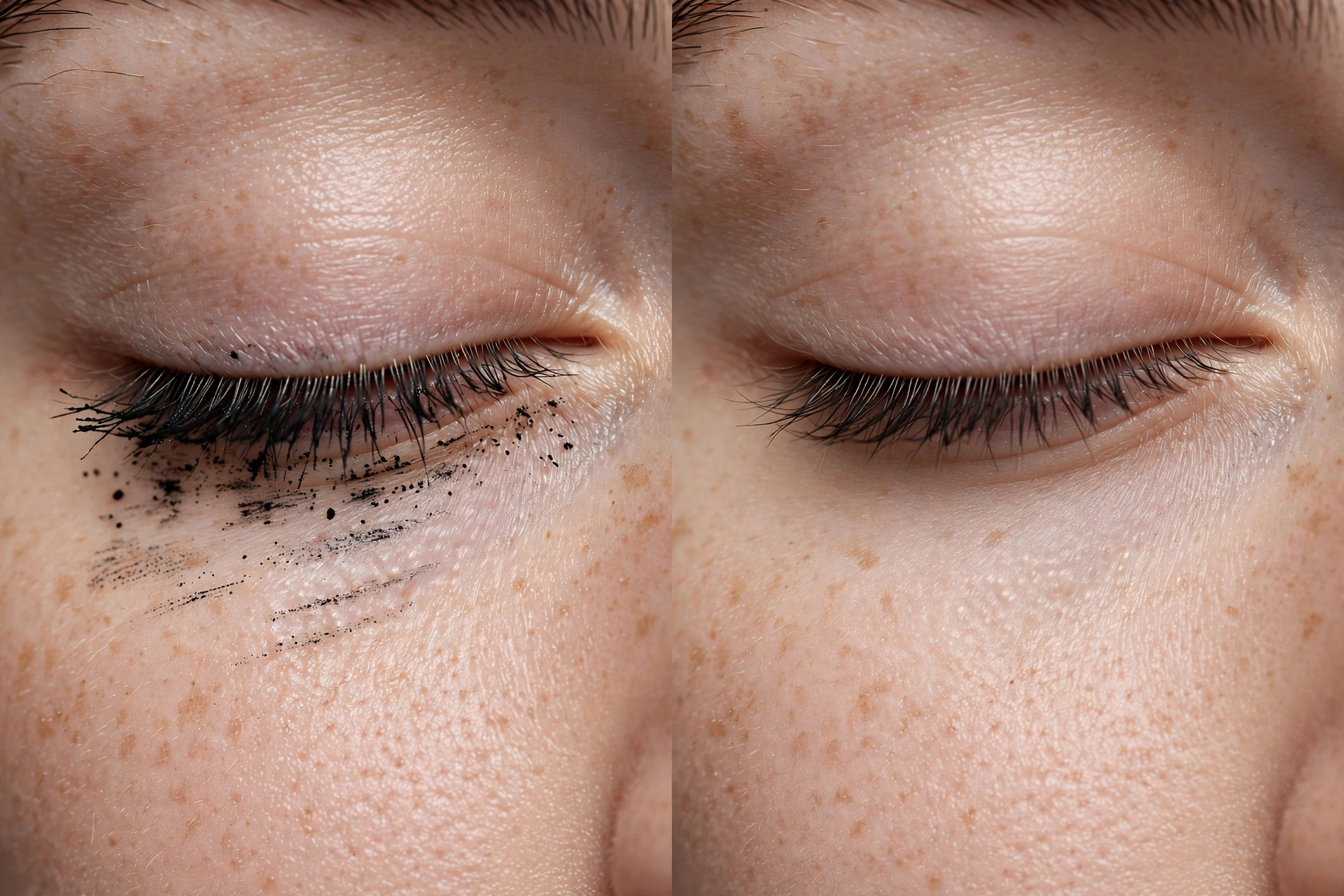
What each outcome proves:
- The product-free eye stays clean; the normal eye smudges. Your skincare is a major contributor — oil from the eye-area products is reaching the film. The fix is placement and weight: keep eye cream on the orbital bone and off the lashes and lash line, use lighter fast-absorbing products, and give them absorption time before mascara. You do not need a new mascara.
- Both eyes smudge equally. Skincare is not the main driver. Your cause is your skin’s own oil, friction/contact, load, or a water event — go back to the differential (Mechanisms B, C, F) and the timing router. The most likely next test is the load test: one thin coat on one eye, your normal amount on the other.
- Neither eye smudges. Congratulations — and information. Either your normal routine was already fine and the smudging days are situational (heat, watering, a heavier product day), or you changed more than one variable without noticing. Repeat on a day you expect smudging, changing only the one thing.
- The product-free eye smudges but the normal eye doesn’t. Rare, but real — sometimes a moisturized lid surface grips film better than a dry one, or the “normal” eye got less product by accident. Don’t over-interpret a single run; repeat it before concluding anything.
The rule behind the test is the same one that runs the whole guide: change one thing at a time, and let the two sides of your face be the control group. Your eyes are as close to a matched pair as an experiment ever gets.
What to change, per diagnosis
| What you see | When | Likely mechanism | Quick test | Change first | Don’t do yet |
|---|---|---|---|---|---|
| Sharp stamps/dots on the upper lid | During/within minutes of application | A — wet transfer | Keep eyes open and still 2 min after applying one eye | Slower application; thin coats; let each coat dry | New mascara or skincare changes |
| Grey dots/streaks under lower lashes | Midday, after clean mornings | B — oil breaking down the film | One-eye skincare skip (Section 7) | Eye cream on orbital bone only; lighter, fast-absorbing products; absorption time | Stronger waterproof mascara |
| Lash-line mirrored on the upper lid | Accumulates through the day | C — friction/contact | Curl one day; compare eyes for asymmetry | Curl lashes; spoolie off excess; light lower-lash load | Skincare overhaul |
| Streaks following tear tracks | Right after watering/tearing | D — water + rubbing | Track smudging vs. watery days | Waterproof or tubing film; dab, don’t drag | Oil-control routine |
| Whole eye area softens and migrates | Hot/humid days only | E — heat/humidity film failure | Cool-day comparison | Most stable film type; thin application on hot days | Seasonal routine rewrite |
| Chunky dark marks, any pattern; rushed light applications look better | Anytime | F — too much product | One thin coat on one eye vs. normal on the other | Wipe wand; thin coats; dry between coats; wand-tip only for lower lashes | New mascara — load defeats every film type |
Smudge vs. other dark marks under the eyes
Not every dark mark under the eyes is a smudge, and misidentifying the mark sends the fix in the wrong direction. Three things get confused most often:
Smudge is what this guide diagnoses: dark pigment that transferred from the lashes to the skin — dots, streaks, mirrored lines, or a grey haze that wasn’t there at application and arrived during wear. It follows one of the six mechanisms above.
Beige or tan product collecting in folds is not smudge — it’s concealer settling into under-eye lines. It looks like the concealer itself gathering, usually in the skin’s natural color rather than black or grey, and it sits in the folds rather than below the lashes. The fix is completely different (amount, placement, film flexibility — not oil control), which is why the two problems have separate guides. If this is what you’re seeing, the diagnostic question to ask is why concealer creases under eyes — that guide’s WHERE × WHEN × WHAT framework works the same way this one does.
Dry flakes are not smudge either: small, crisp specks of a dried film breaking off the lashes — often landing on the cheeks rather than hugging the lash line. Flaking points at an old or dried-out tube, an overly rigid film, or overloaded lashes — not at oil or friction. If your marks are flaky rather than smeary, check the tube’s age before anything else in this guide.
FAQ
Why does my mascara smudge even when I don’t touch my face?
Because touching your face was never required. Three forces work without your hands: your skin’s oil and the lipid oil from your lid margin soften the film over hours; blinking moves your lids across your lashes thousands of times a day, transferring what the oil loosened; and lashes simply rest against skin, especially lower lashes. This is the standard no-touch smudge: oils appear above and below the eyelids, the film’s structure breaks down, and transfer begins on its own. If you never touch your face and still smudge by midday, Mechanisms B and C together are almost certainly the answer — and the isolation test will show how much is skincare versus your skin’s own oil.
Why does my waterproof mascara still smudge?
Because waterproofing resists water, not what’s actually causing your smudge. A waterproof film is hydrophobic — it ignores water — but oil and sebum dissolve it (“like dissolves like”), and no film stops lashes from touching skin. If a waterproof film smudged on you, that’s diagnostic information, not product failure: water is ruled out; your cause is oil/sebum (B) or friction/contact (C). The fix is skincare placement and lash-skin contact, not a stronger formula. The exception: if tears are your trigger, waterproof is genuinely the right film — and one that still fails in tears may simply be past its prime.
Does tubing mascara smudge, or is it really smudge-proof?
Tubing is strongly smudge-resistant but not smudge-proof — nothing is. The mechanism is genuinely different: film-forming polymers wrap each lash in a tiny tube instead of painting on a wax-based film, so there’s less mobile pigment to transfer and the encapsulated color resists flaking and water. Removal is the famous part — warm water and gentle pressure slide the tubes off intact. But the polymers can still fail under sustained oil, hard rubbing, and heat, and a disturbed tube can shed. Diagnostically: if tubing fixes your smudging where regular and waterproof failed, your driver was probably film mobility or flaking. If tubing smudges too, the remaining suspects are friction, contact, and load.
Why does mascara transfer to my upper eyelid?
Because your upper lid meets your lashes — by blinking, by anatomy, or by wet product. Every blink folds the lid across the lash line, and skin touching a coated lash exchanges pigment. Hooded or deep-set eyes concentrate the contact, and some people blink harder than others. Wet product is the fast version: looking down while upper lashes are still wet stamps the lid. The separation: transfer within minutes means wet product (A) — keep your gaze level while it dries. A line mirroring the lashes that builds through the day means blink contact (C) — curl to reduce contact and spoolie off the excess that transfers first.
Will eye cream make my mascara smudge?
It can — and it’s one of the most commonly missed causes, precisely because the cream felt absorbed hours ago. The mechanism, described by a professional makeup artist director: moisture and oils from eye cream mix with skin heat and natural oils, and that mixture travels toward the mascara and breaks the film down over hours. The standard guidance is placement-based: eye cream belongs along the orbital bone, not on the lashes or near the lash line, in small amounts with absorption time before mascara. Honest tiering: this is professional and editorial practice, not clinical proof — but it’s consistent across independent makeup artists, and the one-eye isolation test lets you verify it on your own face in a single morning.
Does old mascara smudge more easily?
Usually, yes — through two routes. First, the formula degrades: air exposure dries it out, the film becomes brittle and flakes instead of flexing — and flakes under the eyes are often an old tube before they’re anything else. Second, the hygiene clock: the FDA recommends replacing mascara about every three months, because the wand travels between tube and eye area daily. Treat sudden flaking or smudging from a months-old tube as a formula-age problem first — replace before you re-diagnose. Never revive a dried tube with water or saliva; that thins the film unpredictably and introduces contamination. If the tube is fresh and the smudging is new, age isn’t your mechanism — go back to the router.
Sources
Evidence tiers are labeled deliberately — they are part of the article’s honesty, not decoration.
- Biology Blogger, “Waterproof mascara is engineered against water, not against oil” (Medium, Sept 2026) — the hydrophobic-film mechanism: volatile non-water carriers (most often isododecane), film-forming polymers, waxes, and silicones left behind as a water-repelling layer; the “like dissolves like” principle explaining why oil dissolves what water can’t; regular mascaras as water-carried films that water can re-enter; tubing as oil-free polymer tubes removed by warm water plus pressure; contamination data behind the three-month replacement guidance. Read it. (Independent editorial — states traceable references; cited for formulation principles, not as peer-reviewed science.)
- ScaryMommy, “Why Does My Mascara Always Smudge? Makeup Artists Explain” — MUA practice from Soraya Hawatmeh (natural oils above and below eyelids degrading the film), Shirley Pinkson-Mañas (thin layers dried fully between coats; eye cream on the orbital bone, not the lashes; clean dry lashes; excess wiped from the wand), and Nyssa Green (tubing as a non-smudging option). Read it. (Editorial interviews — professional practice.)
- Who What Wear, “How To Stop Mascara Smudging According to an MUA” — celebrity MUA Lan Nguyen-Grealis: oily eyelids as a leading transfer cause; skincare’s role and lightweight alternatives; curling and mascara primers; not overloading lashes; tubing as polymer tubes more long-lasting than waxy formulas; waterproof for heat and humidity; powder and setting barriers against oil. Read it. (Editorial interview — professional interview. Product recommendations on the page are not cited and not used.)
- Cosmopolitan Philippines, “The Secret Reason Behind Mascara Smudging” — Pixi Global Makeup Artist Director Amanda Bell: moisture and oils from eye cream mix with skin heat and natural oils, affecting the formula and breaking it down into bleeds and smudges; plus absorption and placement practice. Read it. (Editorial — professional practice, not clinical proof; framed as such in the article.)
- Bustle, “What Is Tubing Mascara?” — cosmetic chemist Ginger King: tubing formulas use acrylate copolymers that form tiny tubes around lashes; removal by water and pressure; MUAs Gilbert Soliz and Lex Smith on the wrap-vs-paint construction and non-smudging behavior vs. wax-based formulas. Read it. (Editorial quoting a cosmetic chemist and MUAs — professional practice and formulation context.)
- Her World Singapore, “The real reasons why your eye makeup is always smudging” — beauty-editor analysis: blinking and individual eyelid movement as the contact driver (smudging occurs “precisely when the skin folds and creates contact”); hooded eyes; oily eyelids; even waterproof formulas failing on very oily lids; shifting skin and sebum with environment. Read it. (Beauty editorial — practice-level analysis, not science.)
- EyeWiki (American Academy of Ophthalmology), “Meibomian Gland Dysfunction” — meibomian glands as large sebaceous glands in the eyelids that secrete lipids through ducts at the lid margin, forming the tear film’s outer lipid layer; blinking mechanically facilitates the secretion. Read it. (Physician-contributed ophthalmology reference — physiology.)
- PhillyVoice, “Makeup hygiene: How often you should replace common beauty products” — the FDA recommends replacing mascara (and liquid eyeliner) every three months, because the wand transfers bacteria into the tube with each use. Read it. (Hygiene-authority guidance via editorial — a usage recommendation, not a scientific finding.)
The limitation, restated. No peer-reviewed study was found that measures mascara wear duration or smudge timing as a consumer phenomenon — nothing that quantifies, under controlled conditions, how many hours a film lasts against oil, friction, or humidity. The film chemistry above is established formulation principle; the physiology is established anatomy; everything about timing, testing, and fixing is professional practice and practical diagnostic inference, labeled as such. The WHERE × WHEN × WHAT router is a reasoning tool — it organizes evidence, it doesn’t manufacture certainty.
1 thought on “Why Does My Mascara Smudge? How to Find Your Cause.”
Comments are closed.