The short answer
Concealer creases under the eyes when three things meet in the wrong combination: product amount, the moving under-eye surface, and the film the product forms as it wears. The under-eye area is the thinnest, most mobile skin on your face — so some product settling into natural folds is normal anatomy, not failure. What people call “creasing” is actually several different things: excess product pooling in a fold, unsettled skincare sliding underneath, powder building up where it shouldn’t, a formula too rigid for constant movement, or dryness that only looks like creasing. Each has a different fix, and the timing — when the crease first appears — usually tells you which one you’re dealing with.
The framework this guide uses is WHEN → WHERE → WHAT: when does the crease appear, where exactly does it sit, and what is physically happening there. Run that sequence before you change anything, because the most common “fix” for creasing — adding more powder, or switching concealers — routinely solves the wrong problem.
Medical firewall note: This is a cosmetic troubleshooting guide, not medical or dermatological advice. Nothing here diagnoses a skin condition. If you notice a new, persistent change in the skin itself — unrelated to makeup — see a clinician. This article also deliberately does not cover color correction, concealer shade selection, covering dark circles, or grey under-eye concealer: those belong to a future guide, and folding them in here would blur the diagnosis.
Normal folds vs. real creasing: the anatomy distinction that changes everything
Before you diagnose anything, you need the single most important distinction in this entire subject — and it comes from anatomy, not cosmetics.
The under-eye area is not normal skin. Periorbital skin is the thinnest skin on the body, it has fewer oil (sebaceous) glands than other areas, it has very little subcutaneous fat beneath it, and it sits directly over muscles that are constantly contracting — blinking, smiling, squinting, expressing. That description comes from Dr. Wendy Lee, an oculoplastics surgeon at Bascom Palmer Eye Institute, quoted in a clinical review of the periocular area: with fewer oil glands the skin dries out and wrinkles faster, and with almost no cushioning tissue the skin tightly adheres to the underlying muscles, “which are constantly contracting and transmitting movement to the delicate tissue.” Anatomy teaching material from the University of the Philippines’ ophthalmology program describes eyelid skin the same way: thinnest on the body, moves constantly, paucity of sebaceous glands. Healthline’s dermatology-reviewed coverage adds the same trio — thinner, less fat, fewer oil glands — and notes that fine lines simply show up there first.

Here’s what that means for your diagnosis:
Normal movement. A small amount of product enters an existing fold after blinking or smiling, softens again when the face relaxes, and the under-eye still looks covered and smooth from a normal viewing distance. Tiny lines under the eyes exist in everyone, regardless of age. A visible hint of a line at the fold is not evidence that the concealer “failed” — it’s evidence that your face moved.
Excessive creasing. Product visibly accumulates, migrates, cracks, or leaves the surrounding skin unevenly covered. The line gets darker or more textured as the day goes on. Coverage that looked smooth at application looks gathered, broken, or piled by the afternoon.
This section does not make promises about erasing fine lines, stopping the under-eye from moving, or making mature skin perfectly smooth. No concealer does those things, and any guide that implies otherwise is describing a filter, not makeup. The honest goal is proportionate: the right amount of the right film, sitting well on a prepared surface — so the fold doesn’t become the headline of your face.
The rest of this guide only earns its value if you carry that distinction with you. Every cause below, every test, every fix — read them through the lens of “is this normal movement, or is something actually failing?”
WHEN → WHERE → WHAT: the timing router
This is the fastest way to narrow the field, and it’s the thing no competitor guide structures properly. Most people can place themselves in one row just by remembering when the creasing shows up — but timing alone doesn’t prove a mechanism, so each row pairs the timing with the physical distinction that actually separates the causes.

Creases almost immediately — during application or within the first few minutes
Investigate amount and prep. If the product is pooling before you’ve even finished your face, it wasn’t put there by wear. Ask: was there too much concealer placed at once? Was the skincare underneath still wet or tacky when concealer went on? Was product placed directly into a fold that’s already folded while you apply? Go to the five-cause differential (Sections 4) and the isolation test (Section 5).
Looks fine until powder, then creases or gets worse right after powder
Investigate the powder interaction. The base wasn’t the problem; the layer on top of it is. Ask: was the surface already moving before powder locked it in place? How much powder went on, and how broadly? Was it pressed where the fold actually is? Go to the powder section (Section 8) before changing your concealer.
Fine initially, creases after normal movement — smiling, talking, blinking
Investigate anatomy plus quantity. This is the row where the fold location matters most: is the crease sitting exactly inside a natural fold, or is product gathering somewhere the skin doesn’t naturally fold? A crease that appears only after movement, in a fold that exists without makeup, is usually product quantity meeting normal anatomy. Go to the anatomy distinction (this section’s first half) and the amount section (Section 6).
Fine for hours, then gathers or migrates later in the day
Investigate film behavior and wear. The product’s film — the continuous layer it dries into — is interacting with oil, moisture, and thousands of small movements over time. This is the row where formula flexibility and wear conditions matter most. Go to Cause 5 (film/finish) and the prep section (Section 7).
Looks rough, flaky, or textured rather than gathered into a line
Route toward dryness and texture, not creasing. If there is no line where product has collected — just roughness, flakes, or thickness — the problem is the surface, not the fold. Go to the visual-distinction section (Section 9) and the dryness discussion; if the issue is generalized thick, cakey product rather than accumulation in folds, the cakey guide is the right home for the diagnosis.
Notice what the router refuses to do: it doesn’t assign mechanisms with false confidence. “Creases within minutes” is strong evidence about amount and prep — it is not proof of which one. The differential and the isolation test are what convert evidence into a diagnosis.
The five causes of concealer creasing
Each cause below is a genuinely different mechanism. Most people who say “my concealer creases” are on exactly one; some are on two at once. Each entry gives you what it looks like, when it appears, a quick test, what to change — and what not to change yet, because the standard reflexes (more powder, a new concealer) are how one problem becomes two.
Cause 1: Too much concealer
What it looks like. Product visibly accumulates along the fold, sometimes as a darker, denser line. Coverage looks heavy or mask-like from the start, and the crease deepens over the day as movement works the excess into the groove. The same concealer often looks fine elsewhere on the face — the problem is volume, not the product itself.
When it appears. Early. Often visible within minutes of application, getting worse with movement and hours.
Why it happens. Concealer is more pigmented and more heavily bound than foundation by design — so the same volume creates a thicker, stiffer film in the one place that moves most and has the thinnest skin. An independent beauty-science editorial on makeup settling into lines put this plainly: the first thin pass does the great majority of the color correction, and a second pass roughly doubles film thickness for a small coverage gain — you’re buying a little extra coverage and paying with twice the material that has to fold. Every thin layer has somewhere to go when the skin folds; a thick layer has only one option: buckle into the groove.
Quick test. On your next application, apply half your usual amount to one eye only, blended out fully before it sets. Compare after an hour of normal expression. If the lighter eye creases less, you had an amount problem — regardless of which concealer you own.
What to change. Reduce product and place it strategically: only where coverage is actually needed (typically the darkest area, usually the inner corner and the fold’s shadow), blended outward — not a broad triangle across the whole under-eye.
What NOT to change yet. The concealer formula. If less product fixes it, the formula was never the problem — and swapping formulas would have “fixed” it only by accident, if at all.
Cause 2: Too much — or unsettled — skincare underneath
What it looks like. Concealer slides, never quite sets, or creases in a “wet-looking” way — smeary rather than gathered. Sometimes it separates or sheers away from certain areas by midday. It can look fine in the mirror right after blending and then move the moment the face does.
When it appears. From application onward, worsening with warmth and time. If it creases fastest on mornings when you rushed, this cause is a prime suspect.
Why it happens. This is not “moisturizer causes creasing” — that’s too crude to be useful. The real variables are: how much emollient product is directly under the concealer, whether the layers have settled before makeup goes on, and whether the surface is still slick or tacky. A film-forming product laid over a tacky moisturizer never quite sets — it slides on the wet layer all day. An independent analysis of makeup settling into facial lines states this directly: skincare needs to be absorbed, not wet, before base goes on, because a film laid over tacky moisturizer “never sets and slides all day,” and eye cream is the usual culprit — a rich one under concealer will move the concealer for you. The amount, the timing, and the slickness of what’s underneath all matter independently.
Quick test. One morning, do your normal routine but wait several minutes until the under-eye feels fully absorbed — press a tissue lightly; if product transfers, it wasn’t ready. Apply concealer as usual. If the creasing improves on that morning alone, the driver was unsettled prep, not the concealer.
What to change. Less eye-area product in the morning, applied earlier, and — critically — a real absorption pause before concealer. If the surface still feels slick, blot lightly with a tissue first.
What NOT to change yet. Don’t drop your eye cream or moisturizer entirely — and never remove sun protection or medically necessary skincare for a makeup experiment. The fix is amount, timing, and absorption — not elimination. If you need richer eye care, put it in the evening and keep mornings light.
Cause 3: Product placed directly into moving folds — the anatomy mismatch
What it looks like. Creasing sits exactly inside natural folds — the line you can see when you smile with a bare face. The concealer looks fine on the flat areas between folds. This is the most “expected” creasing there is, and also the one most guides try to fix with products, which is why it persists.
When it appears. After movement begins — smiling, talking, blinking. Usually fine in the mirror right after application, visible once the face has been used.
Why it happens. You placed product where the skin folds, and the skin folded. The fold isn’t a defect; it’s the anatomy from the first section doing its job. Applying concealer to stretched skin (looking up hard, pulling the under-eye taut) is a common version of this: the film sets stretched, and the moment the skin relaxes, the spare material bunches into the groove.
Quick test. Apply with your face relaxed — eyes open, normal expression, no stretching the skin taut — and keep product off the deepest part of the fold itself, blended from just outside it. Compare with a day you applied looking up. If the relaxed application creases less, the driver was placement, not product.
What to change. Placement and expression during application: apply with the face at rest, blend from the darkest area outward, and don’t try to fill the fold itself with product. A little less coverage directly inside the crease is a trade that wins all day.
What NOT to change yet. Don’t pile powder into the fold to “fill” it — powder in a moving fold is often what turns a soft line into a hard one (see Section 8).
Cause 4: Powder or setting technique
What it looks like. Fine until powder, then worse — either immediately drier and more textured, or creased into sharper, harder lines where powder concentrated. Sometimes the under-eye looks good at home and cracked by afternoon: the powder locked everything in place, including the beginning of a crease.
When it appears. Right after setting, or progressively through the day as the powdered layer dries the area further.
Why it happens. Powder is both a partner and a culprit — this cause is big enough to get its own section (Section 8). Briefly: powder absorbs oil and moisture, which immobilizes surface product — but it also dehydrates the thin under-eye skin, stiffens the film, and adds a second dry layer that can’t flex. Loose setting powder dusted across the whole under-eye is the most common self-inflicted version: it works on the T-zone and punishes the eye area. Targeted, minimal powder where things actually slip is a different intervention than broad powdering.
Quick test. One day, set only a narrow band where your concealer actually migrates (often just the inner corner), with a whisper of finely milled powder pressed in — nothing along the outer fold. Compare with your usual all-over set. If the fold area creases less with less powder, powder was the driver.
What to change. Amount, placement, and tool: less powder, targeted where slipping actually happens, pressed — not swept — into place.
What NOT to change yet. The concealer. A product that creases only after powder was fine until powder; the powder is the variable.
Cause 5: Product film or finish that doesn’t match the conditions
What it looks like. Creases late — fine for hours, then gathers, migrates, or breaks down in the afternoon. Often worse on long, warm, or expressive days. Sometimes the concealer looks like it’s “crawling” or separating rather than settling into a clean line.
When it appears. Hours in. This is a wear phenomenon, not an application one.
Why it happens — the film, qualitatively. Once a liquid concealer dries down, its polymers knit into a thin continuous film over the skin. That film is what gives wear time and even coverage. But a film has a fixed surface area and limited elasticity — on a surface that keeps changing shape underneath it, a film that can’t flex has limited options when the skin folds: it buckles, cracks, or gets worked into the low spot. Formulation trade literature describes this as a genuine balancing act: film formers must provide durability (rigidity, transfer resistance) without sacrificing comfort and flexibility, and harder polymer loads make a drier, less forgiving film. In practical terms: heavy, matte, very long-wear or full-coverage formulas tend to form stiffer films, which is exactly the wrong property for the most mobile skin on the face. More emollient, flexible formulas move with the skin — at the cost of faster wear, which is a trade, not a flaw.
Quick test. On a day you can observe, note when the crease first appears: if it’s genuinely hours into wear on days the product looked perfect at application — and Causes 1–4 don’t fit — you’re looking at a film-and-wear problem, not a technique problem.
What to change. The wear strategy, not necessarily the product: realistic expectations for wear time on a mobile area, midday redistribution (press, don’t add — see the matrix), and choosing flexibility over maximum coverage for this specific area.
What NOT to change yet. Don’t assume “long-wear” marketing means “better under the eyes.” A formula engineered to survive a wedding on oily skin is engineered for rigidity — and rigidity is the failure mode here.
The one-variable isolation test
Knowing the five causes is useful. Knowing which one is yours is the diagnosis — and that’s what this test is for. It adapts the isolation principle from our pilling guide (if you’ve read why foundation pills, the logic will be familiar): change one variable at a time, keep everything else constant, and let the result tell you the driver.
This is a practical isolation test, not a scientific experiment. It won’t produce publishable data. What it produces is better: an observation about your own face, under your own conditions.
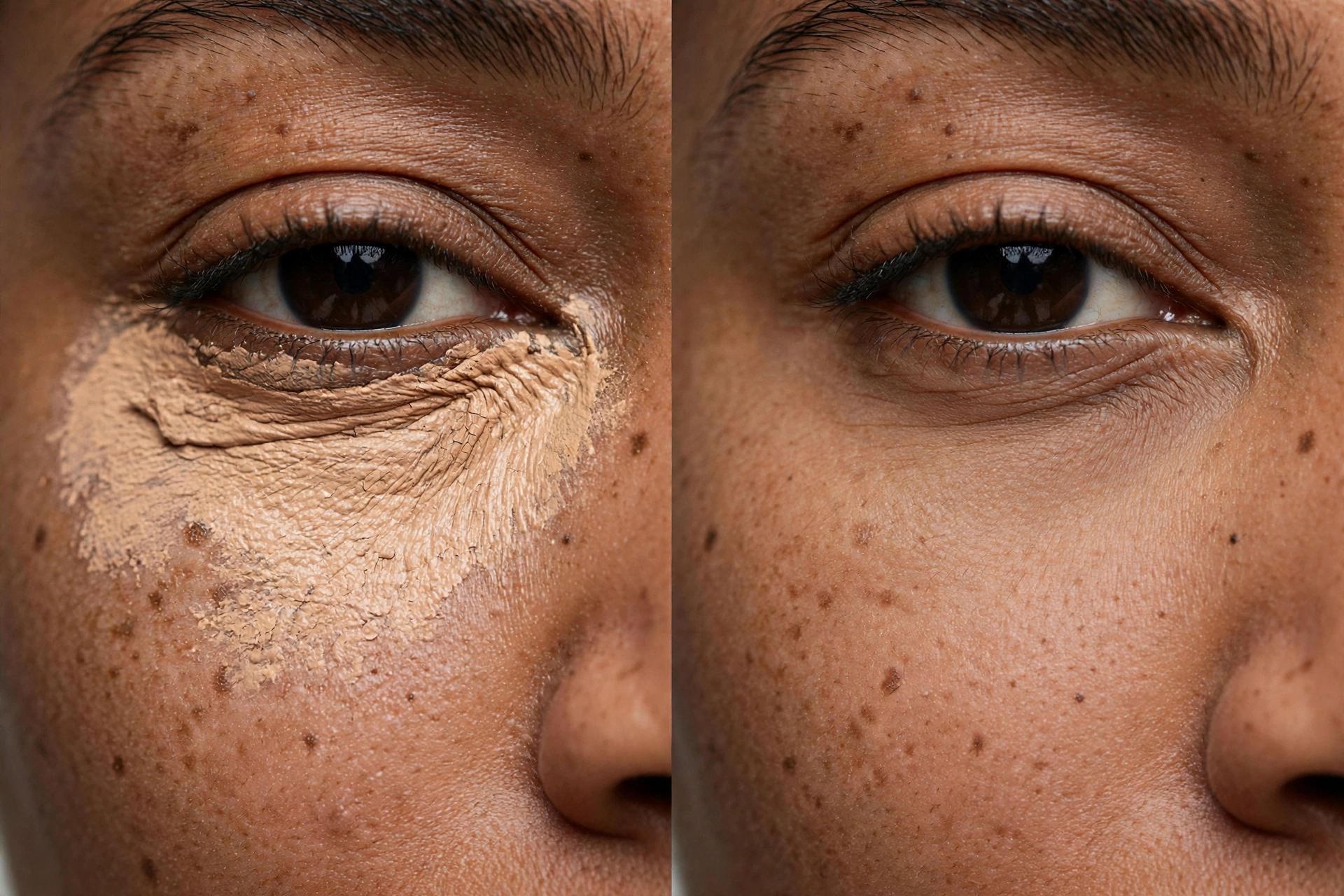
The setup — one morning, one face, two sides:
- Do your normal morning skincare, including sun protection. Do not remove or skip anything medically necessary or protective for this test — if you wear sunscreen, keep wearing it. The point is to diagnose under real conditions, not laboratory ones.
- Wait until everything is fully absorbed. The under-eye should feel like skin, not product. Press a tissue lightly — if anything transfers, wait longer or blot.
- Side A (control): apply your concealer exactly as you normally do — your usual amount, placement, and tools.
- Side B (test): same concealer, same skincare — but half the amount, placed only on the darkest area (usually the inner corner), blended outward with the face relaxed. Keep it off the deepest part of the fold.
- Observe before powder. After about 15 minutes of normal expression — talking, blinking, living — check both sides in the same light. If Side B is already creasing less, your driver is amount/placement (Cause 1 or 3), and powder was never the question.
- Add powder only if your normal routine includes it — and only to one side at a time. Set Side A as usual; set Side B only with a whisper of powder pressed where it actually migrates, if at all. Compare after another hour. If the powder-free or lightly-powdered side wins, your driver is setting technique (Cause 4).
- Check at end of day. If both sides looked good at lunch and only gathered in the late afternoon, your driver is film and wear (Cause 5) — technique was fine, and the product’s film is what’s giving up.
Rules of the test:
- One variable per round. Don’t change the amount and the skincare and the powder in the same morning — you’ll learn nothing.
- Same light, same mirror, both sides, every check.
- If you suspect skincare is the driver, the next round’s single variable is the prep: same concealer and amount both sides, lighter or longer-absorbed skincare under Side B only.
- The midday fix is redistribution, not addition: if a crease has formed, press it out with a clean fingertip or a barely damp sponge — warmth softens the film and the pooled product spreads back out. Adding more product on top only makes a thicker crease.
How much concealer is too much? The amount problem, in detail
Cause 1 named it; this section explains why more is worse, because the instinct to add product when a line looks obvious is nearly universal — and nearly always backwards.
Coverage doesn’t scale with amount. The first thin pass does the great majority of the color correction. A second pass adds a little more evening-out and roughly doubles the film thickness — so you’ve bought a small gain and paid for it with twice the material that has to buckle when the skin folds. A line filled with concealer isn’t a hidden line: it’s a line with a raised, differently textured stripe through it, catching light at its own angle. That’s why an over-covered crease often reads more visible in daylight, not less.
Think in layers, not dots. Thin, sheered-out layers flex; thick deposits don’t. Where you need real coverage (the darkest point, usually the inner corner), press a small amount in and blend outward — let the edges sheer to nothing rather than ending in a border of product. Blend beyond the darkest area instead of building a wall of coverage inside it.
Strategic placement beats volume. The under-eye doesn’t need to match the rest of your face in coverage — it needs to look like skin that happens to be more even. Two common professional-practice placements: a small amount in the inner corner blended outward, and a touch at the outer corner angled upward for lift — avoiding the broad triangle that loads product exactly where the skin folds most.
No universal dot-count rules. You will not find “always use exactly two dots” in this guide, because no count survives contact with different faces, different formulas, and different coverage needs. The rule is observational, not numerical: apply less than you think, blend it fully, check after normal expression, and add only where coverage is genuinely missing. The test in Cause 1 is the arbiter, not a number.
The prep question: skincare under concealer
The claim to retire: “moisturizer causes creasing.” It doesn’t — at least, not as a sentence. What causes problems is specific, separable, and fixable:
- Too much emollient product immediately under the concealer. A rich layer right under makeup gives the film a slick surface to slide on. Mornings and evenings can be different routines: richer at night, lighter before makeup.
- Layers that haven’t settled. Every layer — moisturizer, eye cream, sunscreen — needs to reach “absorbed, not wet” before concealer goes on. This is the single most underrated prep variable. The tissue-press check from the isolation test is the practical version.
- A very slippery surface. Some formulas are simply slicker than others. If the under-eye feels glossy after prep, it’s not ready — blot or wait.
- An excessively dry surface. The opposite failure: concealer applied to a dry, unprepped under-eye grabs onto micro-texture and looks sandy or flaky rather than smooth. Hydration here is structural, not optional.
- Combinations. The classic: rich eye cream + rushed morning + no absorption wait = sliding concealer by 10 a.m.
What professional practice actually says. Makeup artists consistently recommend a lightweight hydrating layer (not a heavy cream) before concealer, given real absorption time. The specifics vary by artist — what doesn’t vary is the principle: hydrated and settled beats dry, and settled beats slick. Treat brand-specific eye-cream advice as technique, not science.
One myth to leave buried. You may encounter claims that concealer creasing comes from mixing “water-based” and “silicone-based” products. That compatibility framework was examined and debunked in our pilling guide — the layer-isolation logic there applies to products that ball up and roll off the skin. Creasing is a fold-pooling and film problem, not a pilling problem. If your product is balling or rolling off rather than collecting in lines, that’s the pilling article’s territory, not this one’s.
Powder: partner or culprit?
This is the section most creasing guides get wrong in one of two directions: “powder prevents creasing” or “never powder under the eyes.” Both are universal claims about a conditional variable. Powder under the eyes is a tool with two faces, and the diagnosis is knowing which face you’re seeing.
What powder does well. It absorbs oil and moisture at the surface, which immobilizes surface product — pigment that can’t slide can’t migrate as far. For oilier under-eyes, or on long warm days, a small amount of powder in the right place genuinely extends smooth wear.
What powder does badly. On the thinnest, driest skin on your face, powder dehydrates the top layer, stiffens the film, and adds a second dry layer that also can’t flex when the skin folds. A heavy or broad application across the whole under-eye is the most common self-inflicted version: it works on the T-zone and punishes the eye area. Powder can also accumulate in folds — turning a soft, re-blendable line into a hard, locked one — and it exaggerates texture, so a slightly creased under-eye reads as a dry creased under-eye, which looks worse.
The conditional rules:
- Targeted, not broad. Set where things actually slip — often just the inner corner or a narrow band where your concealer migrates — not the entire under-eye as a matter of routine. A stripe where you shine is enough; nothing along the deepest fold.
- Less than you think. A whisper of finely milled powder, pressed in — tapped off the tool first — does the job. The amount that disappears into the skin is the right amount.
- Press, don’t sweep. Pressing locks the still-smooth surface in place; sweeping disturbs it and pushes product sideways into the low spots.
- Timing matters. Powder locks in whatever state the surface is in. If the concealer has already started to settle into a fold, powder seals the crease in place — smooth the surface first (the fingertip press from the isolation test), then set.
- Know when to skip it. Dry under-eyes, short wear days, flexible hydrating concealers — sometimes the right amount of powder is none. If skipping it doesn’t make things worse, it wasn’t helping.
The honest summary: powder prevents migration and causes dryness. Whether that’s a good trade depends on your skin, your formula, and the day. Anyone selling you a universal powder rule is selling you their routine, not your diagnosis.
Creasing, cakey, dry/flaky, or separating — which one do you actually have?
“My concealer creases” is a phrase that covers four visually different failures, and they don’t share fixes. Before the matrix, sort your problem into the right family — because the internet’s advice for one is often poison for another.
Creasing — product collects along a fold. The signature is a line: pigment gathered into a groove, with the surrounding skin still looking relatively smooth. This is the family this guide diagnoses. Everything above applies.
Cakey buildup — excess product creates thickness and texture. No single line; instead a heavy, dry, textured layer where you can see product sitting on the skin. If your under-eye issue is generalized thick, cakey product rather than accumulation in folds, the diagnosis belongs to our guide to foundation that looks cakey — the texture-failure logic there applies to concealer too. Don’t try to fix a cakey problem with creasing solutions.
Dry or flaky — surface irregularity remains visible. Flakes, roughness, or a sandy look — pigment catching on micro-texture rather than pooling in a line. A concealer that looks fine on the back of the hand and looks like sand under the eye is meeting a dehydrated surface, not a fold. The fix is hydration and prep, not less product or more powder.
Separation — the film breaks apart rather than collecting in lines. Coverage looks patchy or broken, sometimes with product visibly lifting. This is a film-integrity failure — closer to pilling logic than creasing logic. If product is balling, rolling, or lifting off the skin, see why foundation pills.
Boundary rule, stated once: fold-line pooling = this article. Generalized thick texture = the cakey guide. Balling or rolling off = the pilling guide. Getting the family right is the diagnosis; everything else is just execution.
What to change, per diagnosis
Once you’ve placed yourself in the router, the differential, and the right visual family, change only what the diagnosis points to. Each row includes what not to do — because the standard reflexes for creasing are exactly how one problem becomes two.
| What you see | When it appears | Likely cause | Quick test | Change first | Don’t do yet |
|---|---|---|---|---|---|
| Crease line deepens with a heavy, visible product line; same concealer fine elsewhere | Within minutes, worse with movement | Too much concealer (Cause 1) | Half amount on one eye; compare after an hour | Less product, strategic placement only on darkest areas | Don’t swap the concealer formula |
| Concealer slides, never sets, looks smeary; worse on rushed mornings | From application, worsens with warmth | Unsettled/too-rich prep (Cause 2) | Full absorption wait + tissue check one morning | Lighter morning eye prep, real absorption pause | Don’t drop eye cream or sunscreen — change timing, not elimination |
| Crease sits exactly in the natural fold; fine on flat areas | After movement (smiling, talking) | Placement into folds / anatomy (Cause 3) | Apply with face relaxed, keep product off the deepest fold | Placement: face at rest, blend from outside the fold | Don’t pile powder into the fold to “fill” it |
| Fine until powder, then drier, harder lines | Right after setting | Powder interaction (Cause 4) | Narrow targeted set on one side vs usual all-over | Less powder, targeted placement, press don’t sweep | Don’t change the concealer — it was fine until powder |
| Fine for hours, then gathers, migrates, or crawls | Late afternoon | Film/wear behavior (Cause 5) | Note the hour it first appears; rule out Causes 1–4 | Wear strategy: midday redistribution, flexibility over coverage | Don’t assume “long-wear” marketing means better under eyes |
| Rough, flaky, sandy — no gathered line | From application | Dryness/texture, not creasing | Compare back-of-hand (smooth?) vs under-eye (sandy?) | Hydration + settled prep | Don’t treat with creasing fixes (less product won’t fix a dry surface) |
| Thick, heavy, textured layer; no single line | From application | Cakey buildup | — | See the cakey guide | Don’t apply this article’s creasing fixes to a texture problem |
| Product balls, rolls, or lifts off | During/after application | Pilling/separation | Finger-rub test | See the pilling guide | Don’t confuse with fold-pooling |
If your result sits between rows — say, a little too much product and unsettled prep — fix the bigger one first. Change one variable, re-observe, then move to the next. That discipline is the whole method.
FAQ
Is some concealer creasing normal?
Yes — and this is the most honest sentence in the guide. The under-eye area has the thinnest skin on the body, sits over constantly moving muscle, and every face has natural folds there. A small amount of product entering an existing fold after blinking or smiling is normal anatomy, not product failure. The goal is proportionate: minimal, re-blendable settling — not the visible accumulation, cracking, or loss of even coverage that signals a real problem.
Why does my concealer crease even after setting powder?
Because powder isn’t a universal fix — it’s a conditional tool. If the crease was already forming before powder went on, powder seals it in place and makes it worse. If too much powder was applied broadly, it dehydrates the thin under-eye skin and stiffens the film. And if the real driver was amount or prep, powder was never the variable that mattered. Smooth the surface first, then set — targeted, minimal, pressed — and test whether less powder (or none) actually performs better for your skin.
Why does concealer settle into fine lines?
Because fine lines are exactly where a moving film has to go. The under-eye folds and releases constantly; once concealer dries into a film with limited elasticity, the folded skin compresses the film, it buckles into the groove, and movement works pigment down into it. Less product means less material to pool; a more flexible film means more forgiveness; settled prep means the film actually adheres. “Settling into fine lines” is the same problem as creasing described by its mechanism — which is why it doesn’t need a separate guide.
Should I use less concealer under my eyes?
Usually yes — it’s the single most common fix. Concealer is the most pigmented, most heavily bound product on your face, and the under-eye is the thinnest, most mobile skin. That combination punishes excess more than any other placement. Try half your usual amount, placed only where coverage is actually needed and blended outward, and judge after normal expression — not immediately after application.
Can too much moisturizer make concealer crease?
Not moisturizer as such — but too much emollient product immediately underneath, or layers that haven’t absorbed before concealer goes on, absolutely can. A film laid over a tacky, unsettled layer never quite sets and slides all day. The fix is amount, timing, and absorption — lighter morning prep, a real pause, a tissue check — not dropping your skincare. Never remove sun protection or medically necessary skincare for a makeup experiment.
Is powder necessary under the eyes?
No — not universally. Powder prevents migration and causes dryness; whether that’s a good trade depends on your skin, your formula, and the day. If your under-eye is dry, if the day is short, or if skipping powder changes nothing, the powder wasn’t earning its place. When you do set, keep it targeted (only where slipping actually happens), minimal, and pressed — never swept broadly across the eye area as a matter of routine.
My concealer looks dry under my eyes — is that creasing?
Probably not — and the distinction matters. Creasing is product collecting along a fold; dryness is surface irregularity — flakes, roughness, a sandy look where pigment catches on dehydrated texture. If the back of your hand takes the same concealer smoothly but your under-eye looks like sand, you’re meeting a dry surface, not a fold. The fix is hydration and settled prep. If instead the whole under-eye looks thick and textured with no single line, that’s the cakey guide’s territory.
Sources
Evidence tiers are labeled deliberately — they are part of the article’s honesty, not decoration.
- Review of Optometry, “In the Eye of the Beholder: Aesthetic Procedures for the Periocular Area” — quotes Dr. Wendy Lee, MD, oculoplastics surgeon at Bascom Palmer Eye Institute: periorbital skin is the thinnest on the body with lower numbers of sebaceous glands, so it dries out and wrinkles faster; with little subcutaneous tissue it tightly adheres to constantly contracting muscles. Read it. (Clinical/anatomical source — physician-quoted.)
- Healthline, “Thin Skin Under Eyes: Causes, Symptoms, and Treatment” — dermatology-reviewed editorial corroborating the trio: thinner skin, less subcutaneous fat, fewer oil glands; fine lines show there first. Read it. (Reputable health editorial, not primary research.)
- University of the Philippines — “Eyelids and Lips” anatomy teaching material — eyelid skin: thinnest on the body, moves constantly, paucity of sebaceous glands. Read it. (Academic teaching material.)
- Global Cosmetic Industry, “Shin-Etsu Silicones of America Unveils Silicone Film Former Tech” — trade reporting on film-former technology: balancing durability/transfer resistance against comfort and flexibility; harder polymers vs. comfort. Read it. (Industry trade publication — formulation context, manufacturer-sourced.)
- Vectree, “Polymer chemistry and film-forming agents” — knowledge-map overview: film formers must balance rigidity (prevent smudging) against flexibility (prevent flaking as skin moves); blends of hard and soft polymers. Read it. (Vendor knowledge content — qualitative formulation principle only.)
- Millennial Skin, “Why Foundation Settles Into Lines, and What Actually Stops It” (Dec 2025) — independent beauty-science editorial: the film-mechanics framing (fixed-surface-area film buckling into folds), concealer’s higher pigment binding vs. foundation, dehydrated-surface pigment “grabbing,” the unsettled-skincare mechanism, and the press-don’t-sweep principle. Subject is foundation on facial wrinkles/crow’s feet — adjacent, not under-eye concealer. Read it. (Independent editorial, affiliate-linked; cited for mechanism framing, not as science.)
- mybeauty.tips, “Why Does My Concealer Always Crease? A Step-by-Step Guide to a Smooth, Crease-Proof Finish” (updated Sept 13, 2026) — the strongest current dedicated competitor; read in full 2026-09-29. Used here as the practice reference it is: natural-folds-vs-wrinkles distinction, less-is-more placement, absorption timing. Its procedural 5-step system is the gap this article’s diagnostic framework is built against — not a source of scientific claims. Read it. (Beauty editorial — professional practice, not evidence.)
- Woosh Beauty, “Does Your Under Eye Concealer Always Crease?” — MUA practice: honest-expectations framing (“minimizing you can do; eradicating, good luck”), dry-skin accentuation of folds, tiny eye-cream amounts. Read it. (Brand blog — professional practice.)
- 614 Beauty, “Why Does My Concealer Crease? (And How to Stop It)” — practice guide: movement pushing product into lines, dry/dehydrated skin giving texture, over-application, formula-skin mismatch. Read it. (Beauty editorial — professional practice.)
- HerWorld, “Concealer mistakes you need to stop making” — expert-sourced editorial: setting concealer where lines exist, avoiding heavy product mixing into layers above. Read it. (Beauty editorial — professional practice.)
The limitation, restated. No peer-reviewed study was found that tests when or why concealer creases during the day as a consumer phenomenon. The anatomy above is established; the film mechanics are standard formulation principles stated qualitatively; everything about timing, testing, and fixing is professional practice and practical diagnostic inference, labeled as such. The WHEN → WHERE → WHAT router is a reasoning tool — it organizes evidence, it doesn’t manufacture certainty.
2 thoughts on “Why Does Concealer Crease Under Eyes? How to Tell Which Cause Is Yours”
Comments are closed.